
In this article
Before You Remove Text from Video, Identify Where the Text Lives
Text can exist as an editable title layer, a subtitle track, a player caption, or pixels burned into every exported frame. Only the burned-in case requires image reconstruction. This is the first decision to make when you want to remove text from video, because using AI on an editable layer wastes time and can lower image quality.
If you still have the project, delete the title, lower third, watermark layer, or graphic and export again. If the text is a separate subtitle stream, disable or remove that stream. If the words remain visible in every player and are part of the image, then choose between reframing, covering, blurring, or inpainting.

| Text type | Lowest-risk method | When AI is needed |
|---|---|---|
| Editable title/lower third | Delete the project layer | Never if project is available |
| Subtitle/CC track | Disable or remove track | Only if text was rendered into image |
| Edge watermark/date stamp | Crop or inpaint | When crop hurts framing |
| Text over moving subject | Inpaint with careful temporal review | Usually |
| New label replacing old label | Cover with new graphic | AI optional |
| Text inside screen recording | Re-record or cover sensitive area | AI only when re-recording is impossible |
Crop, Cover, Blur, or Inpaint: Pick the Simplest Method That Preserves the Shot
A clean edit does not always mean an invisible edit. Choose the method based on the purpose of the video, where the text sits, and what the text covers.
- Crop when a watermark, date, or label is safely near an edge and the subject still fits the new frame.
- Cover when you are intentionally replacing the old label with a new lower third, banner, logo, or graphic.
- Blur or pixelate when the goal is privacy or redaction rather than restoring the exact background.
- Inpaint when you need the full frame to look as if the text was never there.
- Return to the source when the title is editable or the screen recording can be captured again without the private information.
Cropping has a predictable cost: less frame area. Inpainting has an unpredictable cost: generated pixels may flicker. Covering is visually explicit but often appropriate for branded content. The best method is the one whose tradeoff is easiest to control in your specific shot.
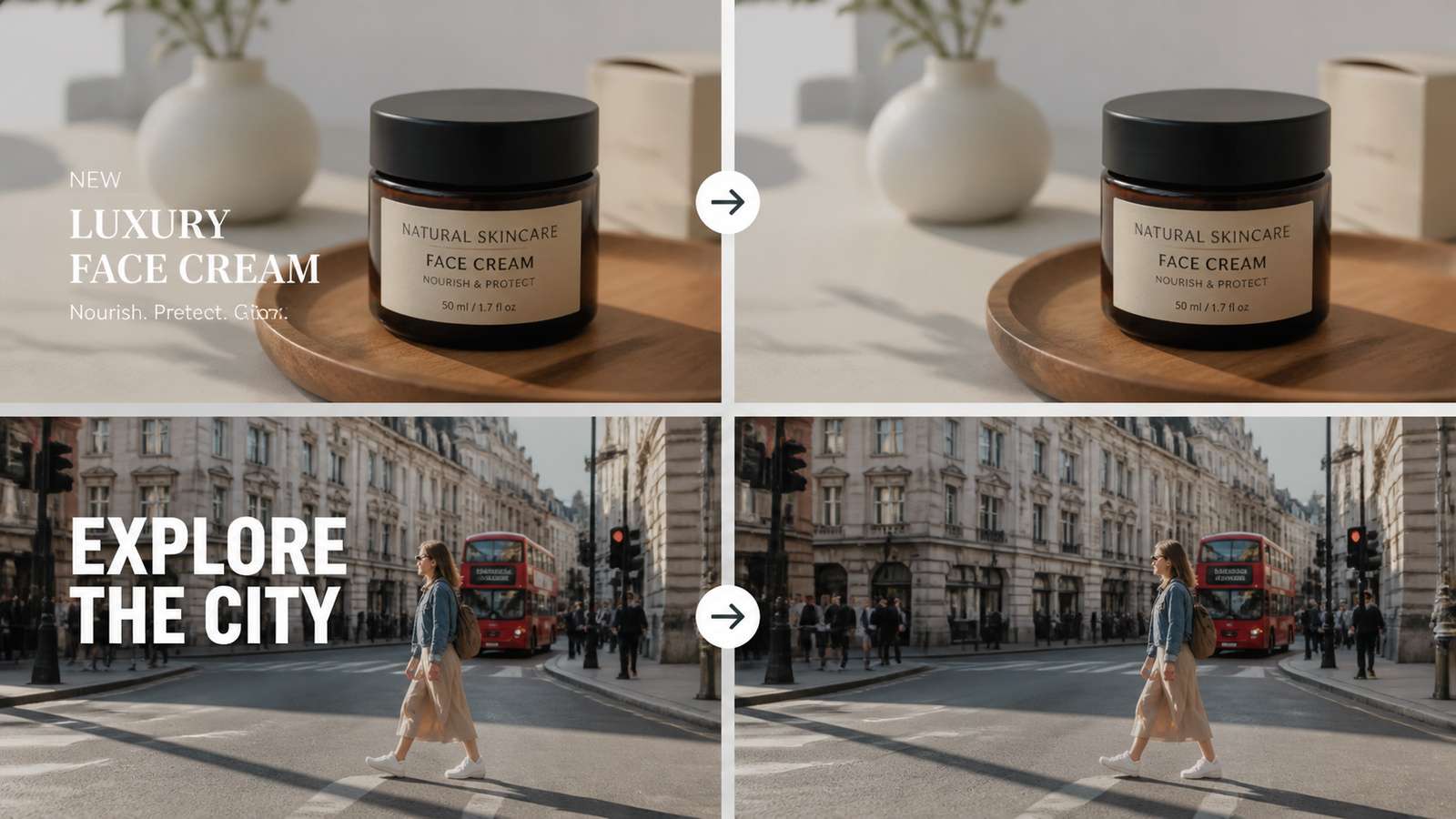
Use AI Video Eraser for Burned-In Text, Captions, Timestamps, or Watermark Text
Media.io AI Video Eraser is designed to remove text from videos and erase other unwanted visual elements, including text, captions, timestamps, logos, stickers, and people. It is most effective when the background under the text is visible in nearby frames and the selected area is not excessively large.

- Upload the cleanest, highest-bitrate source you have. Social re-uploads and low-bitrate screen captures contain fewer reliable details.
- Mask the full text including shadow, outline, stroke, glow, or translucent background box.
- Keep the selection close to the overlay. Do not select a huge rectangle when only a few words need removal.
- Preview a section where the background changes. A static frame is not enough to judge temporal consistency.
- If a hand, face, product, or other foreground object passes behind the text, process that difficult range separately.
- Export and watch at 1x speed for flicker, ghost text, bent lines, or a blur patch that follows the old overlay.
Moving Text and Moving Cameras Need More Care
A timestamp fixed over a static wall is relatively easy because the hidden texture changes little. A moving label over a panning city scene is harder because both the selection and the replacement texture must change across time. Dynamic social captions can be harder again because the words move, scale, bounce, and change color while the background also changes.
Track only when the text itself moves
If the overlay stays in one screen position while the camera moves, the mask can often stay fixed but the fill must adapt to new background content. If the text follows an object or animates around the frame, the mask needs to follow it. Do not confuse screen-space stability with background stability.
Split at cuts and major camera changes
A single long processing range can mix unrelated visual contexts. If the scene cuts from a wall to a person, treat those as separate shots. Even within one shot, a whip pan or zoom can change the reconstruction problem enough to justify a new range.
Watch the first and last frames of each overlay
Ghosting often appears when a title fades in or out because semi-transparent letters extend beyond the mask. Include motion blur and glow during the transition, not just the solid center of the text.

Protect Faces, Products, Screens, and Straight Geometry
Text frequently sits exactly where visual content matters: subtitles over a speaker, a watermark on a product, a username over a face, a timestamp across surveillance footage, or a label over a screen recording. These cases require conservative masking.
- Faces: protect eyes, lips, jawline, and hair. If text crosses a face, expect some manual repair because the model may alter identity.
- Hands: fingers are easy to distort when they pass through the selection. Review frame by frame around contact moments.
- Products: packaging edges, logos, labels, and reflections can change shape. Use source frames or clean reference images when exact geometry matters.
- Screens: removing text from a UI may expose dynamic data that was never visible. For privacy edits, covering or re-recording can be more honest than inventing interface content.
- Architecture: railings, windows, shelves, horizons, and tile lines reveal even small warps. Manual clean plates may outperform generic inpainting.
If the hidden information matters factually, do not let the AI invent it. For example, removing a private account number from a screen recording should not create fake numbers underneath. Replace the area with a neutral cover, blur, or crop when reconstruction could mislead viewers.

Common Failure Modes and What to Do Next
| Problem | Cause | Better approach |
|---|---|---|
| Ghost outline remains | Mask misses stroke/shadow | Expand selection a few pixels |
| Blurry rectangle | Mask covers too much image | Use smaller region or shorter processing range |
| Texture swims | Frame-to-frame fill changes | Split the shot or use advanced reference-frame workflow |
| Straight line bends | AI invents geometry | Clone/paint a clean line in a reference frame |
| Face loses detail | Text overlaps important anatomy | Protect subject edge and repair separately |
| Text reappears during fade | Animated glow extends outside mask | Include full transition and motion blur |
When AI fails repeatedly, step back and ask whether invisibility is actually required. A clean branded cover, crop, or privacy blur may look more professional than an unstable attempt to reconstruct complex pixels. Good editing is not about forcing one technique to work everywhere.
Quality Checklist: What Good Text Removal Looks Like
- No ghost outline from the original font stroke, shadow, glow, or background box.
- Straight background lines remain straight throughout playback.
- Texture does not swim, pulse, or repeat obviously when the camera moves.
- Foreground subjects do not lose fingers, hair, face detail, or product edges when crossing the old text area.
- Color, noise, sharpness, and motion blur match the surrounding frame.
- The edit remains stable at normal playback speed, not just on one paused frame.
- An untouched original is preserved when the footage has legal, archival, security, or documentary importance.
Four common text-removal scenarios
Date stamp in the lower corner. If it sits against a simple floor, sky, or wall, either crop a small edge or inpaint a tight rectangle. Do not mask a full-width band. A fixed timestamp is easier than animated text because the selection remains in one screen position.
Username over a moving face. Invisibility may not be the safest goal. If the username contains private information, covering it with a neutral bar or blur avoids inventing facial details and communicates that the area was intentionally redacted. Use inpainting only when a natural background is genuinely needed and inspect identity-sensitive features carefully.
Store sign or street label in travel footage. The text may be part of a physical object rather than a digital overlay. Removing the letters while keeping the sign shape is a surface-reconstruction task. If the camera moves, the sign perspective and lighting change. A tracked mask and reference frame can preserve the rectangular geometry better than a broad generative erase.
Confidential field inside a screen recording. Re-recording is usually best if possible. A UI contains meaningful text, icons, rows, and numbers; AI inpainting can invent fake interface content. For privacy, use a cover, crop, or blur that clearly redacts the field instead of pretending the hidden data was something else.
Plan a text-free master for future reuse
If you regularly repurpose videos into different languages, platforms, or campaigns, keep a clean master without burned-in text. Store titles, captions, logos, and callouts as editable layers. This makes localization, compliance changes, rebranding, and accessibility updates much easier. It also prevents quality loss from repeatedly removing one set of pixels only to add another set of words on top.
Do a motion-first review, not only a frame review
After removal, watch the whole affected shot without pausing. Your eye is sensitive to a patch that pulses or sticks to the camera even when individual frames look convincing. Then step through the most difficult transition frames. A professional result needs both spatial quality in each frame and temporal consistency across frames.
Use masks that match the text, not the entire lower third
A common mistake is to brush one large rectangle across the full width of the frame because the title sits near the bottom. That forces the model to reconstruct hundreds of thousands of unnecessary pixels and makes a blurry band more likely. Select only the letters, background box, and visual effects that must disappear. When several text blocks are separated, process them as separate regions if the tool allows it.
This is especially important for vertical video, where a lower-third rectangle can cover a large percentage of the useful frame. Smaller masks preserve more original texture and reduce the chance of damaging hands, clothing, products, or captions that should remain.

FAQ About Removing Text from Video
-
Can AI remove text from a moving video background?
Yes, but camera motion, moving subjects, reflections, and complex texture increase the risk of flicker. Preview several seconds around the edit instead of judging one frame. -
Is cropping better than AI text removal?
Crop when the text is safely near an edge and reframing will not damage composition. AI inpainting is better when you need to preserve the full frame. -
Can I remove a title or caption without AI?
If the title is still an editable project layer or the caption is a separate subtitle track, delete or disable that layer or track instead of reconstructing pixels. -
Will AI restore the exact pixels behind the text?
Not if the text is burned into the only copy of the video. The tool generates a plausible replacement from surrounding frames and texture. -
Why does removed text flicker during playback?
The fill may be changing from frame to frame or the background may be moving too much. Shorter ranges, tighter masks, and reference-frame workflows can improve stability. -
Should I remove confidential text or just blur it?
For privacy and redaction, blur or cover is often clearer and safer because it does not invent hidden content. Use inpainting when a natural-looking background is genuinely needed.


