
In this article
Why Removing a Person from Video Is Harder Than Removing One from a Photo
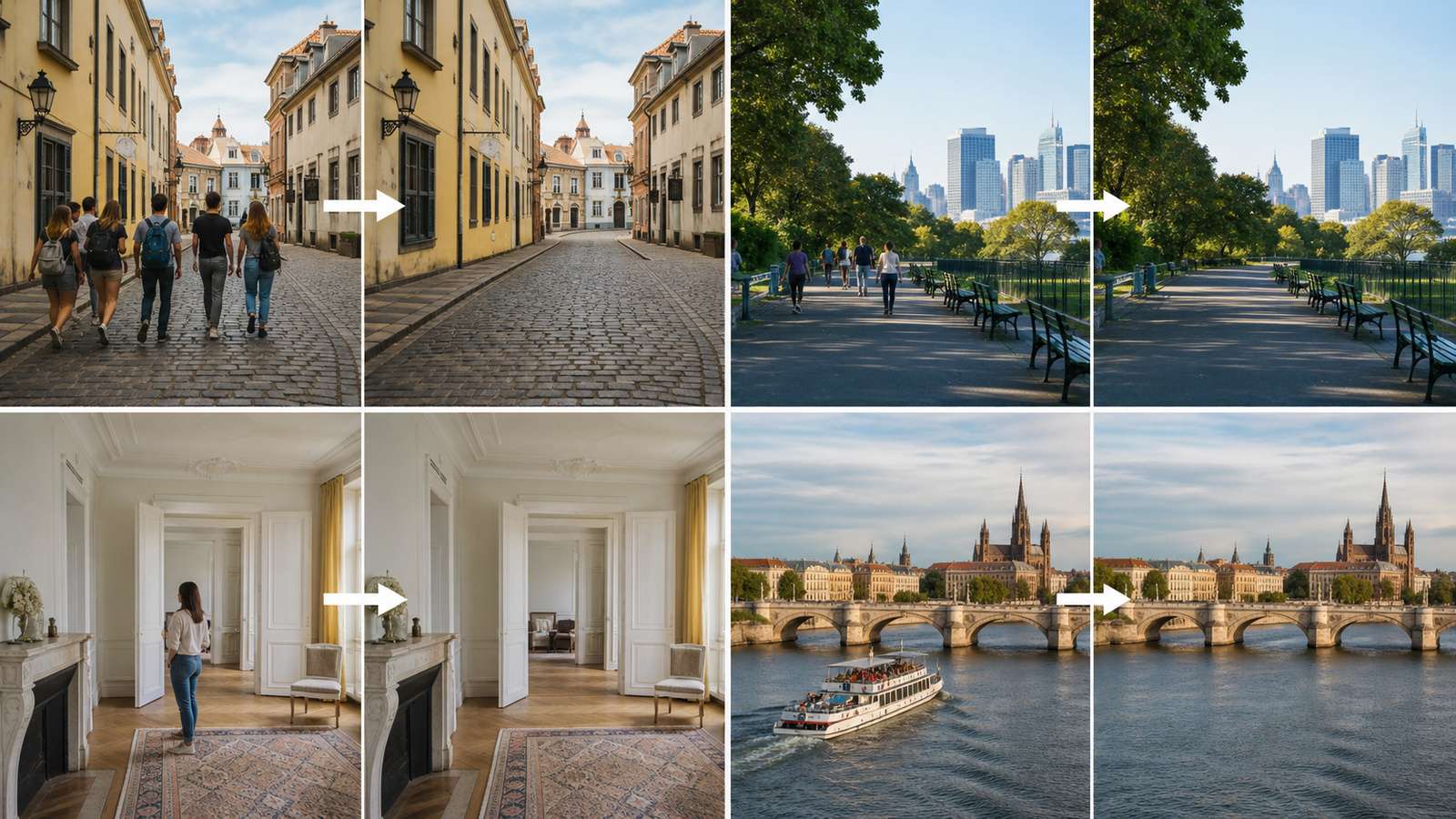
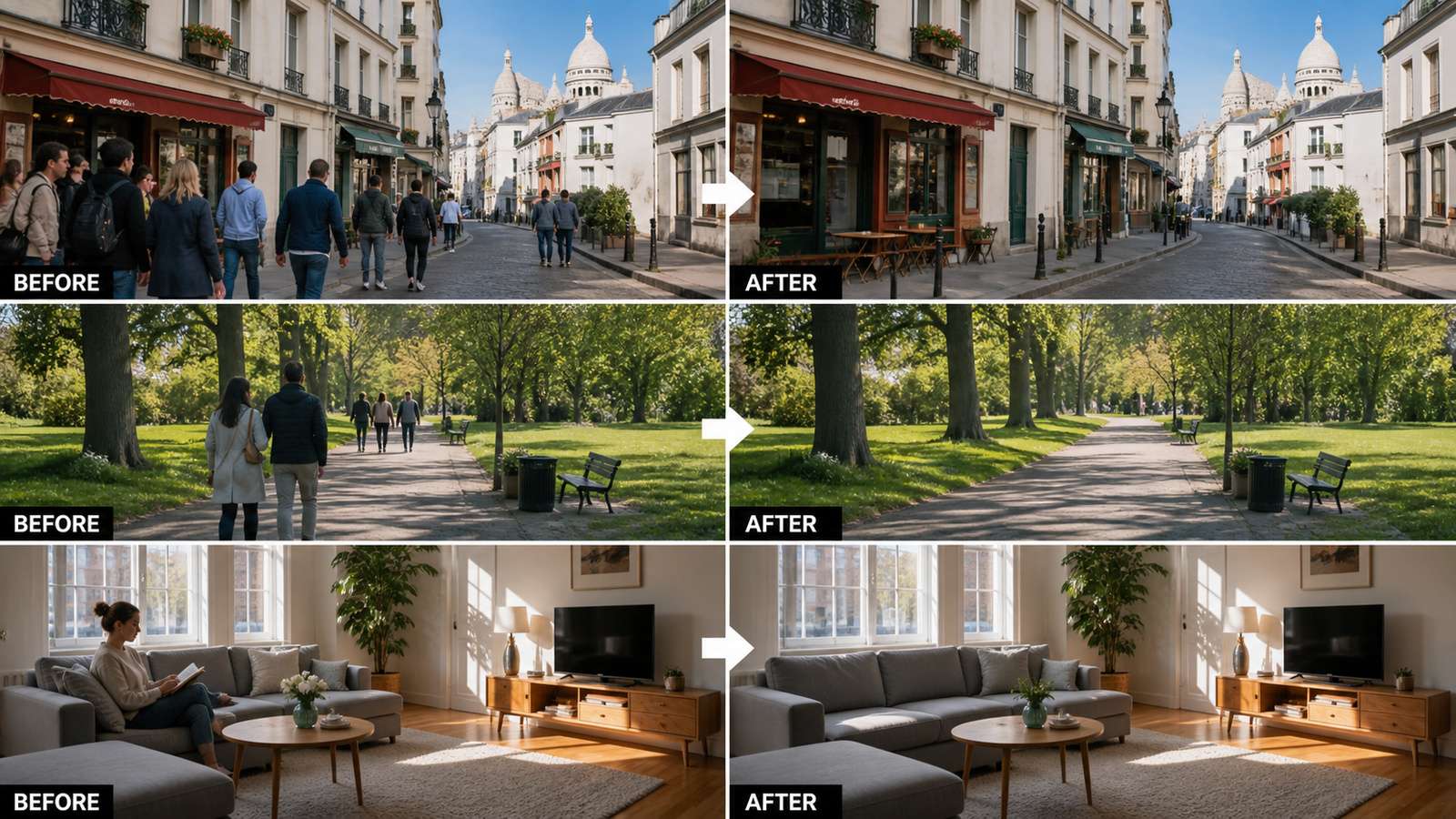
To remove people from video, an editor has to solve the same visual problem repeatedly across time. A photo remover fills one hole. A video remover must fill hundreds of related holes while making the replacement texture move consistently with the camera, background, shadows, reflections, and foreground subjects. A single convincing frame is not enough; the edit has to survive playback.
The difficulty depends less on the size of the person than on what they cover. A distant pedestrian crossing an empty wall may be easy. A small person walking in front of railings, water, crowds, text, or a moving vehicle can be difficult because the hidden background changes every frame. The editor must infer both what is behind the person and how that hidden content should move.
| Shot condition | Difficulty | Why |
|---|---|---|
| Locked camera, simple wall | Low | Background can be borrowed from nearby frames |
| Slow camera pan, repeating texture | Medium | Fill must follow camera motion |
| Person crosses detailed architecture | Medium-high | Straight lines expose small fill errors |
| Person overlaps another person | High | Foreground anatomy and background both need reconstruction |
| Water, smoke, foliage, reflections | High | Texture changes unpredictably over time |
| Person and shadow cover large area | High | Multiple moving elements must be reconstructed separately |
Choose the Tool by Motion and Occlusion, Not by the Marketing Label
Online AI removal is ideal when you want a fast result and the unwanted person is relatively small, isolated, and surrounded by useful background. Advanced compositing becomes worthwhile when the shot is long, the camera moves, the person crosses important foreground elements, or the background needs manual reconstruction. If your actual goal is to isolate the main subject rather than rebuild what is behind a passerby, a video background remover is usually the more direct workflow.
Use AI inpainting when the shot is forgiving
AI video erasers are a good first choice for travel clips, social footage, product demos, real-estate shots, and casual B-roll where the person occupies a limited region. The model can use neighboring frames to estimate the missing background. If the result stays stable at normal playback speed, there is little reason to build a complex effects workflow.
Use tracked masks and reference frames when the shot is not forgiving
Adobe After Effects Content-Aware Fill analyzes frames over time and can use different fill methods, lighting correction, tracked masks, and manually created reference frames. Those controls matter when automatic removal creates a smear or when the hidden background contains structure that must look exact. The tradeoff is time: you may need to roto the person, adjust masks, create clean plates, and repair problem frames manually.
Quick Workflow: Remove People with Media.io AI Video Eraser
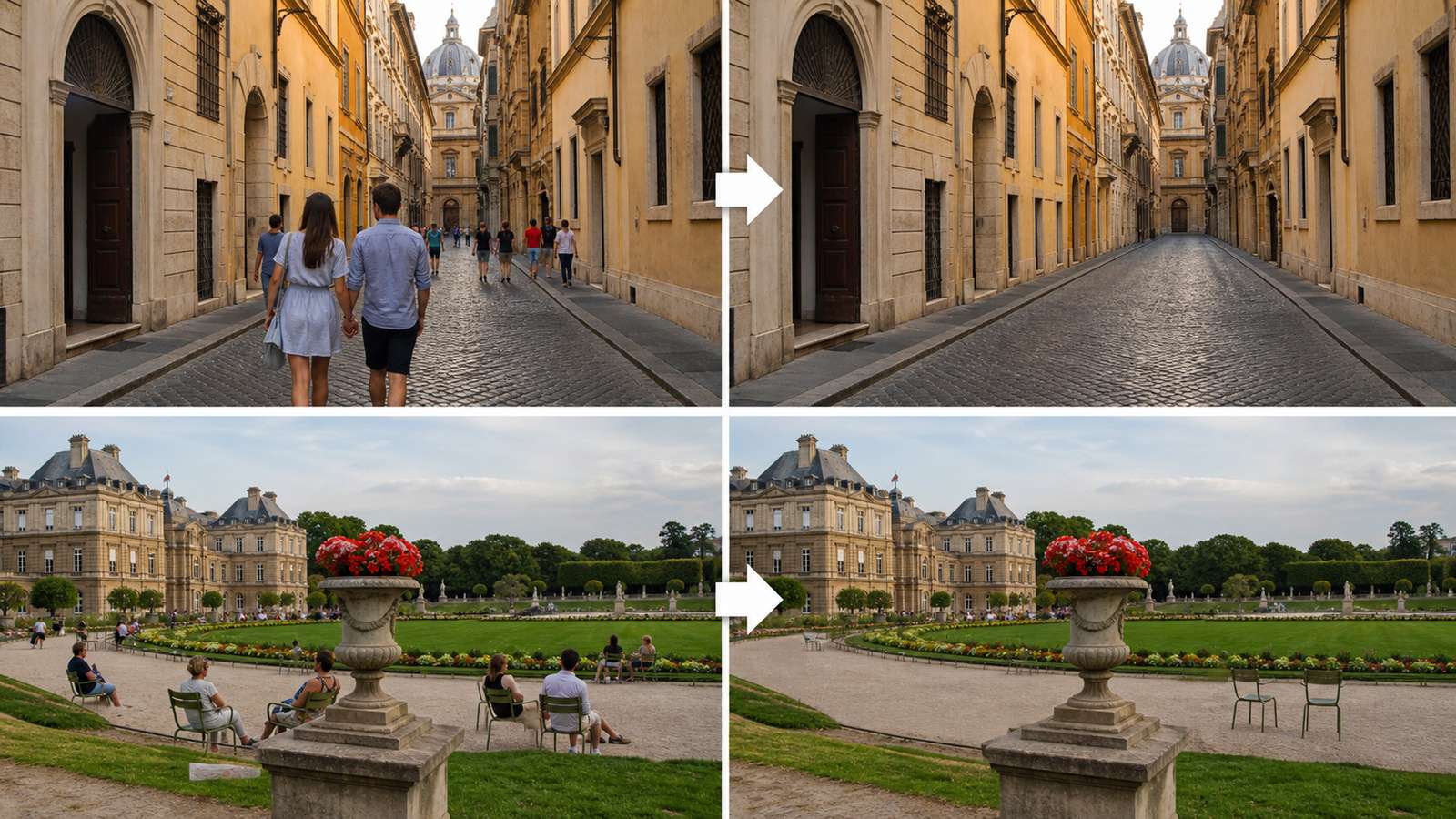
Media.io AI Video Eraser makes it easy to remove people from video online. The most important step is not the upload; it is selecting the person carefully and testing a representative section before you trust the whole clip.
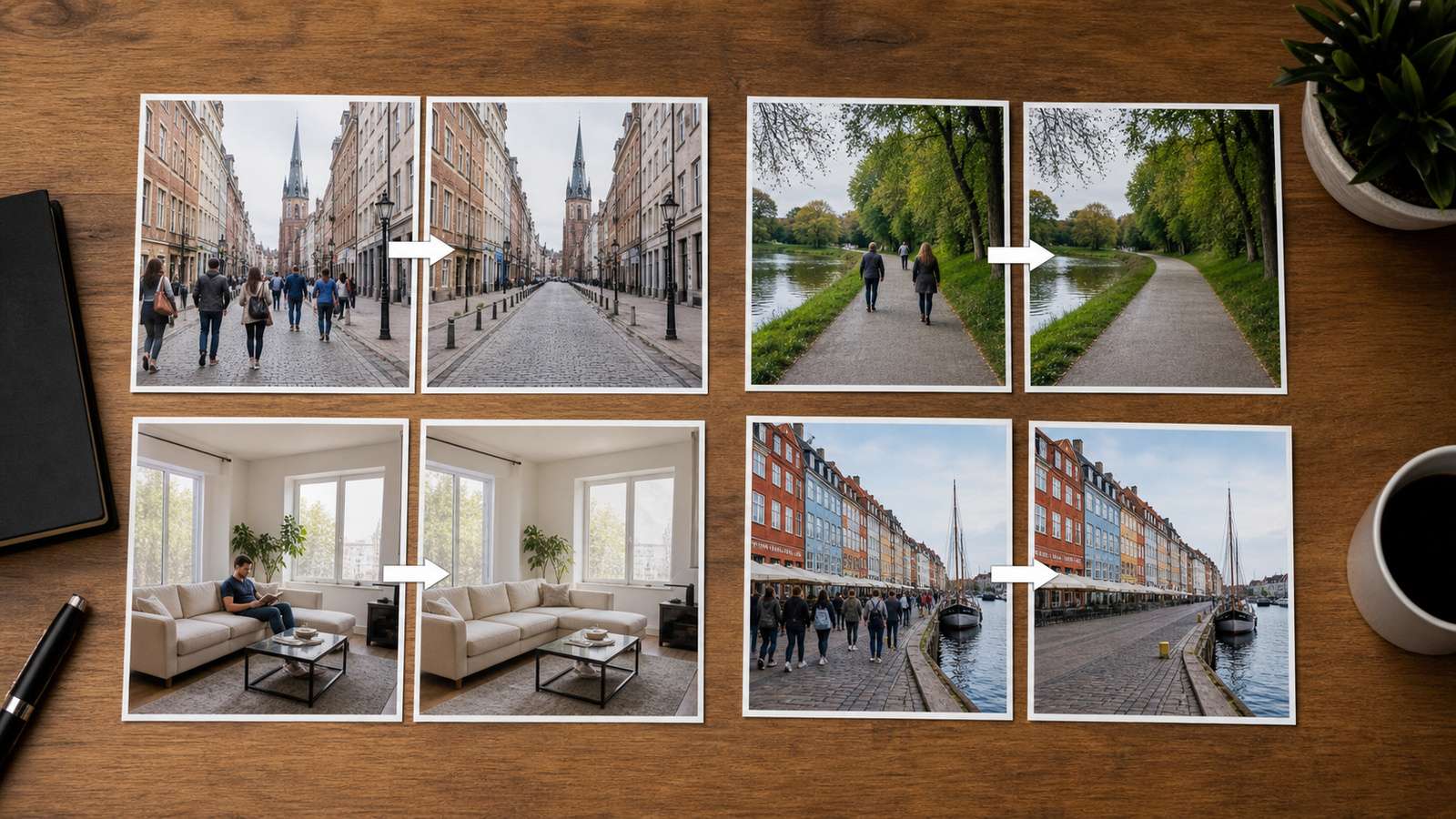
- Start with the highest-quality clip available. Heavy social compression makes edges and texture harder to reconstruct.
- Select the unwanted person and include obvious attached elements such as a bag, hat, or bicycle only if they should disappear too.
- Do not automatically include the person's shadow. Test person and shadow separately because the background under each may need different reconstruction.
- Preview a section with movement. Check the moment the person enters and leaves the frame, not just the easiest middle frame.
- Watch at normal speed and frame by frame. Look for ghosts, repeated texture, wobbling edges, or a patch that follows the old person position.
- If the result fails only during one overlap, split the clip and treat that short range separately.
Advanced Workflow: Track a Mask and Use Reference Frames
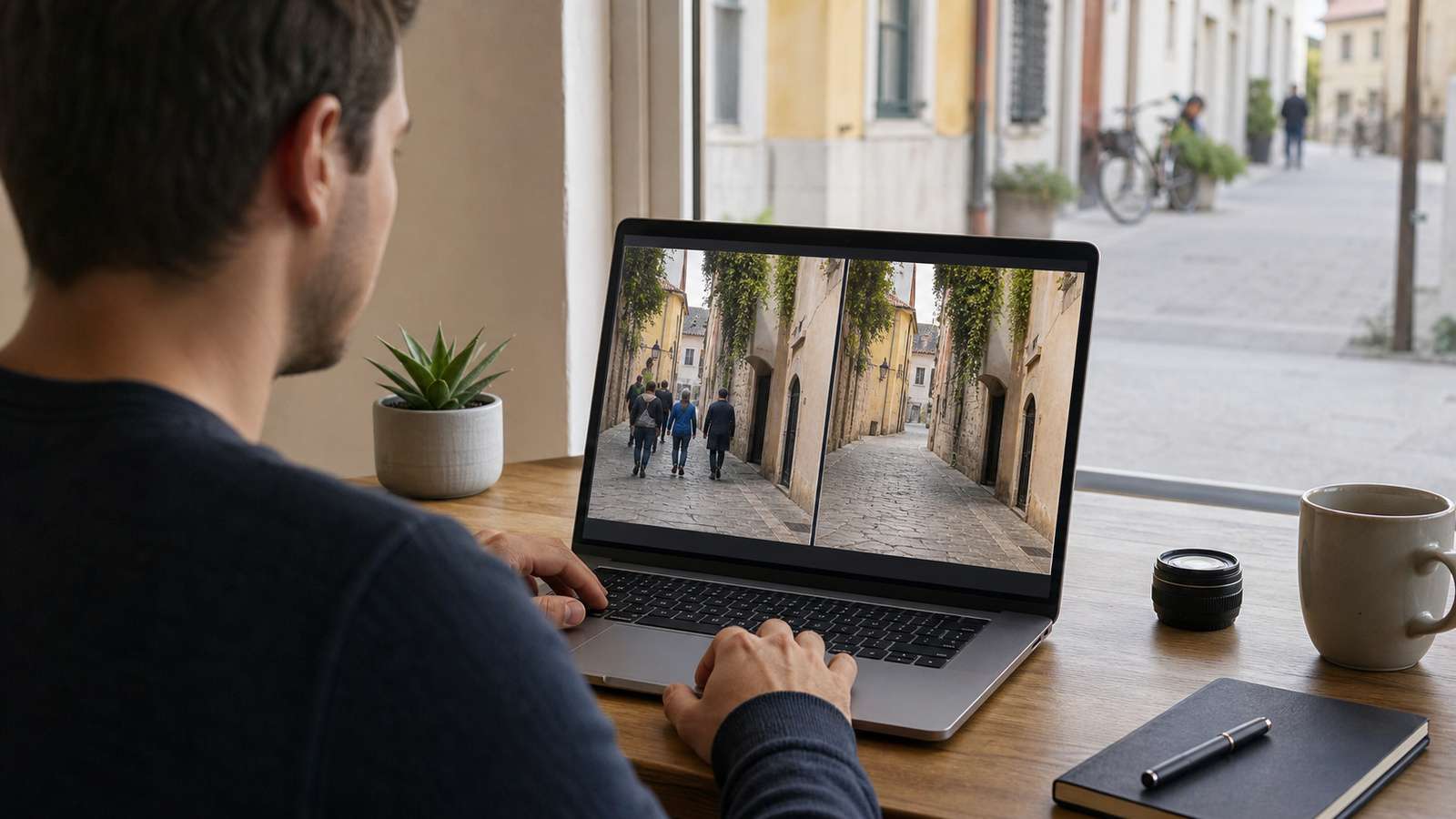
When the automatic result is not good enough, a compositing workflow gives you more control. The core idea is to create transparency where the person was, then synthesize or paint the missing background. After Effects Content-Aware Fill is temporally aware: it analyzes the current and surrounding frames to produce a fill layer. For complicated shots, Adobe also provides a reference-frame workflow so you can paint a clean frame and let that guide the fill.
- Rotoscope or mask the person. Keep the mask close enough to avoid deleting unnecessary background, but leave enough margin to remove clothing edges and motion blur.
- Track the mask. A moving person or camera requires the cutout to follow the subject across time. Correct track drift before generating a fill.
- Choose a fill strategy. Moving objects usually need object-style temporal fill; flat surfaces may be easier to reconstruct as a surface.
- Create a reference frame when geometry matters. Paint the clean wall, railing, floor, sign, or other background structure in a representative frame.
- Generate the fill and inspect transitions. Pay attention to moments when the person reveals previously hidden areas.
- Patch only problem ranges. One long shot may need two or three fill treatments instead of a single global solution.
Reference frames are especially useful when the background contains strong lines or recognizable objects. AI can invent generic texture, but a manually corrected clean plate tells the fill exactly how the region should look at a key moment.
Camera Motion, Occlusion, Shadows, and Reflections Need Separate Decisions
Moving camera
If the camera pans or pushes in, the hidden background changes position and scale. Stabilizing the shot temporarily can simplify masking, but the fill still needs to respect perspective. Choose short ranges around major camera changes rather than assuming one fill will remain valid through the entire movement.
Person crosses another subject
This is one of the hardest cases. If the unwanted person passes in front of the person you want to keep, the editor must reconstruct body parts, clothing, or hair that were genuinely hidden. A background clean plate cannot solve that. You may need frames from before or after the overlap, manual paint, or a different edit point.
Shadow
A shadow may extend far beyond the body. Removing body and shadow in one huge mask increases the amount of synthesis and can create a soft patch. Often it is cleaner to remove the person first, then evaluate whether the shadow is still distracting. If the light source is visible, make sure the repaired floor remains consistent with surrounding shadow direction.
Reflection
Mirrors, windows, glossy floors, and car paint can show a second version of the person. A perfect body removal with a surviving reflection looks obviously edited. Treat reflections as separate moving objects and consider whether they contain unique background information that is difficult to rebuild.
Common Failure Modes: Ghosts, Smears, Bent Lines, and Popping Texture
| Artifact | Cause | Fix |
|---|---|---|
| Ghost silhouette | Mask misses motion blur or clothing edge | Expand/refine mask slightly and regenerate |
| Smear follows person | Fill borrows pixels from contaminated frames | Shorten the analysis range or use a clean reference frame |
| Bent railing or curb | Model invents geometry | Paint a reference frame or use clone/patch techniques |
| Texture pops frame to frame | Fill solution changes temporally | Split the shot, reduce mask area, or add a stabilized clean plate |
| Person disappears but shadow remains | Shadow was not selected | Treat shadow separately after body removal |
| Foreground subject gets damaged | Mask overlaps wanted subject | Rotoscope more carefully and protect foreground edges |
Do not judge a people-removal edit from a thumbnail. Full-resolution playback exposes errors that are invisible in a single screenshot. It also helps to watch once without pausing. Some frame-level imperfections disappear in motion, while a small patch that flickers every frame can be far more distracting than one imperfect still.
Quality, Editorial, and Ethics Checklist
- Keep the original clip untouched before making any removal edit.
- Check the edit at the beginning and end of the mask range, where tracking errors often appear.
- Inspect straight lines, repeated tiles, text, faces, hands, and reflections around the removed region.
- For documentary, news, legal, security, or evidentiary video, label edited versions clearly and preserve the source.
- Do not remove people in a way that falsely changes the meaning of an event, transaction, attendance record, or evidence.
- If privacy is the goal, blurring may be more truthful than deleting a person entirely because it preserves the fact that someone was present.
Three real-world removal examples
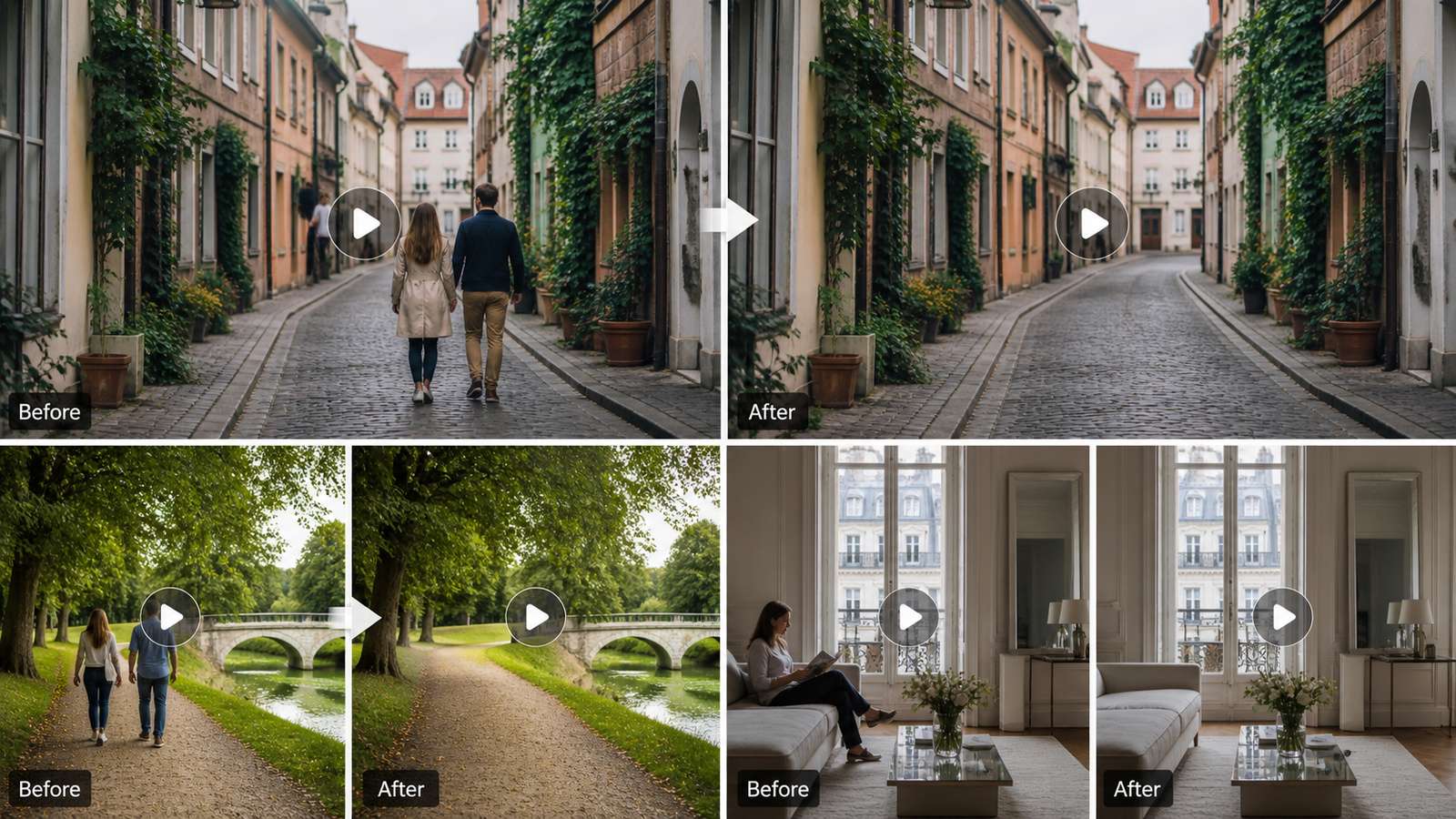
Travel vlog with a pedestrian in the background. If the camera is mostly stable and the pedestrian crosses an open plaza, an AI eraser is a sensible first choice. Mask the person closely and process the interval from just before entry to just after exit. Because the plaza is visible before and after the person passes, the model has strong temporal evidence for the missing background.
Real-estate walkthrough with someone reflected in a mirror. Removing only the visible person is not enough. Their reflection may move differently because of perspective, and the mirror contains a second view of the room. Treat the direct person and reflection separately. If the reflection covers important furniture or doorway geometry that is never visible elsewhere, a clean plate from another take can be more reliable than generative filling.
Street interview where a passerby crosses behind the speaker. This may look simple until the passerby overlaps hair or a shoulder. The background can be reconstructed from nearby frames, but the wanted speaker's silhouette needs protection. Use a tighter tracked mask, split the overlap into a short range, and be prepared to restore a few edge frames manually. If the passerby never blocks the speaker, the same shot may be easy.
Plan removal before shooting when you can
If you know a shot may need cleanup, capture a few seconds of the empty background before or after the action. Lock exposure and focus when possible. A clean plate gives an advanced compositor exact information about the wall, street, floor, or furniture that was hidden later. This simple production habit can turn a difficult generative repair into a straightforward tracked composite and often produces a more faithful result than trying to invent background from scratch.
FAQ About Removing People from Video
-
Can AI remove a moving person from video?
Yes, particularly when the person is isolated and the background is visible in nearby frames. Camera motion, occlusion, shadows, reflections, and complex texture make the job harder. -
Is After Effects better than an online people remover?
It offers more control for difficult shots because you can track masks, choose fill methods, correct lighting, and create reference frames. An online AI remover is usually faster for simpler footage. -
Why does the background smear after the person is removed?
The fill may be borrowing from frames where the person still covers the area, or the mask may be too large. Shorter ranges and a clean reference frame can help. -
Should I remove the person and their shadow together?
Not always. Separate passes often work better because the body and shadow cover different textures and move differently. -
Can I remove someone who walks in front of another person?
Sometimes, but that is difficult because the wanted person was physically hidden. You may need clean frames from another moment or manual compositing. -
Is deleting a person from video appropriate for privacy?
It can be, but blur is often a more transparent privacy treatment. For sensitive or evidentiary footage, preserve the original and clearly mark edited copies.


