
In this article
Identify the Subtitle Type Before You Remove Anything
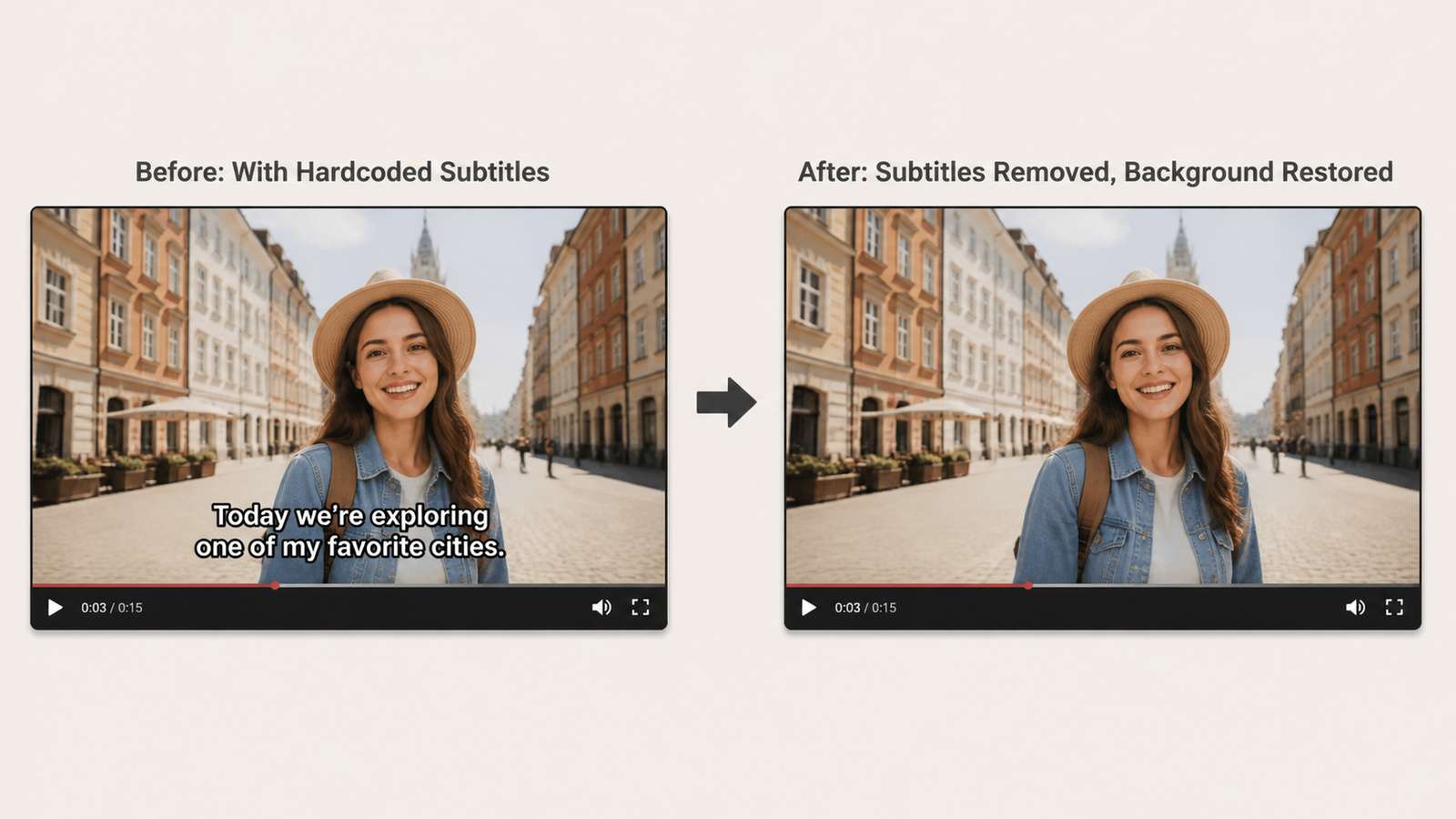
The phrase remove subtitles from video covers three different technical situations. Soft subtitles are separate tracks stored inside or beside the video. Player captions are delivered by a platform and drawn during playback. Hardcoded subtitles are actual pixels rendered into every frame. Only the hardcoded case requires visual reconstruction.
This distinction can save a lot of time. If a subtitle track is separate, removing it is a stream-management task and the video image never needs to be touched. If the captions only appear because a player has CC enabled, simply turn them off. Running AI inpainting on either of those cases would reduce quality for no reason.
| Subtitle type | How to recognize it | Best removal method |
|---|---|---|
| Soft subtitle track | Can be toggled on/off in player; may appear as SRT/ASS track | Disable or remux without subtitle stream |
| External subtitle file | Separate .srt, .vtt, .ass, or similar file | Do not load or distribute the file |
| Platform/player captions | CC button controls visibility | Turn captions off in player |
| Hardcoded/burned-in subtitles | Text is part of every video frame | Crop, cover, or AI inpainting |
| Open captions with stylized graphics | Always visible and often integrated into design | Edit source project if available; otherwise visual reconstruction |
Remove Soft Subtitles Without Rebuilding the Video Image
Soft subtitles are metadata or timed text streams. A container such as MKV can hold video, audio, and several subtitle tracks. Tools such as FFmpeg can select which streams go into a new output. The important concept is that you are remuxing or transcoding streams, not erasing letters from pixels.
If the subtitle is external, the simplest solution is even easier: do not load the subtitle file. In VLC and many players you can disable the subtitle track during playback. If you want a new file without the subtitle stream, remux the video while excluding subtitles. FFmpeg supports manual stream mapping and the -sn option to skip subtitle streams in an output.
Why remuxing is preferable
When the output container and codecs allow stream copy, a remux can preserve the encoded video and audio without visually recompressing them. That means fast processing and no generational image loss. If you are working from an editing project, disable the subtitle layer or caption track and export again. Always choose this path before visual removal.
What “Remove Subtitles from YouTube” Usually Means
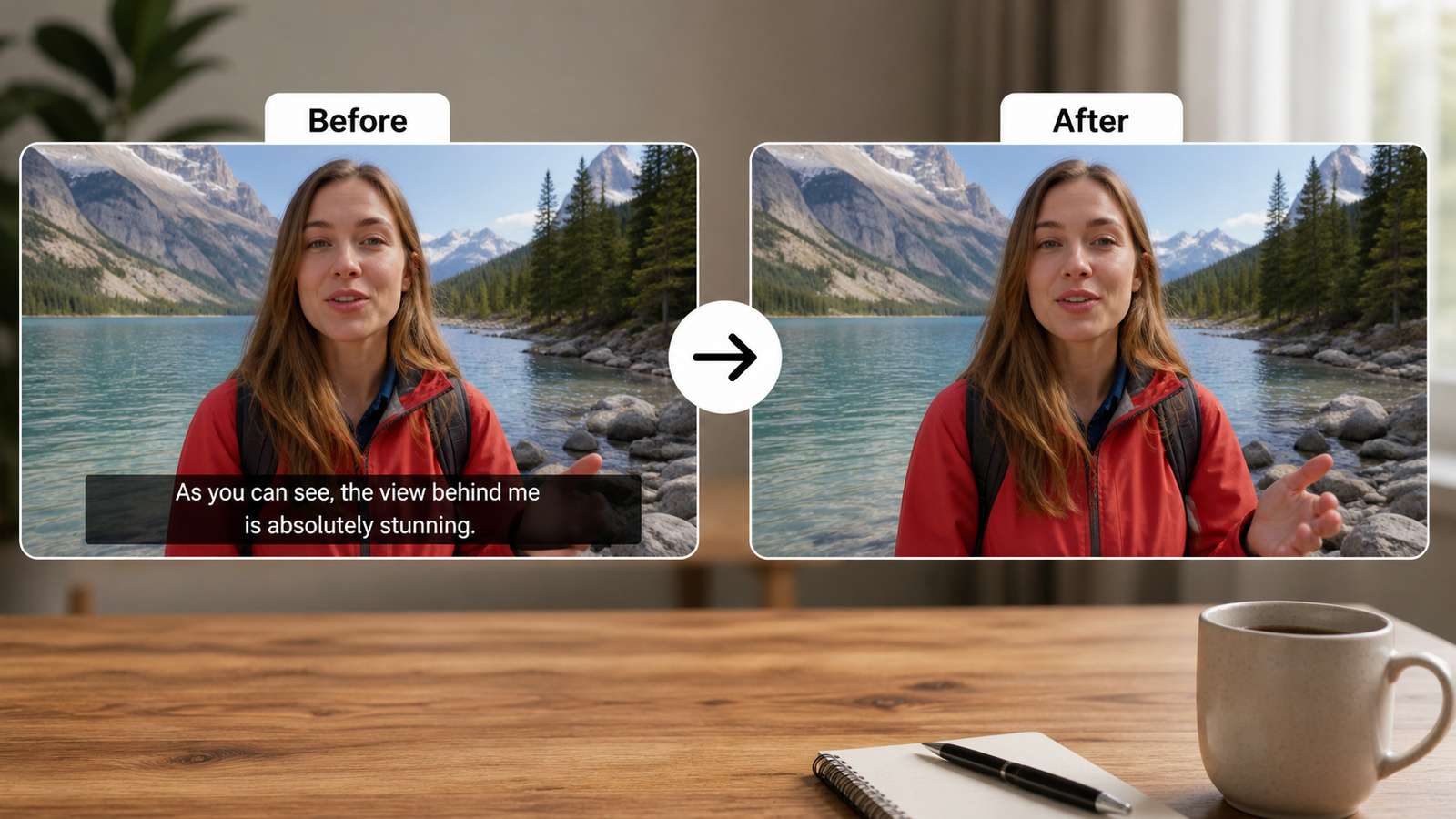
On YouTube, captions shown by the player are often not burned into the video. If a CC button turns them on and off, there is nothing to erase from the underlying image. Disable captions in the player. If the creator rendered subtitles directly into the uploaded video, the text is hardcoded and the only visual options are crop, cover, or inpainting.
Be careful with download workflows. YouTube provides official ways to download your own uploads and offers offline viewing features through supported YouTube experiences. That does not automatically give permission to download, edit, or redistribute someone else's video. For subtitle-removal projects, work with footage you own, licensed source files, or material you are otherwise authorized to edit.
Remove Hardcoded Subtitles with Crop, Cover, or AI Inpainting
Hardcoded subtitles are the difficult case because the text has replaced real image pixels. Choose the least destructive method that works.
| Method | Best when | Tradeoff |
|---|---|---|
| Crop | Subtitles sit in a black bar or safe lower edge | Changes framing and resolution |
| Cover with new bar/graphic | You are redesigning the lower third anyway | Does not restore original background |
| Blur/pixelate | Privacy or redaction matters more than clean image | Text area remains visibly altered |
| AI inpainting | You need a natural-looking full frame | Generated pixels may flicker or distort |
| Return to source project | You created the subtitles originally | Best quality if project still exists |
Cropping is often underrated. If the subtitle sits entirely in a letterbox bar, trimming the bar can be cleaner than asking AI to invent content that viewers never needed. Inpainting is most useful when subtitles overlap valuable picture area and the background can be inferred from surrounding frames.

Moving Backgrounds, Two-Line Captions, and Speaker Overlap Need More Care
A static caption over a locked-off wall is a simple temporal repair. Subtitles over moving faces, hands, clothing, water, crowds, or a panning camera are much harder. The text may cover different content every frame, so the fill must change coherently without leaving a visible horizontal band.
- Two-line captions: remove both lines and their shadow together if the style overlaps, but avoid selecting an unnecessarily tall strip across the entire frame.
- Word-by-word captions: dynamic karaoke-style text changes rapidly. Use a mask that follows the active region or process short ranges.
- Speaker crosses caption area: inspect hands, clothing, and chin edges frame by frame because AI may smooth away anatomy.
- Camera pans: static texture under the caption becomes moving texture; shorter processing ranges can reduce drift.
- Transparent subtitle box: include the box, border, glow, and text in the selection. Leaving the translucent background behind can make the edit look unfinished.

Use Media.io AI Video Eraser for Burned-In Subtitles
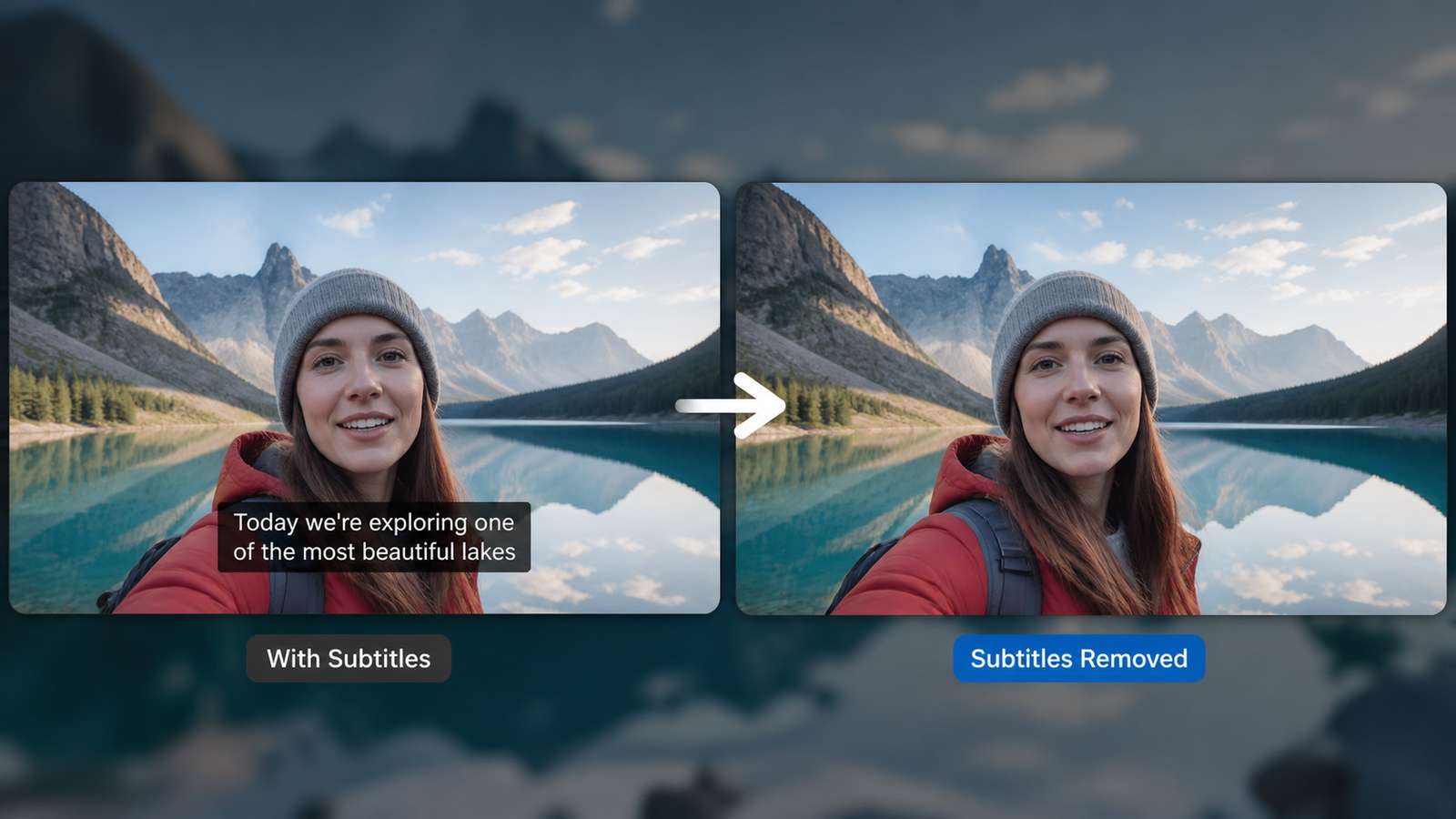
Media.io AI Video Eraser is designed for visual objects that are already part of the footage, including hardcoded captions. The useful workflow is to select the subtitle region carefully, process a representative section, and judge motion consistency rather than a single still.

- Upload the cleanest source video available and identify a subtitle section with difficult background motion.
- Mask the text, outline, shadow, and any translucent caption box. Keep the selection tight to the actual overlay.
- Preview a sequence where words change. Check whether the fill remains stable when one subtitle disappears and the next appears.
- If a foreground subject moves through the caption area, split that range and process it separately.
- Watch the finished clip at 1x speed, then step through frames around transitions for ghost letters or flickering texture.
- Keep the untouched source and export the cleaned version as a separate file.
Where AI Subtitle Removal Fails - and How to Reduce Artifacts
| Failure | Typical cause | Improvement |
|---|---|---|
| Ghost letters remain | Mask misses stroke, shadow, or outline | Expand selection slightly around glyph edges |
| Horizontal blurry band | Mask spans too much of frame | Select only subtitle region and process shorter ranges |
| Faces or hands deform | Foreground subject crosses text | Protect subject edge and repair that section separately |
| Background flickers | Fill changes from frame to frame | Shorten range, reduce mask, or use clean reference frames in advanced tools |
| Straight lines bend | Subtitle covers architecture or horizon | Use manual clean plate/clone for geometry |
| New subtitles look worse after re-encoding | Multiple generations of compression | Work from original source and avoid unnecessary conversions |
When the subtitle area is consistently difficult, consider reframing instead of forcing an invisible repair. A slightly tighter crop with clean motion is often more professional than a full frame with a shimmering strip at the bottom.
Practical examples: choose the least destructive route
MKV file with selectable English and Spanish subtitles. Do not touch the pixels. Disable the unwanted track for playback or remux the file without subtitle streams. This preserves the picture and avoids the long render time and artifacts of inpainting.
MP4 with captions burned into a black letterbox bar. If the final composition can tolerate it, crop the lower bar and reframe. The result may be cleaner than reconstructing an area that contains no valuable picture content. Check the target aspect ratio first so you do not create an awkward nonstandard frame.
Short social video with bold animated captions over the speaker. This is one of the hardest visual cases because the text moves, changes word by word, and may cover hands or the lower face. If you created the original, re-export from the project with captions disabled. If you only have the final video, process short caption ranges and expect some manual cleanup around the subject.
Foreign-language film with hardcoded subtitles over detailed scenery. AI may remove the letters but can create a shimmering lower band across long scenes. For a professional restoration, use shot-by-shot masks and clean reference frames. For casual viewing, a crop or redesigned subtitle band may be more acceptable than trying to make every frame look untouched.
What to do before adding new subtitles
If you plan to replace the removed subtitles with a new language, finish visual cleanup first. Then create the new captions as a separate editable track or title layer instead of burning them in immediately. Separate subtitles are easier to correct, translate, restyle, or disable later. When you eventually export a hardcoded social version, keep a clean master without text so you never have to solve the same removal problem again.
Preserve timing information when possible
Even when you remove a subtitle stream from one deliverable, keep the SRT, VTT, ASS, or project caption data in your archive. Timing is valuable for translation, accessibility, search, and future versions. Removing captions from the visible video does not mean deleting the underlying transcript from your production workflow.
Batch jobs still need shot-level checks
If you are cleaning subtitles from a long interview, course, or compilation, it is tempting to select the entire lower third and process the whole timeline. That is efficient only when the background stays simple. A long video can contain dozens of scene types: faces, slides, outdoor footage, screen recordings, and camera moves. Use one broad workflow for easy shots, but flag difficult scenes for separate treatment. A five-second manual fix around a face can prevent a visible artifact from repeating through the final export.
Also compare audio and video sync after any long transcode. Subtitle removal should not change timing, but rebuilding or converting the file through multiple tools can introduce unrelated export issues. Check the first minute, a middle section, and the ending before deleting your working files.
FAQ About Removing Subtitles from Video
-
How do I know if subtitles are hardcoded?
Turn captions off in the player. If the text remains, it is probably burned into the video pixels. Soft subtitle tracks can usually be disabled independently. -
Can VLC permanently remove subtitles?
VLC can disable subtitle tracks for playback. To create a new file without a soft subtitle stream, remux or convert the media while excluding that track. -
Can FFmpeg remove a subtitle track without touching the video image?
Yes. FFmpeg supports stream selection and can omit subtitle streams. When stream copy is compatible with the output container, the video and audio can be preserved without visual reconstruction. -
Can AI remove burned-in subtitles cleanly?
Often on simple backgrounds. Results become harder when captions cover faces, hands, moving objects, water, detailed architecture, or strong camera motion. -
Can I remove subtitles from a YouTube video?
Player captions can simply be turned off. Burned-in subtitles require editing the video itself. Only download or edit content you are authorized to use. -
Is cropping better than subtitle inpainting?
If the captions sit in a safe lower edge or black bar, cropping can be cleaner and more predictable. Inpainting is better when you must preserve the full composition.