

YouTube audience retention measures how successfully a video keeps viewers watching after they click. It is not merely an editing score. Retention reflects the entire promise chain: topic, thumbnail, title, opening, structure, pacing, clarity and payoff.
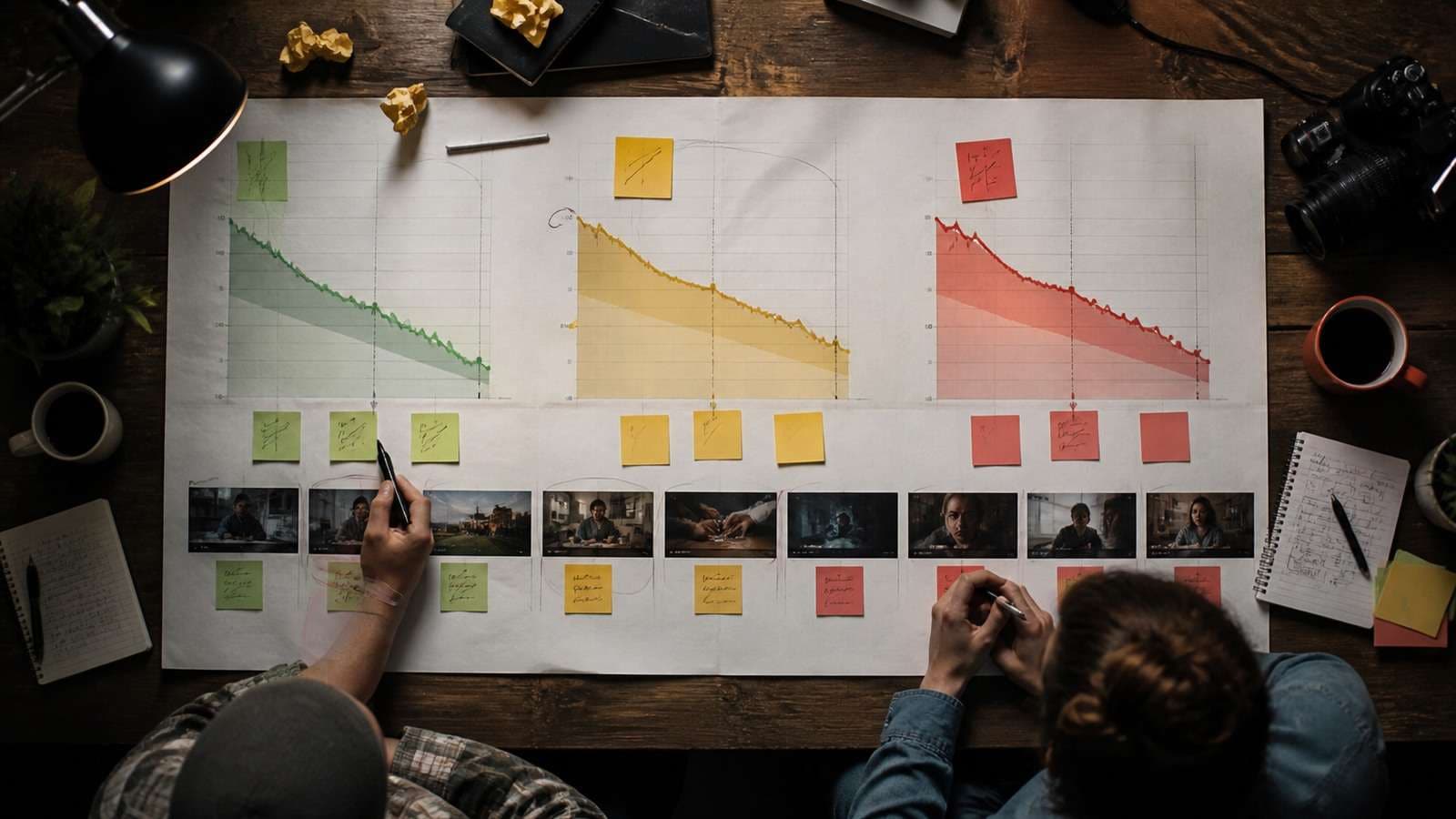
A declining graph is normal because every video loses viewers over time. The goal is not a perfectly flat line; it is to understand why viewers leave, rewatch or skip, then improve the specific creative decision responsible. A 35% average viewed percentage on a 30-minute documentary may generate far more watch time than 60% on a three-minute clip, so benchmarks must be interpreted alongside video length and traffic source.
In This Article
What Is Audience Retention on YouTube?

Audience retention shows what percentage of the starting audience remains at each moment. In YouTube Studio, creators can inspect key moments such as the intro, top moments, spikes and dips. YouTube describes the intro as the percentage of viewers still watching after the first 30 seconds and notes that a strong intro commonly indicates that the opening matched the title and thumbnail expectation and kept people interested.
Two related metrics answer different questions:
- Average view duration: the estimated average number of minutes watched.
- Average percentage viewed: the average share of the video watched.
Watch time vs audience retention is therefore not a competition. A longer video can have lower percentage retention but produce more minutes watched. You need both to understand whether the content holds attention and creates meaningful viewing sessions.
How to Read a YouTube Audience Retention Graph

| Graph pattern | Likely meaning | What to inspect |
|---|---|---|
| Steep opening drop | The click promise and opening do not align, or the setup is too slow | First sentence, logo sequence, greetings and promised result |
| Gradual decline | Normal audience decay | Whether the slope becomes unusually steep |
| Sharp dip | Viewers skipped or exited | Repetition, tangent, sponsor, confusing step or weak segment |
| Spike | Viewers rewatched or navigated to that moment | High-value answer, reveal, unclear explanation or chapter destination |
| Flat top moment | A section retained viewers unusually well | Story device, specificity, pace and visual treatment |
| Late lift | Viewers skipped toward an expected payoff | Whether the answer should appear earlier |
A spike is not automatically positive. Rewatching may signal delight, but it can also mean the explanation was hard to follow. A dip is not always a failure: viewers may skip a chapter that is irrelevant to them while remaining satisfied with the rest of the video.
Compare the graph with context. Traffic from search often brings viewers seeking one answer, while subscribers may watch for personality and narrative. External embeds, autoplay and returning viewers can produce different curves. Evaluate similar videos against each other rather than treating one universal benchmark as a law.
What Is a Good Audience Retention Rate on YouTube?

There is no official universal “good” percentage. Creator tools often cite approximate targets such as retaining around 60% past the first 30 seconds or achieving roughly 30% average viewed, but those are orientation points, not platform guarantees. Length, niche, format, audience intent and traffic source can shift the expected result dramatically.
| Video type | Retention context | Better comparison |
|---|---|---|
| Short tutorial | Viewers expect an immediate answer | Other tutorials solving similar problems |
| Long documentary | Lower percentage may still yield high watch time | Videos of similar length and narrative density |
| Personality vlog | Returning viewers may tolerate more setup | Your own recent uploads |
| News or commentary | Topic urgency affects the opening | Comparable topics and traffic sources |
| YouTube Short | Loops and swipes change interpretation | Viewed vs swiped away plus engaged views |
The most useful YouTube audience retention benchmark is your channel's own baseline. Group videos by format and length, calculate a median, and identify the top and bottom performers. Then compare decisions: Did the stronger video reveal the outcome earlier? Was its title more accurate? Did it use examples instead of explanation?
Why YouTube Audience Retention Drops

The Opening Repeats the Thumbnail Instead of Advancing It
A viewer already understands the broad topic. Long greetings, channel introductions and restating the title delay progress. In the first 30 seconds, confirm the promise, establish stakes and begin delivering evidence.
The Title Promises One Video and the Script Delivers Another
A high click-through rate can coexist with weak retention when the packaging overpromises. If the title says “I tested every AI video generator,” but the opening becomes a general history lesson, viewers feel the mismatch immediately.
The Information Order Follows the Creator's Process
Creators often narrate events in the order they experienced them. Viewers need the order that makes the result easiest to understand. Lead with the problem, stakes or surprising result, then supply background only when it becomes necessary.
The Video Repeats a Point Without Increasing Value
Repetition feels like padding when the second explanation adds no example, evidence or consequence. Popular editing analysis frequently warns against distrusting the viewer: overexplaining every transition can reduce momentum.
The Visual Does Not Support the Sentence
Random B-roll may create movement without improving comprehension. Use screen recordings, diagrams, demonstrations, captions and comparisons that answer the viewer's current question. A video caption generator can create a first transcript layer, but manual emphasis should highlight only the terms that matter.
The Payoff Is Delayed Beyond Its Value
“Watch until the end” is not a retention strategy unless the journey continuously earns attention. Reveal useful partial answers throughout the video and let each answer create the next question.
How to Improve YouTube Audience Retention
- Write the title and thumbnail promise first. The opening must answer the expectation created by the packaging.
- Cut the preamble. Begin at the first moment where the viewer receives new information, tension or proof.
- Create an open loop with substance. Show the result, problem or contradiction, then explain what the viewer will learn—not a vague teaser.
- Organize the middle into escalating beats. Each section should add evidence, difficulty, consequence or a new decision.
- Use pattern changes intentionally. Switch framing, demonstration, pace or visual mode when the information changes, not on an arbitrary timer.
- Compress repeated explanations. If two sentences do the same job, keep the clearer one.
- Place proof near the claim. Show the test, screenshot, result or example when it is mentioned.
- Design transitions around questions. Close one loop and open the next before attention resets.
- End after the payoff. Move the next-video recommendation close to the natural conclusion instead of adding a long farewell.
When a topic is already validated but needs a stronger social structure, Media.io Viral Studio can help turn the idea into hook-led short-form variations. This is most useful for testing different openings; it should not replace the creator's audience insight.
A Retention-Led Scripting and Editing Workflow

Step 1: Build a Promise Map
Write three lines before the script: what the viewer clicked for, what evidence will prove the promise and what transformation or answer they should have at the end. If the title is still changing, revise the opening with it.
Step 2: Mark Value Beats
Label each script section as setup, evidence, example, escalation, payoff or transition. Long runs of setup usually create retention risk. For narrative or educational videos, Script to Video can help divide an approved script into scenes, making under-visualized sections easier to spot.
Step 3: Make a Radio Edit
Before adding effects, cut the spoken track until the logic works without decorative visuals. Remove duplicate sentences, unnecessary qualifiers and pauses that do not add emotion. Good retention editing begins with information architecture.
Step 4: Add Evidence-Driven Visuals
Use visuals to clarify, prove or intensify the narration. The YouTube video editor workflow is suitable for assembling demonstrations, text, B-roll and audio into a coherent sequence. If one section is demonstrably weak, use a YouTube video trimmer to create a tighter test cut instead of rebuilding everything.
Step 5: Run a Cold-Viewer Review
Ask someone who has not seen the script to watch without context. Record where they predict the video is going, where they become confused and when they feel they have already received the answer. Do not explain the intention during the test.
Step 6: Diagnose the Published Graph
After sufficient views accumulate, annotate meaningful dips and spikes with the exact creative event. Convert the finding into a rule for the next upload: “Show the finished result before explaining setup,” not merely “improve retention.”
YouTube Shorts Audience Retention

Shorts require a different lens because viewers can swipe immediately and videos may loop. Review viewed versus swiped away, engaged views, average view duration and percentage viewed together. A percentage above 100% can result from rewatches or looping; it does not mean every viewer completed the Short.
- Make the first frame visually legible without context.
- Remove spoken wind-up such as “today I am going to show you.”
- Use captions for silent viewing, but keep each line easy to scan.
- Create progression every few seconds through a new fact, visual or consequence.
- Let the ending resolve the promise or connect naturally to the first frame when a loop supports the idea.
Trend selection affects initial interest but does not guarantee retention. Use Media.io's guide to what is trending on social media to understand the surrounding format, then add a specific point of view rather than copying the visible surface.
A Seven-Question Retention Audit
- Does the first sentence advance the title and thumbnail promise?
- Can the viewer understand why the result matters?
- Does every background section arrive before it is needed?
- Does each visual prove or clarify the spoken idea?
- Are examples more specific as the video progresses?
- Can any section be removed without weakening the payoff?
- Does the ending direct satisfied viewers toward a relevant next video?
Prepare alternate cuts without degrading playback quality. Use a YouTube-focused editing workspace for platform versions, resize video for a genuinely different format, and compress the final MP4 only after the master has been approved.
Frequently Asked Questions
-
What is YouTube audience retention?
Audience retention shows the percentage of viewers still watching at each point in a video. Average view duration and average percentage viewed summarize that behavior in different ways. -
What is a good audience retention rate on YouTube?
There is no universal target. Compare videos of similar length, format, audience and traffic source, then use your channel's median as the most useful baseline. -
Why does retention drop in the first 30 seconds?
Common causes include a mismatch with the title or thumbnail, long greetings, delayed value, unclear stakes or an opening that repeats information the viewer already knows. -
What do spikes and dips mean in YouTube retention analytics?
Spikes may indicate rewatching or navigation to a valuable moment. Dips suggest skipping or exits. Inspect the exact content at that timestamp before deciding whether it is good or bad. -
Is watch time more important than retention?
They answer different questions. Retention shows how well the video holds attention, while watch time measures total minutes consumed. Evaluate both with video length and viewer satisfaction. -
How can I improve retention without excessive editing?
Strengthen the premise, align the opening with the click promise, remove repetition, order information around viewer questions and use visuals as evidence rather than decoration.


