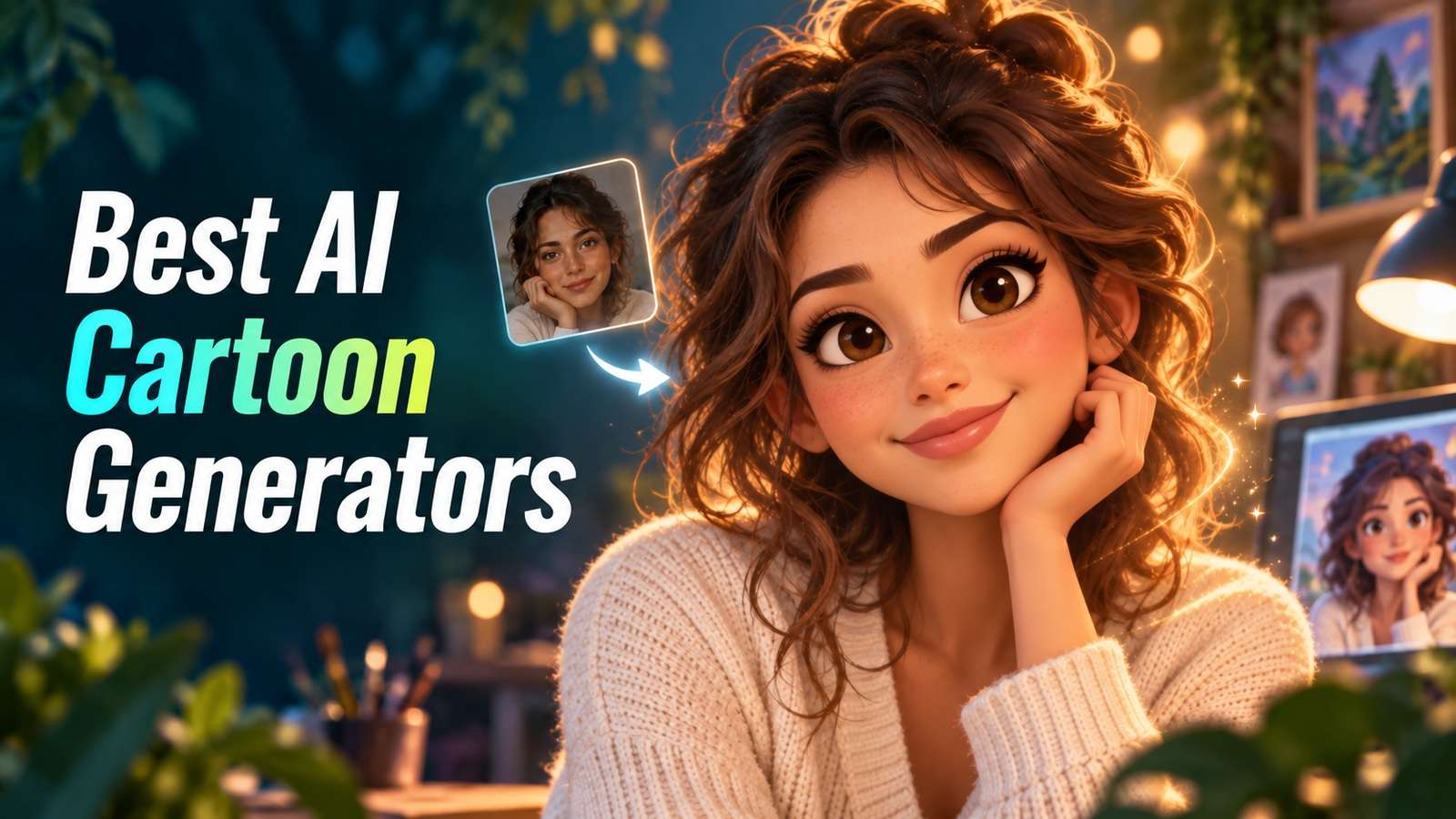
The first cartoon looks right, then the next one quietly changes family: flat 2D becomes 3D, or chibi becomes a standard portrait. If you are comparing the best AI cartoon generators, you need a look you can reuse from text or a photo, not one viral selfie filter.
I treated that as a style contract. Media.io, Midjourney, Ideogram, Leonardo, ToonMe, ChatGPT, Canva, and OpenArt had to keep 2D, comic, chibi, or 3D-cartoon distinct after a few images. Phone apps that mainly cartoonize selfies are a different shopping trip, covered separately.
If you are building a mascot, a comic cover, or a set of matching stills, that reuse is the whole point. The rest of this review shows which tools hold a look, which ones are better as one-off filters, and how to brief the family in plain language.
In this article
- Cartoon Generators Fail When the Style Contract Slips
- Best AI Cartoon Generators by Input and Style Family
- 8 Cartoon AI Tools for Text, Photos, and Character Sheets
- 2D, 3D, Comic, and Chibi Are Not Interchangeable
- The Style Contract Test
- How to Choose a Cartoon AI Generator From Text or Photo
- Final AI Cartoon Generator Recommendations
- AI Cartoon Generator FAQ
Cartoon Generators Fail When the Style Contract Slips
Cartoon is not a complete brief. Say whether you want print 2D, comic ink, chibi, or a 3D cartoon render. If you leave that unsaid, image three will not match image one, and a character sheet will not match the poster.
Failures look like this:
- A 2D mascot grows subsurface scattering on the next shot.
- A comic character loses ink weight and becomes a sticker.
- A chibi prompt returns an adult-proportioned portrait with big eyes.
- A photo input keeps skin pores that the style family cannot afford.
The generator has to hold the contract across inputs: text, photo, and reuse on a sheet.
Best AI Cartoon Generators by Input and Style Family
Route by input first. Photo cartoonizers, text-to-cartoon illustrators, and sheet tools can share a landing page and still be different products.
| Tool | Best input | Style family fit | Sheet reuse | Watch-out |
|---|---|---|---|---|
| Media.io | Photo or image-to-image, plus text-to-image | Cartoon, anime, chibi, yellow-portrait paths | Character and image-to-image reuse | Name the family; do not prompt only "cartoon" |
| Midjourney | Text plus style references | Strong directed 2D and stylized frames | Manual | Family can drift without a reference lock |
| Ideogram | Text, including signs in-frame | Poster and comic covers with type | Limited | Not a dedicated chibi sheet tool |
| Leonardo | Text, image guidance, canvas | Many cartoon models | Canvas iteration | Model hopping breaks the contract |
| ToonMe | Photo | Fixed cartoonizer looks | Weak | Likeness and style are bundled; little family control |
| ChatGPT | Text or photo in chat | Flexible drafts | Conversational, not a sheet OS | Can mix families in one thread |
| Canva | Templates plus AI | Marketing cartoon graphics | Brand-kit reuse | Template look can dominate the family |
| OpenArt | Multi-model prompts | Whatever model you pick | Depends | The playground tempts contract-breaking hops |
8 Cartoon AI Tools for Text, Photos, and Character Sheets
Each review is tagged with a style-family contract: what to lock, what to forbid, and which input to start from.
Media.io
Keep this look: pick one family per project, such as 2D print, anime, chibi, or yellow-portrait, and keep those files together. Media.io is the easy browser start because it can cartoonize a photo and also generate from text. The core cartoon path is image to cartoon. Related long-tail pages include photo to anime, a cartoon yellow portrait generator, and chibi cartoon prompts. Text-to-image covers prompt-first cartoon stills. Character sheets live in the character tools if the cartoon has to persist.
Choose Media.io when you need photo and text cartoon stills in a browser, including mobile browser use without installing an app. Skip it if you only want a locked Discord style community or a native iOS cartoon app with stickers.
Midjourney
Keep this look: add a style reference and a plain family phrase such as "cel shaded 2D, hard outlines, flat color." Midjourney is strong when you are directing a frame. It is weaker if you need a selfie to still look like you.
Start from text or a style reference, not from a selfie, unless you have accepted likeness drift.
Ideogram
Keep this look: a poster or comic-cover family with readable type. If the cartoon has to spell a title, Ideogram earns the slot because packaging, title cards, and signs fail in models that cannot spell. It is not the chibi sheet default.
Leonardo
Keep this look: pick one cartoon model and freeze it. If you will keep iterating on a canvas, that lock is the whole product. Hopping from a 3D cartoon model to a comic model because the last frame looked tired is how the look falls apart.
ToonMe
Keep this look: ToonMe's looks are the contract. If you just want your photo in a known cartoon filter, that honesty is useful. You get a photo cartoonizer, not a family designer, so skip it for a mascot system.
Likeness and export behavior still need a check. Treat ToonMe as a photo input specialist, then leave if you need text-to-cartoon worldbuilding.
ChatGPT
Keep this look: restate the family every turn. If you are drafting cartoon ideas in chat, ChatGPT is a useful partner for prompts and quick photo stylizations. Threads that say "make it funnier" will also make it a different family.
Canva
Keep this look: brand kit plus one cartoon template family. If the cartoon has to live in a marketing file that must resize, Canva wins. It loses when you need an original character sheet with turnarounds.
OpenArt
Keep this look: the selected model is the contract. If you are still comparing cartoon families, OpenArt is a playground, which is the feature and the risk. Compare there, then production-lock the winner in Media.io, Leonardo, or a sheet tool.
2D, 3D, Comic, and Chibi Are Not Interchangeable
Write the family on the project ticket. 2D print wants outlines and flat or simple shading. 3D cartoon wants volume and designed lighting. Comic wants ink, panels, and sometimes halftone. Chibi wants a head-to-body ratio and simplified hands. If those words are not in the prompt or the model choice, the contract is unwritten and will slip.
Photo inputs add a fifth problem: residual realism. Pores, realistic hair, and photographic perspective can leak into a 2D family. When that happens, you did not get a cartoon. You got a filter.
Keep photo-to-cartoon apps in their own decision when the user is on a phone, cares about watermarks, and needs a selfie export. That is the next article's job. This article is the style-family job.
Photo leakage versus drawn intent
Photo cartoonizers keep too much of the camera. That is useful when you need a recognizable person, and harmful when you need a mascot that can be redrawn by another artist next year. If the output still has photographic perspective, stray hair flyaways, or real-world lighting wrap, you did not lock a 2D family. You applied a filter. Filters are valid. They are just a different deliverable, and they travel poorly into merch, animation, and extra poses.
Text-to-cartoon has the opposite leak: generic cute. Without a family lock, models reach for big eyes, smooth gradients, and a sticker outline because that cluster is common in training. If your brand needs woodcut, newspaper comic, or UPA-flat, you must say so in the first prompt and in the model choice. Repeating "cartoon" will not get you there.
Sheet reuse is the proof. Generate a side view from the first approved still. If the outline weight changes, the family was never a contract. It was a lucky first frame. Media.io character and image-to-image paths exist so you can reuse an approved still rather than rolling a new "cartoon fox" from text every time. Midjourney users should pin a style reference. Leonardo users should stop hopping models after the first approved frame.
For teams making both posters and stickers, split the files. Posters can carry more detail. Stickers need fewer interior lines. If one generator is used for both without a detail budget, the sticker will look noisy and the poster will look empty. That is not a model failure. That is an unspecified contract.
The Style Contract Test
Use one character description and, where the tool allows, one photo. Demand three outputs in the same family, then one output in a second family to prove the tool can switch on purpose rather than by accident.
- Write a 4-line character and lock family A (for example, 2D print, two-tone, hard outline).
- Generate image 1 from text in family A.
- Generate image 2 as a new pose in family A.
- Generate image 3 from a photo input in family A if the tool accepts photos.
- Score line weight, proportions, shading model, and palette against image 1.
- Generate image 4 in family B (for example, chibi) and fail if it still looks like A, or if A had already drifted into B on image 2.
- Record whether a sheet or reuse feature kept family A without a new prompt essay.
The winner holds family A across three images and can switch to family B when asked. Accidental mixing is a fail even if each image is cute.
Color scripts belong in the contract too. A 2D print fox that is orange on frame one and scarlet on frame three will look like two mascots in a shop. Name the hex range or the two-tone pair. Chibi can use the same pair with less interior shading. 3D cartoon will interpret the same pair as materials, which is why you should not share palettes across families without a note that "orange is albedo, not a gradient."
If you animate later, the still contract has to survive in-between frames. That is another reason not to accept photographic leakage. Hair flyaways that look charming on a still become a tracking nightmare. Prefer simpler interior lines if motion is even a maybe.
How to Choose a Cartoon AI Generator From Text or Photo
If the source is a selfie and the output is one shareable still, a cartoonizer may be enough. If the source is a mascot brief and the output is a set, you need a generator that can take text and then reuse a sheet.
- Photo, one-off: Media.io image-to-cartoon, ToonMe, or ChatGPT.
- Text, poster with words: Ideogram or Canva.
- Text, art-directed still: Midjourney or Leonardo.
- Persistent character: Media.io character plus image-to-image, not a filter app.
- Compare models: OpenArt, then lock the winner.
Always name the family in the first prompt. "Cartoon" is not a family.
A worked mascot in two families
Mascot: a small fox barista, two-tone orange, hard outline, 2D print. Generate a counter pose, a walking pose, and a photo-to-cartoon of a real cup only if you need the cup to stay real. If pose two grows fur highlights that look like 3D, the contract slipped. Then switch on purpose to chibi: bigger head, simpler hands, same orange. If chibi still has adult proportions, the switch failed. If 2D print had already become chibi on pose two, the contract was never held.
Keep separate folders per family. Teams get into trouble when they dump every "cute fox" into one drive and later cannot tell which file is on-brand. Canva templates will also pull you toward sticker outlines that are not your 2D print bible. That can be useful for social, but it is a different family. Name it.
Photo inputs of real staff should be treated as likeness problems as well as style problems. A cartoon of an employee is still that employee. Get permission. Do not use a photo cartoonizer as a silent HR tool. Text-to-cartoon mascots avoid that issue and are usually the better start for a brand character that has to live for years.
If you only needed a selfie filter, stop and use the apps comparison instead. Forcing a style-contract generator to behave like ToonMe wastes the sheet features, and forcing ToonMe to behave like a mascot system wastes the morning.
Final AI Cartoon Generator Recommendations
Lock a style contract, then pick the input tool.
- Use Media.io for browser cartoon stills from photos or text, including anime, chibi, and yellow-portrait paths.
- Use Midjourney or Leonardo for directed frames and canvas iteration.
- Use Ideogram if the cartoon must include readable text.
- Use ToonMe for a known photo cartoonizer look.
- Use ChatGPT for conversational drafts.
- Use Canva for marketing graphics that must resize.
- Use OpenArt to compare families, not to skip a contract.
AI Cartoon Generator FAQ
-
What is the best AI cartoon generator in 2026?
Media.io is a strong browser option for photo and text cartoon stills, including anime, chibi, and yellow-portrait workflows. Midjourney and Leonardo help with directed frames. Ideogram helps with text in the image. ToonMe, ChatGPT, Canva, and OpenArt cover filters, chat drafts, templates, and model comparison. -
Can AI generate cartoons from text and from photos?
Yes, but those are different inputs. Text is better for original mascots and scenes. Photos are better when likeness or a real product must carry into the cartoon, at the cost of residual realism. -
What is a cartoon style contract?
It is a written lock on family (2D, 3D cartoon, comic, or chibi), line weight, proportions, and shading. Without it, generators drift after a few images. -
Is a photo cartoonizer the same as a cartoon generator?
No. A cartoonizer applies a look to a selfie. A cartoon generator must also handle text prompts, style families, and often sheet reuse. Phone apps with export and privacy issues are a separate comparison. -
How do I keep a cartoon character consistent?
Freeze the family, reuse a sheet or image-to-image reference, and avoid model hopping. Do not prompt a new "cartoon" from scratch each time. -
Can I use AI cartoons commercially?
Only under the vendor's current terms and your own trademark and likeness review. Photo inputs add extra rights issues because a real person or brand may still be recognizable. -
Why does my cartoon suddenly look 3D?
The model switched families. Name 2D print language, lock a model, and reject subsurface or cinematic lighting if the contract is flat color. -
What is a style contract test?
It is a three-image same-family test plus a deliberate family-switch image, scored on line, proportion, shading, and palette drift.