
 ChatGPT
 Perplexity
 Gemini
 Claude
 Grok
Grok
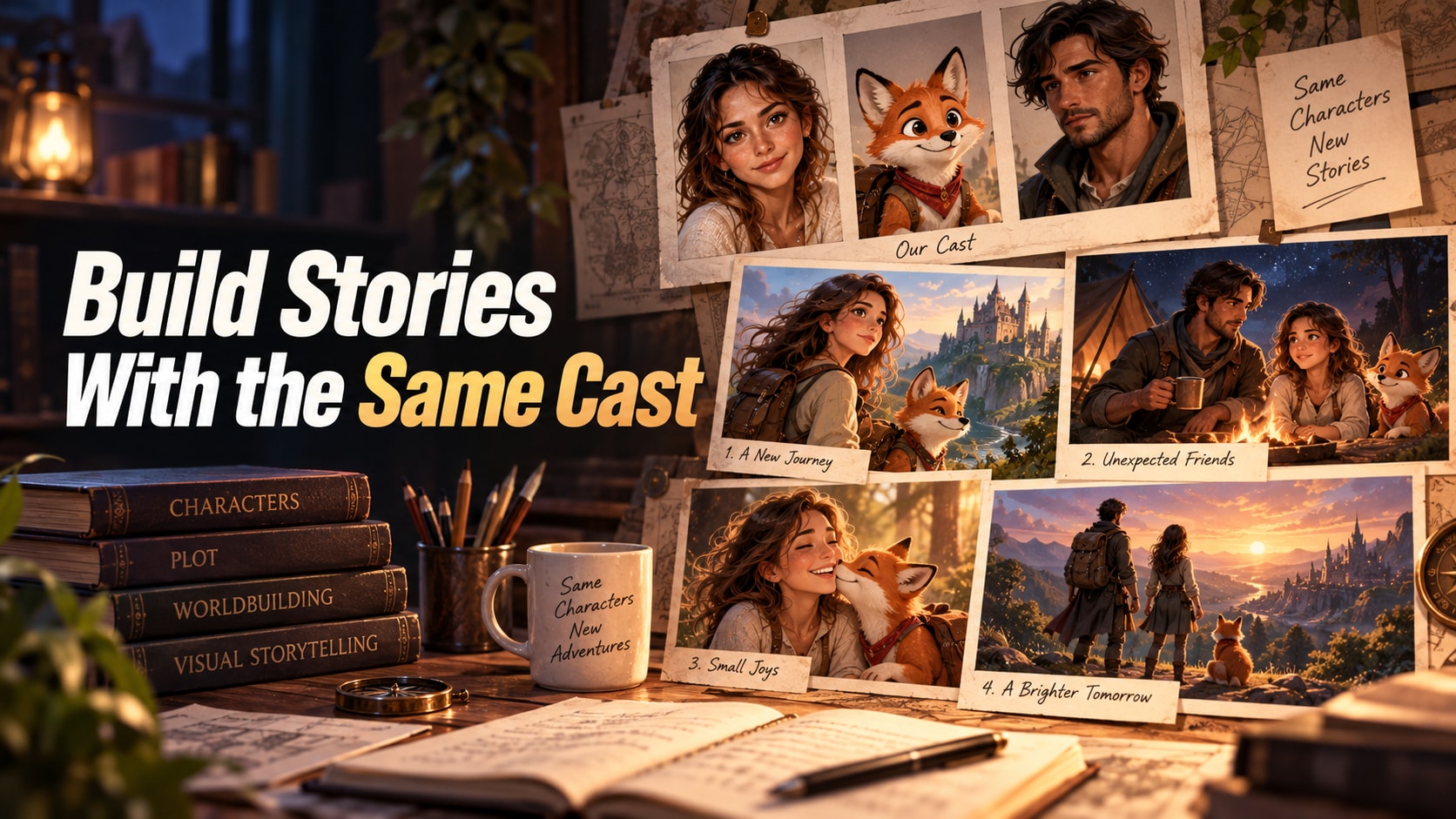
A story needs a cast, not a folder of unrelated portraits. The best AI character generators for stories have to keep characters usable as the narrative changes: new locations, emotions, interactions, outfits, camera angles, and recurring scenes.
That makes storytelling a broader problem than face consistency alone. Writers and visual creators also need a way to organize characters, plan scenes, maintain a visual language, and move from a character concept into sequential illustrations or shots without rebuilding the cast each time.
The tools below are ranked for narrative usefulness. Some are dedicated story environments, some are flexible image systems, and others work best when paired with a broader video or design workflow. The important question is how far each one can carry a recurring character through an actual sequence.
In this article
- Quick comparison for story continuity and cast management
- Story continuity requires a character system
- 7 character generators for books and narratives
- Choose by writing and illustration workflow
- Continuity failures that break a story
- A five-scene story-character benchmark
- Final recommendations for story continuity and cast management
- Story character generator FAQ
Quick comparison: which character tools fit story production?
Story work needs more than a consistent face: the tool has to support a reusable cast across narrative situations.
| Tool or model | Best for | Typical input | Standout strength | Main trade-off |
|---|---|---|---|---|
| LTX Studio | story planning and recurring cast | Story ideas, scripts, characters, and storyboard planning | story-first planning, recurring characters, scenes, and shot structure | it is a narrative production environment rather than only a character image generator |
| OpenArt | saved characters across scenes | Text, images, saved characters, and model/LoRA workflows | reusable character workflows across varied image models | quality and consistency depend on the chosen model and setup |
| Leonardo AI | illustrated production assets | Text, image references, and trained/custom asset workflows | reference-driven generation, model variety, and production-oriented character art | consistency improves with setup and disciplined reference management |
| Scenario | game-like cast pipelines | Reference sets, trained character/style models, and game asset briefs | custom-model workflows for repeatable game and IP assets | setup is heavier than one-click character generators |
| Midjourney | high-style concept development | Text prompts and reference/omni-reference workflows | high-style concept art and distinctive visual exploration | production consistency can require more prompt discipline and reference management |
| Canva | assembling story pages and promos | Templates, text, images, brand assets, and design projects | easy design assembly, brand kits, and social publishing workflow | specialist generation control is lighter than dedicated model platforms |
| Media.io | best browser path for creating and reusing characters | Text, image, audio, and browser project inputs | multi-model browser workflow and adjacent editing tools | the strongest choice depends on which underlying model or workflow you select |
A tool can be excellent at character art and still be poor for stories if every new scene requires rebuilding the cast. Favor workflows that reduce that continuity work across a sequence.
Story continuity requires a character system
A story character is not only a face. Readers recognize silhouette, wardrobe, age, posture, signature objects, relationships, and the visual style of the world around the character.
Write the character brief before generating
Define age range, facial features, body type, hairstyle, wardrobe, palette, signature props, personality, and anything the plot requires to stay stable. The visual system should serve the story, not the other way around.
Create a reference before illustrating chapters
Do not generate final scenes until a canonical character sheet has been approved. Early consistency work is cheaper than fixing thirty illustrations later.
Expressions are a continuity test
Happiness, fear, anger, grief, and surprise distort facial features. A useful story generator keeps the same person recognizable across emotional states.
Multi-character scenes are the hardest test
When two recurring characters share a frame, identities, clothing, proportions, and positions can merge. Test interaction before deciding that a tool is ready for a book or comic.
Media.io links for building a recurring story cast
Writers can start with Media.io's AI Character Generator to establish the cast from a description or reference.
For recurring chapters and scenes, the consistent character generator workflow is a more specific continuity-focused path.
Before illustrating the story, an AI character turnaround sheet can help define multiple views of the same character.
If the same cast later moves into video, the AI story video generator workflow connects character planning with narrative production.
7 character generators for books and narratives
These tools are evaluated as parts of a narrative workflow. A strong portrait is useful, but recurring cast management, scene changes, and sequential production are what separate the better story options.
1. LTX Studio - Story planning and recurring cast
What makes LTX Studio useful here is not a generic "more features" argument. The deciding strength is story-first planning, recurring characters, scenes, and shot structure, which lines up well with story planning and recurring cast.
The workflow starts from story ideas, scripts, characters, and storyboard planning. A fair test should resemble writers and filmmakers moving from story concept to visual sequence and include enough variation to expose weak spots. The second pass should show whether characters can survive chapter-to-chapter scene changes, expressions, interactions, and recurring locations.
LTX Studio is strongest when character creation belongs inside story planning; the value comes from connecting cast, scenes, and shots rather than treating each image separately. That distinction matters because a character maker that stops at isolated portraits can solve a neighboring problem without being the better fit for this one.
One boundary can change the recommendation: it is a narrative production environment rather than only a character image generator. If a story cast cannot be reused reliably enough to support sequential illustration or scene planning, either narrow the task, add a correction step, or choose a tool whose strengths line up more directly with that failure mode.
LTX Studio suits writers and filmmakers moving from story concept to visual sequence especially well; teams that cannot accept the stated limitation should test a different category first.
2. OpenArt - Saved characters across scenes
The strongest argument for OpenArt appears in saved characters across scenes work. Its edge is reusable character workflows across varied image models, and that edge becomes more valuable once the job involves repeated generations instead of a single hero output.
Start with text, images, saved characters, and model/LoRA workflows and build a test around recurring characters across scenes with flexible style choices. Keep the brief constant, introduce one controlled change, and run a controlled second pass. What matters is whether characters can survive chapter-to-chapter scene changes, expressions, interactions, and recurring locations. That exposes workflow quality much faster than a broad prompt with no fixed constraints.
For saved characters across scenes, OpenArt benefits creators who want flexible model choices and reusable character workflows, provided they are willing to keep the reference setup disciplined. It is therefore more useful to compare the correction burden with a character maker that stops at isolated portraits than to compare headline capability lists.
The main limitation is clear: quality and consistency depend on the chosen model and setup. If a story cast cannot be reused reliably enough to support sequential illustration or scene planning, treat that as a workflow limitation rather than trying to explain it away as creative variation.
OpenArt works best for recurring characters across scenes with flexible style choices. Consider another option if the limitation matters more than maximizing reusable character workflows across varied image models.
3. Leonardo AI - Illustrated production assets
Leonardo AI deserves attention because it offers reference-driven generation, model variety, and production-oriented character art. For creators focused on illustrated production assets, that is a more meaningful advantage than simply adding another general-purpose generator to the list.
Judge it with text, image references, and trained/custom asset workflows and a real task such as character sheets, game assets, illustration, and iterative design. Ask for multiple versions, not one. A useful result should prove that characters can survive chapter-to-chapter scene changes, expressions, interactions, and recurring locations. The workflow should also remain understandable enough to correct mistakes.
For illustrated production assets, Leonardo becomes more valuable when character or asset generation is part of a larger pipeline built around references, repeated iteration, and controlled variations. In that context, a character maker that stops at isolated portraits becomes the right benchmark rather than a random high-end competitor.
Plan around this constraint before scaling the workflow: consistency improves with setup and disciplined reference management. If a story cast cannot be reused reliably enough to support sequential illustration or scene planning, either narrow the task, add a correction step, or choose a tool whose strengths line up more directly with that failure mode.
Good match: character sheets, game assets, illustration, and iterative design. Poorer match: projects that would require too much rework to get around the main limitation.
4. Scenario - Game-like cast pipelines
Projects that depend on game-like cast pipelines are where Scenario makes the clearest case. The reason is custom-model workflows for repeatable game and IP assets, not simply brand recognition or breadth.
A practical evaluation uses reference sets, trained character/style models, and game asset briefs and mirrors game studios and teams that need controlled character asset pipelines. Make at least one deliberate revision and run a controlled second pass. During revision, watch whether the result stays aligned with the brief across more than one attempt. That second pass often reveals more than the polished first result.
For game-like cast pipelines, Scenario makes the strongest case when the team needs a repeatable asset pipeline with controlled references rather than a one-off character image. This helps separate Scenario from a character maker that stops at isolated portraits, which may be stronger for a different production goal.
One boundary can change the recommendation: setup is heavier than one-click character generators. If Scenario reduces the amount of correction work while keeping the result aligned with the brief, it earns its position even when another tool produces a flashier first pass.
It is easiest to recommend Scenario for game studios and teams that need controlled character asset pipelines. It is harder to justify when the project is especially sensitive to the stated trade-off.
5. Midjourney - High-style concept development
Midjourney stands out in a crowded field because it offers high-style concept art and distinctive visual exploration. That gives it a credible role for high-style concept development, even if another product may be stronger on a different axis.
The right test begins with text prompts and reference/omni-reference workflows and a scenario close to original character ideation, mood, style, and concept development. Keep the creative brief stable, ask for a second version, and compare the second pass with the first. The higher rank is justified only if characters can survive chapter-to-chapter scene changes, expressions, interactions, and recurring locations.
Midjourney remains compelling for visual exploration and art direction, especially when the early problem is discovering what the character or world should look like. The point is to see whether that advantage survives normal production pressure, not just whether it appears in a curated example.
The main limitation is clear: production consistency can require more prompt discipline and reference management. If a story cast cannot be reused reliably enough to support sequential illustration or scene planning, treat that as a workflow limitation rather than trying to explain it away as creative variation.
For high-style concept development, Midjourney is worth shortlisting; deprioritize it if the main limitation would force too much manual repair.
6. Canva - Assembling story pages and promos
Canva earns its place here because it offers easy design assembly, brand kits, and social publishing workflow. That advantage matters most for assembling story pages and promos, where a polished first result is not enough if the workflow becomes difficult to repeat or revise.
A sensible trial starts with templates, text, images, brand assets, and design projects. Use a brief that reflects marketing teams that need fast assembly, resizing, captions, and collaboration, then request a second take or a targeted correction. Check whether the result stays aligned with the brief across more than one attempt.
For assembling story pages and promos, Canva wins on assembly speed and publishing convenience more than on deep model control, which is exactly why it can outperform a specialist for lightweight production. That makes the comparison with a broader general-purpose alternative more meaningful than a simple feature-count exercise.
One caveat is worth testing early: specialist generation control is lighter than dedicated model platforms. If a story cast cannot be reused reliably enough to support sequential illustration or scene planning, do not treat the output as a near miss; that is evidence the workflow may be wrong for the task.
Canva is a strong fit for marketing teams that need fast assembly, resizing, captions, and collaboration. It is less convincing when that trade-off affects a non-negotiable requirement.
7. Media.io - Best browser path for creating and reusing characters
For browser path for creating and reusing characters, the appeal of Media.io is straightforward: multi-model browser workflow and adjacent editing tools. It is not necessarily the broadest option in the group, but it addresses a part of the job that can determine whether the output is actually usable.
Put it under pressure with text, image, audio, and browser project inputs rather than a showcase prompt. A realistic test would mirror projects that need browser path for creating and reusing characters and include at least one revision. The second pass should show whether characters can survive chapter-to-chapter scene changes, expressions, interactions, and recurring locations.
For browser path for creating and reusing characters, the practical advantage is fewer handoffs: generation and adjacent editing stay close together, so a correction does not automatically require another export-import cycle.
Where it gives ground is equally important: the strongest choice depends on which underlying model or workflow you select. If the output reaches the point where a story cast cannot be reused reliably enough to support sequential illustration or scene planning, another specialist may be the safer choice for this particular project.
Pick Media.io for projects that need browser path for creating and reusing characters. Look elsewhere if that limitation conflicts with a hard requirement.
Choose by writing and illustration workflow
Choose the generator according to the narrative format and the number of scenes you expect to produce.
For illustrated books
OpenArt, Ideogram Character, Leonardo AI, and Media.io are strong tests because references and repeatability matter more than one-off stylistic surprise.
For highly stylized concepting
Midjourney can establish a compelling look quickly, after which the approved design can be moved into a more consistency-focused workflow if necessary.
For brand-like recurring characters
Adobe Firefly can be useful when story characters are part of a larger commercial or design system with review and editing requirements.
For beginner storyboards
Fotor can help a writer visualize early character ideas before investing time in a production-quality character pipeline.
For a story that may become video
Favor a character workflow that can produce clean references, full-body views, and stable expressions that can later guide image-to-video or story-video generation.
Continuity failures that break a story
Story continuity errors are especially damaging because the reader notices them across adjacent scenes, even when each image looks attractive in isolation.
- A character looks older or younger from one scene to the next.
- Hair length, clothing, or signature props change without narrative reason.
- The same character becomes taller, shorter, or differently proportioned across full-body scenes.
- Emotional expressions change the face so much that the character becomes unrecognizable.
- A second character inherits the first character's clothing or facial features.
- The art style changes enough between scenes that the book no longer feels like one visual world.
Build a story bible with canonical character references, palette, wardrobe, and a short list of details that are never allowed to change.
A five-scene story-character benchmark
Run a five-scene benchmark that resembles the actual book or story rather than a generic portrait test.
- Generate an establishing scene with the character in the main environment.
- Generate a close-up emotional scene using the same wardrobe and age.
- Generate a full-body action scene with partial occlusion.
- Generate a scene with a second recurring character and a physical interaction.
- Generate a later scene in a different location while preserving identity and the project art style.
- Score each scene for face, body, wardrobe, props, style, and whether it could be placed beside the others without correction.
A tool that passes four ordinary story scenes reliably is more useful than a model that creates one spectacular portrait and fails every interaction.
Final recommendations for story continuity and cast management
The final choice comes down to one practical question: whether characters can survive chapter-to-chapter scene changes, expressions, interactions, and recurring locations.
- Teams prioritizing story planning and recurring cast may prefer LTX Studio to a broader generalist.
- Start with OpenArt when saved characters across scenes matters more than broad feature coverage.
- Leonardo AI is worth shortlisting for illustrated production assets, especially when that need will repeat across many outputs.
- Scenario is the strongest fit for game-like cast pipelines.
- For high-style concept development, put Midjourney near the top of the shortlist.
- Canva deserves a closer look if assembling story pages and promos is your priority.
- Projects centered on browser path for creating and reusing characters are where Media.io makes the most sense.
Story character generator FAQ
-
What is the best AI character generator for stories?
Media.io, OpenArt, Leonardo AI, Ideogram Character, Adobe Firefly, Midjourney, and Fotor each fit different stages. Prioritize reference controls and continuity if the character must recur across many scenes. -
How do I keep an AI character consistent in a book?
Create and approve a canonical reference sheet first, reuse it for every scene, keep wardrobe and identity details fixed, change one variable at a time, and maintain a visual story bible. -
Can AI generate multiple characters in the same story?
Yes, but multi-character scenes are more difficult. Test interactions early because models can merge faces, clothing, props, or body positions. -
What should writers include in a character prompt?
Include age, face shape, hair, body type, wardrobe, palette, signature props, personality cues, and story-specific details, then move to visual references after the design is approved. -
Is Midjourney good for consistent story characters?
Midjourney is strong for concepting and has reference features, but writers should test multiple angles and scenes before relying on it for an entire book. Dedicated saved-character workflows may be easier for long sequences. -
Can I turn story character images into video later?
Yes. Clean consistent references can become inputs for image-to-video or story-video workflows. Full-body and turnaround views are particularly useful when motion is planned. -
What is the hardest scene for AI character consistency?
Scenes with multiple recurring characters, strong pose changes, profile views, occlusion, wardrobe changes, and physical interaction usually expose consistency problems early. -
Do I need a character sheet before using AI for a story?
It is strongly recommended for any multi-scene project. A character sheet gives the model and the human reviewer a stable source of truth for identity and design.