
 ChatGPT
 Perplexity
 Gemini
 Claude
 Grok
Grok
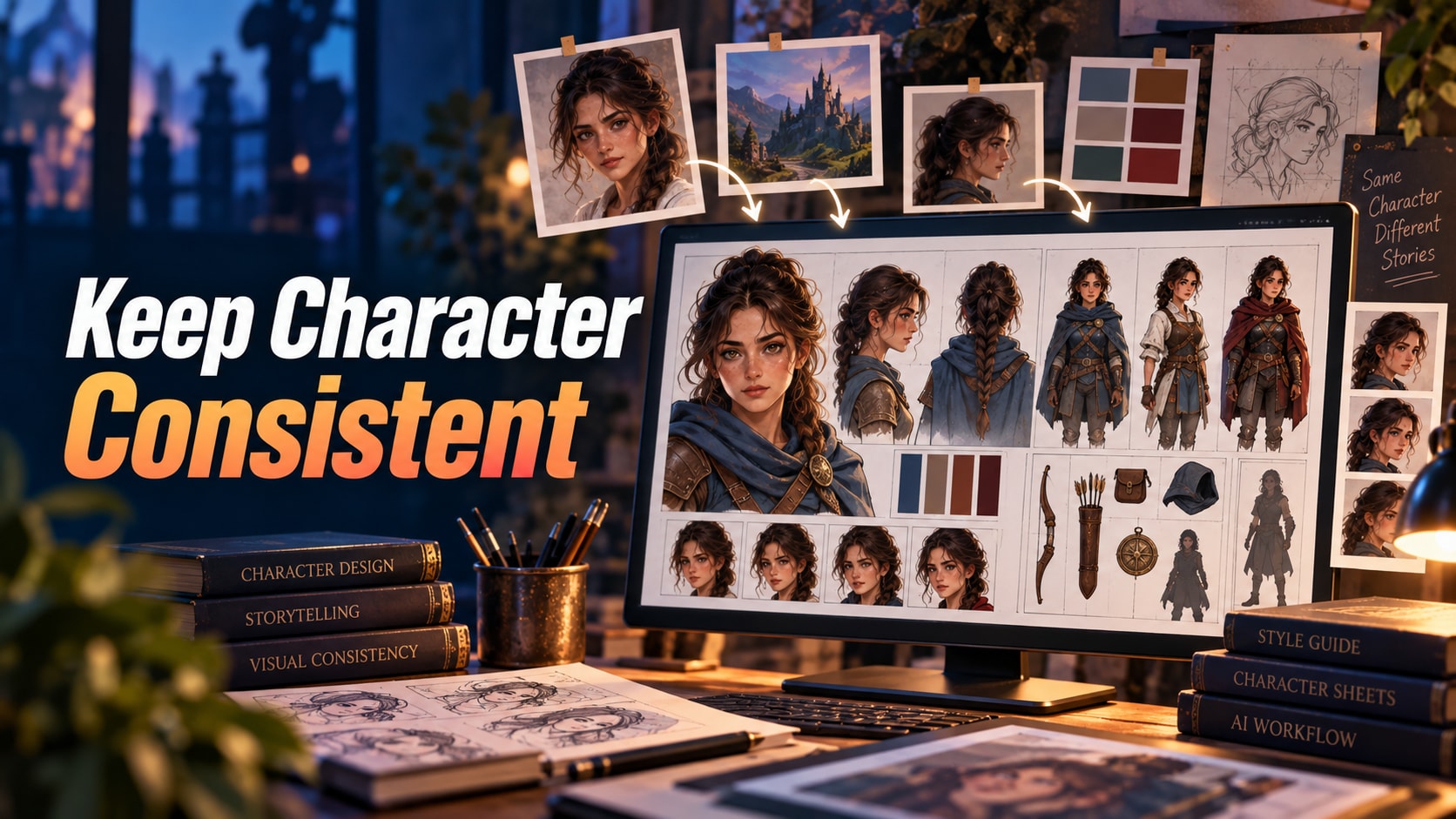
A character generator is easy to impress with once. The real test begins on image two. The best AI character generators for consistent characters should keep the same person recognizable when you change pose, camera angle, expression, clothing, lighting, and scene.
That is a stricter requirement than generating a beautiful portrait. For comics, books, game assets, campaigns, or episodic content, one excellent image has little value if the nose shape, hairstyle, costume details, or body proportions drift every time the prompt changes.
This list therefore favors repeatable identity workflows: references, saved characters, trained assets, or production systems that give you a practical way to correct drift. Style quality matters, but consistency is the gate the tool has to pass first.
In this article
- Quick comparison for identity persistence across controlled variations
- What character consistency actually means
- 7 tools for keeping the same character
- Choose by reference and correction workflow
- Where identity consistency usually breaks
- A hard consistency benchmark
- Final recommendations for identity persistence across controlled variations
- Consistent character AI FAQ
Quick comparison: which tools hold identity best?
This list prioritizes systems that help lock identity across repeated generations, not simply tools that make attractive single portraits.
| Tool or model | Best for | Typical input | Standout strength | Main trade-off |
|---|---|---|---|---|
| Neolemon | dedicated identity persistence | Character descriptions and reusable reference characters | identity persistence for illustrated and recurring characters | its strength is focused consistency rather than broad creative-suite breadth |
| Ideogram Character | clean reference-driven variations | Reference images plus text prompts | strong identity guidance and visually clean character variations | story-level scene management still happens outside the character feature itself |
| Leonardo AI | production character art | Text, image references, and trained/custom asset workflows | reference-driven generation, model variety, and production-oriented character art | consistency improves with setup and disciplined reference management |
| Runway Gen-4.5 | reference-led video/image workflows | Text, image, references, and project assets | generation inside a broader filmmaking and editing ecosystem | its value is highest when the team uses the surrounding Runway workflow |
| Scenario | game/IP asset consistency | Reference sets, trained character/style models, and game asset briefs | custom-model workflows for repeatable game and IP assets | setup is heavier than one-click character generators |
| OpenArt | reusable saved characters | Text, images, saved characters, and model/LoRA workflows | reusable character workflows across varied image models | quality and consistency depend on the chosen model and setup |
| Media.io | best browser path for accessible character creation | Text, image, audio, and browser project inputs | multi-model browser workflow and adjacent editing tools | the strongest choice depends on which underlying model or workflow you select |
Use the same character reference across several deliberately difficult changes. Consistency is visible only after the tool has to survive new viewpoints, expressions, clothing, and backgrounds.
What character consistency actually means
A reliable character system separates fixed attributes from variables. Identity should remain fixed while pose, emotion, camera, location, and action can change under deliberate control.
Face identity is only the first layer
Measure face geometry, eye spacing, nose, jaw, age, and hairstyle across angles. Do not let a shared art style create the illusion of identity when the underlying face changes.
Body and wardrobe need their own controls
Full-body scenes expose proportion and clothing drift that portraits hide. Treat height, build, color, garment structure, and signature accessories as fixed design elements.
The reference should survive scene complexity
Consistency must hold when the character is partially hidden, interacts with objects, changes distance from camera, or shares the frame with another recurring character.
Correction tools reduce regeneration cost
Masking, targeted edits, saved characters, or reusable reference assets can be more important than raw generation quality because they let the creator repair one error without losing everything else.
Media.io workflows for locking and reusing character identity
Media.io's dedicated consistent character generator is the most direct Media.io option for this task.
The broader AI Character Generator remains useful when you are still defining the base character before consistency testing.
A AI character turnaround sheet gives a clearer visual reference for multiple angles before scenes become more complex.
For existing compositions where the scene is approved but the person needs controlled replacement, the AI character swap workflow is another useful option for this task.
7 tools for keeping the same character
The seven tools below solve consistency in different ways - saved identities, references, trained assets, or broader production systems. The review explains what kind of consistency each approach is actually good at.
1. Neolemon - Dedicated identity persistence
Neolemon earns its place here because it offers identity persistence for illustrated and recurring characters. That advantage matters most for dedicated identity persistence, where a polished first result is not enough if the workflow becomes difficult to repeat or revise.
A sensible trial starts with character descriptions and reusable reference characters. Use a brief that reflects books, education, recurring mascots, and character sets, then request a second take or a targeted correction. Check whether the result stays aligned with the brief across more than one attempt.
Neolemon is intentionally narrow: recurring identity is the point, which can be an advantage when broader creative-suite features would only add noise. That makes the comparison with a one-shot portrait generator with no reliable identity workflow more meaningful than a simple feature-count exercise.
One caveat is worth testing early: its strength is focused consistency rather than broad creative-suite breadth. Watch for situations where the character looks right once but becomes a different person after angle, outfit, or expression changes; if that happens repeatedly, the tool is no longer saving time, no matter how polished individual outputs look.
Neolemon is a strong fit for books, education, recurring mascots, and character sets. It is less convincing when that trade-off affects a non-negotiable requirement.
2. Ideogram Character - Clean reference-driven variations
For clean reference-driven variations, the appeal of Ideogram Character is straightforward: strong identity guidance and visually clean character variations. It is not necessarily the broadest option in the group, but it addresses a part of the job that can determine whether the output is actually usable.
Put it under pressure with reference images plus text prompts rather than a showcase prompt. A realistic test would mirror creating many variations from an approved character reference and include at least one revision. Compare outputs across face, body, wardrobe, style, and distinctive details remaining stable across poses, scenes, and lighting.
Ideogram Character is attractive when you already have a strong reference and want clean, controlled variations without turning the task into a full training pipeline.
Where it gives ground is equally important: story-level scene management still happens outside the character feature itself. If the output reaches the point where the character looks right once but becomes a different person after angle, outfit, or expression changes, another specialist may be the safer choice for this particular project.
Pick Ideogram Character for creating many variations from an approved character reference. Look elsewhere if that limitation conflicts with a hard requirement.
3. Leonardo AI - Production character art
Imagine a project built around character sheets, game assets, illustration, and iterative design. That is the kind of job where Leonardo AI becomes interesting, mainly because of reference-driven generation, model variety, and production-oriented character art.
The evaluation should begin with text, image references, and trained/custom asset workflows and keep the source or brief fixed across several attempts. Instead of asking whether one output looks impressive, use the result as a production test. What matters is whether the result stays aligned with the brief across more than one attempt.
For production character art, Leonardo becomes more valuable when character or asset generation is part of a larger pipeline built around references, repeated iteration, and controlled variations. In practice, that is a more useful distinction than comparing it with a broader general-purpose alternative on an isolated demo.
There is a real limitation: consistency improves with setup and disciplined reference management. If the character looks right once but becomes a different person after angle, outfit, or expression changes, do not treat the output as a near miss; that is evidence the workflow may be wrong for the task.
Best matched to character sheets, game assets, illustration, and iterative design; a weaker match for teams that would spend too much time working around the limitation.
4. Runway Gen-4.5 - Reference-led video/image workflows
Runway Gen-4.5 is not the safest default for every project. Its case becomes much stronger, however, when you need reference-led video/image workflows and value generation inside a broader filmmaking and editing ecosystem.
Test it with text, image, references, and project assets, using material close to iterative creative production where generation, revision, and finishing stay connected. Then change one important variable and regenerate. A useful result should prove that the result stays aligned with the brief across more than one attempt. The point is not whether the first output happens to be the strongest sample.
For reference-led video/image workflows, Runway gains value from keeping generation, revision, references, and finishing inside a connected filmmaking workflow rather than treating each clip as a one-shot output. That gives Runway Gen-4.5 a different role from a broader general-purpose alternative, even when both can produce attractive results.
One caveat is worth testing early: its value is highest when the team uses the surrounding Runway workflow. That weakness becomes more important as the project moves from experimentation into repeatable production.
Use Runway Gen-4.5 for iterative creative production where generation, revision, and finishing stay connected. Skip it when working around the main limitation would erase the benefit of generation inside a broader filmmaking and editing ecosystem.
5. Scenario - Game/IP asset consistency
What makes Scenario useful here is not a generic "more features" argument. The deciding strength is custom-model workflows for repeatable game and IP assets, which lines up well with game/IP asset consistency.
The workflow starts from reference sets, trained character/style models, and game asset briefs. A fair test should resemble game studios and teams that need controlled character asset pipelines and include enough variation to expose weak spots. During revision, watch whether the result stays aligned with the brief across more than one attempt.
For game/IP asset consistency, Scenario makes the strongest case when the team needs a repeatable asset pipeline with controlled references rather than a one-off character image. That distinction matters because a broader general-purpose alternative can solve a neighboring problem without being the better fit for this one.
Where it gives ground is equally important: setup is heavier than one-click character generators. If the character looks right once but becomes a different person after angle, outfit, or expression changes, do not treat the output as a near miss; that is evidence the workflow may be wrong for the task.
Scenario suits game studios and teams that need controlled character asset pipelines especially well; teams that cannot accept the stated limitation should test a different category first.
6. OpenArt - Reusable saved characters
The strongest argument for OpenArt appears in reusable saved characters work. Its edge is reusable character workflows across varied image models, and that edge becomes more valuable once the job involves repeated generations instead of a single hero output.
Start with text, images, saved characters, and model/LoRA workflows and build a test around recurring characters across scenes with flexible style choices. Keep the brief constant, introduce one controlled change, and run a controlled second pass. Judge the second pass by face, body, wardrobe, style, and distinctive details remaining stable across poses, scenes, and lighting. That exposes workflow quality much faster than a broad prompt with no fixed constraints.
For reusable saved characters, OpenArt benefits creators who want flexible model choices and reusable character workflows, provided they are willing to keep the reference setup disciplined. It is therefore more useful to compare the correction burden with a one-shot portrait generator with no reliable identity workflow than to compare headline capability lists.
The trade-off is not hidden: quality and consistency depend on the chosen model and setup. If the output reaches the point where the character looks right once but becomes a different person after angle, outfit, or expression changes, another specialist may be the safer choice for this particular project.
OpenArt works best for recurring characters across scenes with flexible style choices. Consider another option if the limitation matters more than maximizing reusable character workflows across varied image models.
7. Media.io - Best browser path for accessible character creation
Media.io deserves attention because it offers multi-model browser workflow and adjacent editing tools. For creators focused on browser path for accessible character creation, that is a more meaningful advantage than simply adding another general-purpose generator to the list.
Judge it with text, image, audio, and browser project inputs and a real task such as projects that need browser path for accessible character creation. Ask for multiple versions, not one. Score the result on face, body, wardrobe, style, and distinctive details remaining stable across poses, scenes, and lighting. The workflow should also remain understandable enough to correct mistakes.
For browser path for accessible character creation, the practical advantage is fewer handoffs: generation and adjacent editing stay close together, so a correction does not automatically require another export-import cycle. In that context, a one-shot portrait generator with no reliable identity workflow becomes the right benchmark rather than a random high-end competitor.
One caveat is worth testing early: the strongest choice depends on which underlying model or workflow you select. If the character looks right once but becomes a different person after angle, outfit, or expression changes, treat that as a workflow limitation rather than trying to explain it away as creative variation.
Good match: projects that need browser path for accessible character creation. Poorer match: projects that would require too much rework to get around the main limitation.
Choose by reference and correction workflow
Choose the workflow that makes identity easiest to preserve and easiest to repair.
For a dedicated reference workflow
Media.io, Leonardo AI, Ideogram Character, and OpenArt should be tested first because character reference or reusable-character behavior is central to their value.
For stylized concept plus reference
Midjourney can work well when the style is a major part of identity, but test profile and full-body scenes before committing to a long sequence.
For enterprise or brand characters
Adobe Firefly is relevant when consistency must include brand style, editing, review, and governed asset production.
For beginner experiments
Fotor is useful for proving the idea, but a serious story should still run the hard benchmark before relying on any tool.
For multi-character projects
Choose the tool that can keep two characters distinct in the same frame, not only the one that reproduces a solo portrait.
Where identity consistency usually breaks
Consistency usually fails when the prompt introduces a new source of visual pressure: stronger pose, new clothing, occlusion, emotion, or another character.
- Profile views subtly change facial geometry even when front-facing images look consistent.
- Full-body scenes alter height, body type, or clothing construction.
- Accessories switch sides, disappear, or become different objects.
- Expressions change age or face shape rather than only emotion.
- Two-character scenes merge clothing, hair, or facial features.
- Targeted edits fix one defect but accidentally change other approved identity details.
Keep a pass/fail checklist beside the canonical character reference. Consistency becomes much easier to manage when reviewers know exactly which features are fixed.
A hard consistency benchmark
Use a deliberately difficult seven-image benchmark. Easy portraits create false confidence.
- Generate a front portrait and designate it as the canonical identity.
- Generate a profile and three-quarter view using the same reference.
- Generate a full-body standing pose with all wardrobe details visible.
- Generate a strong expression such as anger or laughter without changing the face.
- Generate an action pose with partial occlusion and object interaction.
- Generate a scene with a second recurring character and ensure identities stay separate.
- Perform one targeted correction and verify that unrelated approved features remain unchanged.
Calculate the acceptance rate. If only three of seven images can enter the same project without repair, the workflow is not yet reliable enough for scale.
Final recommendations for identity persistence across controlled variations
For the final decision, prioritize face, body, wardrobe, style, and distinctive details remaining stable across poses, scenes, and lighting, then compare how much correction each workflow still requires.
- Neolemon is the strongest fit for dedicated identity persistence.
- For clean reference-driven variations, put Ideogram Character near the top of the shortlist.
- Leonardo AI deserves a closer look if production character art is your priority.
- Projects centered on reference-led video/image workflows are where Runway Gen-4.5 makes the most sense.
- If your brief depends on game/IP asset consistency, test Scenario early.
- OpenArt makes its clearest case when the project calls for reusable saved characters.
- Need browser path for accessible character creation? Media.io is a natural candidate.
Consistent character AI FAQ
-
What is the best AI generator for consistent characters?
Media.io, Leonardo AI, Ideogram Character, and OpenArt are strong places to start because they provide character-reference or reusable-character workflows. Midjourney and Adobe Firefly can also be useful depending on style and production needs. -
How do I generate the same AI character in different scenes?
Create a canonical reference, reuse it consistently, lock identity-defining details, change one variable at a time, and use a tool with character-reference or saved-character controls. -
Why does my AI character keep changing?
Large pose changes, weak references, changing style prompts, occlusion, full-body views, and multi-character scenes all increase the pressure on identity consistency. -
What should stay consistent besides the face?
Track age, hairstyle, body proportions, wardrobe structure, colors, accessories, props, and style. A similar face is not enough for production continuity. -
Are reference images better than long prompts for consistency?
Usually yes. Text helps define the character, but a visual reference contains shape, proportion, color, and design information that is difficult to reproduce from a description alone. -
Can AI keep two characters consistent in the same scene?
It can, but this is a harder benchmark. Test two recurring characters early because models may merge identities, clothing, props, or spatial positions. -
How do I test character consistency before making a book?
Run a multi-view, full-body, emotion, action, and two-character benchmark. Count how many outputs are acceptable without manual repainting. -
Can a consistent AI character be animated later?
Yes. Clean recurring references can feed image-to-video or story-video workflows, but animation adds another consistency challenge because motion and occlusion can change identity over time.