
You drop a product link in hoping the tool will turn the page into ads you can actually test. Then the price is wrong, the colorway is swapped, or the script invents a benefit the listing never made. If you are comparing the best URL to video ad generators, you do not need a prettier template. You need ads that still match the live page.
I ranked Media.io, Creatify, Arcads, Predis.ai, InVideo AI, Pippit, Superads, and AdCreative.ai on a practical question: after you paste one real product URL, can you walk away with a labeled batch you would actually spend against? Accurate facts and fast variants come first. Pretty footage comes second.
In this article
- What Breaks When a Product URL Becomes a Video Ad
- Best URL to Video Ad Generators by Extraction Job
- 8 Tools That Turn a Product Link Into Testable Ads
- The URL Integrity and Variant Velocity Test
- When a Website-to-Video Ad Generator Is the Wrong Starting Point
- How to Choose a Product Link to Video Ad Workflow
- Final Recommendations for URL to Ad Generators
- URL to Video Ad Generator FAQ
What Breaks When a Product URL Becomes a Video Ad
The easy miss is assuming the generator read the page just because it grabbed a title. It can still skip the price, pick the wrong variant photo, or write a claim you cannot defend. That is when paid social starts spending on a story merchandising never approved.
URL-to-ad systems fail in four places that look like creative problems until you inspect the source page:
- Offer drift: price, discount, shipping, or bundle language does not match the live listing.
- SKU mixup: the video shows a color, size, or accessory that is not the advertised item.
- Claim invention: the script adds clinical, ranking, or guarantee language the page does not support.
- Shot mismatch: extracted images are lifestyle crops, watermarks, or out-of-date packshots.
If those four checks fail, hook testing is wasted. The job of a URL-to-video ad generator is to turn a product page into a testable ad set whose facts still match the URL after generation.
Best URL to Video Ad Generators by Extraction Job
Not every tool that accepts a URL is doing the same job. Some extract merchandising fields. Some treat the URL as a brief for a presenter. Some only need the link as a seed for social posts. Route the tool by the extraction job, not by the marketing category.
| Tool | Extraction job | Best output | Standout strength | Skip when |
|---|---|---|---|---|
| Media.io | Product URL, product images, or both | Image ads and short video ads | Browser workflow with Auto or Guided video modes | You need a native mobile ad OS, not a browser generator |
| Creatify | Product page to scripts, shots, and variants | URL-driven video ads | Paste-a-link production speed | The live page is thin, gated, or factually messy |
| Arcads | Product brief to actor-led UGC | Creator-style product ads | Actor library and product interaction | You need packshot-faithful motion, not a presenter |
| Predis.ai | URL or product info to social creatives | Feed, story, and caption sets | Calendar-friendly social volume | The KPI is paid-video testing, not social posting |
| InVideo AI | URL, prompt, or script to assembled video | Narrated marketing videos | Script, media, voice, and captions in one draft | You need strict SKU-accurate product footage |
| Pippit | Links and catalog assets into commerce content | High-volume product content | Commerce automation after ingest | You only need one PDP turned into one ad |
| Superads | Known product into many ad variations | Hook and format variants | Variation after product identity is settled | The URL still has not been extracted cleanly |
| AdCreative.ai | Creative generation and scoring for paid social | Scored ad concepts | Performance-oriented creative ranking | The bottleneck is PDP extraction, not creative scoring |
Use the table to pick a job family. A URL-to-ad extractor, a UGC actor studio, and a scored creative engine can all ingest a link and still produce incompatible outputs.
8 Tools That Turn a Product Link Into Testable Ads
The reviews below start from the URL moment. Each tool is included because it can turn product-page information into ads, but the workflow after paste is different. Read the pass and skip gates before comparing demo quality.
Media.io
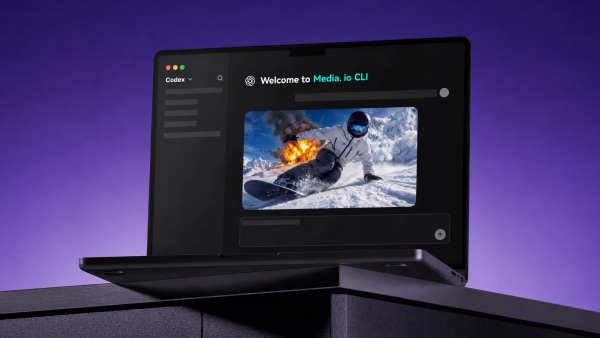
If you have a product link and also some packshots you already trust, start here. Media.io belongs on this list because the AI ad generator creates image and video ads from product URLs, product images, or both. That dual input matters when the live page is messy but the brand already has approved stills.
Image ads can go up to 4K, with up to four images per generation. Video ads go up to 30 seconds and 1080p, with Auto Mode or Guided Mode. The product supports 12 languages and several character paths: presets, a character library, device upload, or AI generation. Those controls are the reason Media.io fits teams that need a browser workflow from a product link without jumping into a native ad OS.
The honest limit is QA. Generated product details, spoken claims, and character behavior still need a human check against the live URL. Media.io is not a substitute for merchandising review. It is a fast way to turn a product page and approved images into ad drafts you can inspect.
For Shopify-heavy catalogs, the same stack has a Shopify ad maker path. Use it when the URL is a store listing and the next job is ad variants, not a cinematic demo film.
Creatify
If the live product page is basically your only approved asset, Creatify is the closest match. It is built around pasting a link, pulling page information, drafting scripts, and generating product shots and variants.
The workflow advantage is speed from URL to a first ad set. The risk is the page itself. If the listing has stale images, incomplete specs, or aggressive marketing copy, Creatify will faithfully accelerate those problems into video. Treat the live URL as a production source, not as decoration.
Arcads
If the ad needs a person holding the product, Arcads is the better bet than a page scraper. Scripts, product briefs, and product media become creator-like ads. A URL can feed the brief, but you are choosing it for the actor, not the crawler.
Use it when the test is hook, face, and delivery rather than packshot fidelity. Product interaction still needs inspection. Hands, scale, and implied use can drift even when the script is accurate. Disclosure and advertising-policy review also sit with the advertiser, not the generator.
If the Media.io path is closer to your asset mix, the UGC ad generator is the long-tail option for creator-style drafts without leaving the browser stack.
Predis.ai
If what you actually need is a week of posts, Predis is a social calendar that also ingests URLs. It can turn a product page into feed creatives, captions, and scheduled posts. That is a different job from a paid-video test batch.
Do not force Predis into a paid-video testing role it was not built to own. The output family is social creative volume. If media buying needs labeled 15-second variants with locked claims, you will still need a video-ad specialist downstream.
InVideo AI
If you want a narrated marketing video assembled for you, InVideo starts from a brief. That is not the same as extracting a product page. A URL can be one input among prompt, script, and product information. The draft often includes narration, stock or generated media, and captions.
That assembly model is useful for explainers and offer videos. It is weaker when the product must remain photographically exact. Stock-assisted scenes can look finished while the item on screen is only a cousin of the SKU. Use InVideo when the URL is a briefing source, then inspect every product frame.
Pippit
If the product link is just one input into a lot of recurring commerce content, Pippit earns a slot. CapCut and ByteDance-adjacent commerce workflows are the context: catalog assets, product links, and recurring content volume. The value appears after ingest, when the team needs many product videos and social cuts rather than one hero ad.
For a single PDP test, Pippit can be heavier than the job. For a catalog that already has product URLs and needs ongoing creative, it is a better fit than a one-link generator.
Superads
If the product is already locked and you only need more hooks, Superads is the variation tool. Product-url and ad-variation workflows matter once extraction is clean and the team needs hook, format, and angle tests. Put Superads later in the stack, not at the first messy URL.
If the live page still disagrees with your offer sheet, Superads will multiply the disagreement. Lock product identity first, then use variation tools to change only the hook.
AdCreative.ai
If the bottleneck is no longer "what does this page say" but "which concept should get budget," AdCreative scores creatives for paid social. URL extraction is not its center of gravity. Generation plus scoring can help a media team rank concepts, but it will not repair a bad product page.
Keep AdCreative downstream of a source-of-truth URL check. Scoring a concept that contains an invented claim only makes the wrong ad more confident.
The URL Integrity and Variant Velocity Test
Do not judge these tools with a pretty demo URL. Use one live product page that your team actually sells, then measure whether the extractor preserves the page and whether the generator can produce a labeled test batch.
The URL Integrity and Variant Velocity Test uses the same PDP in every tool. Score extraction first. Only then score creative speed.
- Choose one live product URL with a visible price, at least two variants, shipping or return language, and two marketing claims.
- Save a screenshot of the page, the current price, the exact claim sentences, and the hero image set before anyone generates.
- Paste the same URL into each tool. Do not "help" the model with extra facts unless the tool requires a field the page already shows.
- Score extraction on six fields: product name, price or offer, hero product identity, variant accuracy, claim language, and missing disclaimers.
- Mark any invented benefit, ranking, or guarantee as an automatic integrity fail, even if the video looks strong.
- Generate five ad variants that change only the hook, keeping product, offer, and claims fixed.
- Record time to a labeled batch, number of usable variants, and minutes spent correcting facts or SKUs.
A tool wins this test when it produces a batch you could actually put into an A/B test without rewriting the offer. A tool that makes a beautiful ad with the wrong colorway loses, no matter how fast it generated.
For catalog-heavy stores, run a second pass with a ecommerce video ad generator workflow after the URL check. That second pass is about variants at listing scale, not about proving extraction for a single PDP.
When a Website-to-Video Ad Generator Is the Wrong Starting Point
A URL is the wrong source when the live page is not the approved source of truth. Common cases:
- The PDP still shows last season's photography.
- Price or shipping differs by geo, and the crawler sees the wrong version.
- Legal has a claim sheet that is stricter than the marketing page.
- The product is a bundle, subscription, or configurable item the page does not describe cleanly.
- You already have a studio packshot set that is more accurate than anything on the website.
In those cases, start from approved images and a claim sheet, then attach the URL only as a reference. Website-to-video ad generators are extractors. They cannot invent a better product record than the page they are given.
Also skip URL-first tools when the real job is a long product demo, unboxing sequence, or marketplace listing video that must follow a shot list. Those jobs need product-video workflows, not ad-variant extractors.
How to Choose a Product Link to Video Ad Workflow
Choose the workflow from the asset you trust and the test you need to run.
- If the live PDP is accurate and you need ads this week, start with a URL-native generator such as Media.io or Creatify.
- If the page is messy but packshots are approved, upload images with the URL so the model is not forced to trust the website photography.
- If the test is creator-style delivery, move to Arcads or a UGC workflow after the product facts are locked.
- If the test is social posting volume, Predis or a commerce content tool is a better default than a single video-ad studio.
- If the test is paid-social ranking, keep extraction and scoring in separate stages so a high score cannot hide a false claim.
Write the claim sheet before generation. The sheet should list allowed benefits, banned phrases, required disclaimers, and the exact SKU that may appear. Every tool in this article becomes safer when that sheet exists.
Then label outputs by hook, not by tool. A media buyer cannot learn from a folder of untitled MP4 files. The URL-to-ad workflow is finished only when variants are named, claims are checked, and the landing page still matches the ad.
Final Recommendations for URL to Ad Generators
Pick a default extractor, a presenter option, and a scoring or volume option. Do not ask one tool to own every URL-to-ad job.
- Use Media.io if you want a browser generator that can start from a product URL, approved images, or both, then output image ads and short video ads.
- Use Creatify if the product page is the main asset and you need URL-driven ad variants quickly.
- Use Arcads if the hypothesis is an actor or UGC-style delivery rather than a packshot-led ad.
- Use Predis.ai if the URL should feed social creatives and captions more than paid-video tests.
- Use InVideo AI if you need a narrated marketing video assembled from a URL or brief.
- Use Pippit if product links are part of a recurring commerce content pipeline.
- Use Superads after product identity is locked and the remaining job is variation.
- Use AdCreative.ai if you need scored paid-social concepts, not a better crawler.
URL to Video Ad Generator FAQ
-
What is the best URL to video ad generator in 2026?
Media.io is a strong browser option when you have a product URL, product images, or both. Creatify is strong when the live page is the main source. Arcads fits actor-led UGC ads, while Predis, Pippit, Superads, and AdCreative.ai fit social volume, commerce pipelines, variation, or scoring. -
Can AI create a video ad from a product URL?
Yes. Several tools can ingest a product page and draft scripts, scenes, or finished ad variants. You still need to verify price, SKU, claims, and images against the live page before spending. -
Why do URL-to-ad tools invent product claims?
Generators optimize for a persuasive ad, not for a legal claim sheet. If the page is vague, the model may fill gaps with stronger language. Treat invented benefits, rankings, or guarantees as fails. -
Should I paste a URL or upload product images?
Paste a URL when the live page is accurate. Upload images when the website photography is stale or incomplete. The most reliable setup is an accurate URL plus approved packshots. -
Are URL-generated ads safe for paid social?
They can be, after human review of claims, product identity, talent or avatar rights, and platform policies. A scored or cinematic ad is not automatically policy-safe. -
What should I measure in a URL-to-ad test?
Measure extraction accuracy, invented claims, SKU mixups, time to a labeled variant batch, and minutes spent correcting facts. Creative polish is a second-stage metric. -
When is a website-to-video ad generator the wrong tool?
Skip it when the live page is not the source of truth, when legal claims are stricter than the PDP, or when the job is a long demo rather than a testable ad set. -
How many ad variants should I generate from one URL?
Generate enough to change only the hook while keeping product and offer fixed. Five labeled variants is a practical first batch for most product pages.