The video is already cut and sitting in the timeline. Now the music ignores every edit, overstays a close-up, or ends three seconds late. If you need the best AI music generators for videos, you are not shopping for another song demo. You are trying to fit a cue to picture that is already locked.
This review is for that locked-timeline moment, not for writing a vocal song and not for podcast beds. I looked at Media.io, Beatoven.ai, Soundraw, Mubert, AIVA, CapCut, and ElevenLabs Music by duration, hit points, and how much editing you still have to do after generation.
In this article
- The Track Can Be Good and Still Miss Every Cut
- Best AI Music Generators for Videos by Picture-Lock Need
- 7 Soundtrack AI Tools That Respect Video Timing
- How to Match AI Music to Scene Length and Energy
- The Cut-Point Alignment Test
- Where Video Soundtrack AI Still Needs a Human Editor
- Final Video Soundtrack AI Recommendations
- AI Music for Video FAQ
The Track Can Be Good and Still Miss Every Cut
A soundtrack can sound expensive and still miss the cut. Picture lock means the picture no longer moves to help the song. The music has to arrive on time, hold through a quiet beat, and get out before the next scene.
Three timing failures appear constantly:
- Length miss: the file is 12 seconds short or 20 seconds long for a locked scene.
- Hit miss: the swell arrives after the reveal, or the drop lands on a leftover hold.
- Energy miss: a montage stays hot through a quiet insert that needed air.
Those misses are the scoring problem. Mixing under dialogue is a different article. Writing a vocal song from lyrics is a different article. Here the locked timeline is the source of truth.
Best AI Music Generators for Videos by Picture-Lock Need
Match the tool to the timing job. A 15-second social cut, a 90-second product scene, and a 10-minute explainer do not need the same generator even if they all need music.
| Tool | Picture-lock need | Timing control | Best use | Human edit still required |
|---|---|---|---|---|
| Media.io | Custom soundtrack from text for video | Duration range about 30 seconds to 5 minutes | Browser generation of MP3 or WAV beds | Hit points and fades |
| Beatoven.ai | Cue length matched to video | Video-timed generation | Scene-length scores | Taste and transition polish |
| Soundraw | Section control against a cut list | User-shaped structure | Montage with planned lifts | Mapping sections to markers |
| Mubert | Long or evolving playback | Continuous generative music | Long-form or ambient timelines | Spotting still needed |
| AIVA | Composed open and close | Cue composition | Titles, stings, finales | Trimming to picture |
| CapCut | Social edit plus soundtrack in one surface | Editor-native music and timing | Short-form cuts | Licensing and originality checks |
| ElevenLabs Music | Audio-studio music for video projects | Prompted music generation | Voice-led shops that also need a cue | Picture alignment in the NLE |
If the tool cannot accept or approximate the locked duration, it is a song source, not a picture-lock soundtrack tool.
7 Soundtrack AI Tools That Respect Video Timing
Each review is a four-step picture workflow, not a feature brochure. The steps show where the human still has to aim the cue at the cut.
Media.io
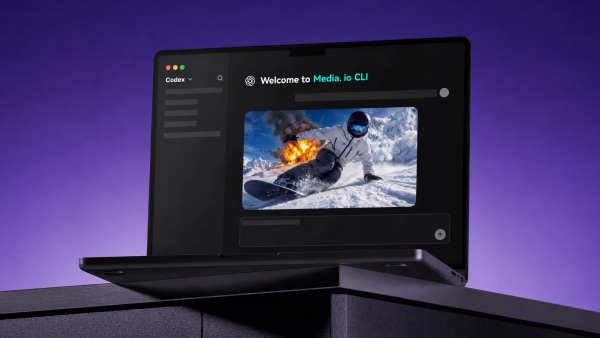
If the cut is already locked, start from the duration, not from a genre mood board. Media.io's text to music generator can create a soundtrack from a prompt, including background music for video, in a range of about 30 seconds to 5 minutes. Export MP3 or WAV, then drop the file on the locked sequence.
- Measure the locked scene and pick a duration inside the official range.
- Prompt energy, genre, and "no vocals" if the scene already has dialogue or VO.
- Generate and export WAV when you expect fades or pitch-neutral trimming.
- Nudge the file so the strongest movement hits the intended marker, then fade.
Media.io is the browser default when you need a custom cue without standing up a full scoring app. It will not automatically read your NLE markers. You still aim the hit. For shorter social energy, a beat maker path can be a better seed than a lyrical song, then you trim to picture.
Skip Media.io for this job if the scene is shorter than the practical duration range and you refuse to edit, or if you need the model to ingest the video file and score it automatically.
Beatoven.ai
If the cue must last as long as the scene, Beatoven is the duration-first specialist. It asks the music to fit the picture length rather than hoping a song happens to match.
- Bring the locked duration or video into the scoring flow.
- Set mood below the picture's peak energy if dialogue exists.
- Generate a cue that is meant to last the scene, not a random song length.
- Check whether the internal lifts land on your actual cuts, then adjust.
Choose Beatoven when length is the constraint you cannot negotiate. Skip it when you only need a looping pad and have no picture duration to honor.
Soundraw
If your cut list already looks like 8 seconds of hold, 12 seconds of build, and 6 seconds of release, Soundraw is useful. You can direct sections instead of accepting a song-shaped curve that fights the edit.
- Write the cut list as section lengths before opening the generator.
- Shape an instrumental that can hold, lift, and release on those lengths.
- Export and place section boundaries on the picture markers.
- If a chorus wants to arrive early, shorten that section rather than moving picture.
Soundraw rewards editors who will map form to picture. It is wasted on a one-click social overlay.
Mubert
If the timeline is long and a single composed cue would feel over-shaped, Mubert helps. Continuous generative music can cover explainers, ambience, and live or long-form video where a three-minute song would loop badly.
- Decide whether you need a downloaded clip or ongoing playback.
- Pick a calmer channel than the picture's most dramatic shot.
- Spot the few places that still need a lift and handle those as separate cues.
- Do not expect Mubert to hit a single frame like a trailer composer.
Use Mubert as a coverage layer. Use a composed tool for the title hit.
AIVA
If you need titles, stings, or finales, AIVA is the composed-cue option. Those jobs want a beginning and an end. Picture lock still requires a trim, but the musical grammar is closer to a scored cue than to a social loop.
- Generate a cue for the emotional job of the scene, not the whole film.
- Place the start on the scene-in and the cadence near scene-out.
- Trim the tail so it does not spill into the next shot.
- If the middle meanders, cut the cue rather than stretching picture.
CapCut
If picture and music never leave your social editor, CapCut belongs here. Generation, stock music, beat timing, captions, and picture live in one surface. That is a production reality, not a claim that CapCut is a film composer.
- Lock the cut in CapCut first so music is not driving random clip length.
- Add generated or library music against the already-timed picture.
- Use beat markers only as a guide; reject any snap that breaks continuity.
- Export and confirm the license for the destination platform.
CapCut is the right default for short-form teams who will not open a separate DAW. It is the wrong default for a brand film that needs a unique score and a legal review of production music.
ElevenLabs Music
If voiceover, cleanup, and music already live in one audio studio, ElevenLabs Music is the nearby option. If VO, dialogue cleanup, and music need to live near each other, generating the cue in the same audio ecosystem can reduce tool sprawl. Picture alignment still happens in the editor.
- Generate the cue to an approximate duration after measuring picture.
- Keep vocals out if the video already has VO from the same studio.
- Export a clean file and align the hit in the NLE, not in the prompt.
- Treat this as a music source plus a voice pipeline, not as automatic spotting.
How to Match AI Music to Scene Length and Energy
Write a spotting note before you prompt. The note should include scene length, the two most important hit points, the energy curve, and whether dialogue is present. Then prompt from the note instead of from a genre cliche.
- Length: generate as close as the tool allows, then trim. Do not time-stretch a 30-second clip across two minutes if you can avoid it.
- Energy: score one notch quieter than the picture's peak, especially if VO exists.
- Hits: name the frame or action ("logo land," "price appear," "door open") in the editor, not only in the prompt.
- Silence: leave room. A locked scene often needs a bar of air after a joke or a product beat.
If the tool offers structure controls, map them to the cut list. If it does not, generate two energies and A/B them on the same picture instead of asking one cue to do every job.
Temp songs train the wrong picture
Editors often lock picture to a temp licensed song and then ask AI to replace it. That is a trap. The cut points were chosen for the temp's downbeats. A new generated cue with different phrasing will feel late even if it is musically fine. Either generate before you lock, or accept that the AI cue must be edited to the existing cuts rather than the other way around. Picture lock means you already chose. The temp song does not get a vote at replacement time unless you are willing to unlock.
Dialogue-heavy videos should not use this article's tools as BGM mixers. A picture-locked explainer still needs headroom. Generate quieter than you think, then duck. If the generator only offers trailer-scale drums, it is the wrong cue family. Media.io and Soundraw can be prompted toward sparse beds. Beatoven can be asked for lower intensity. Suno-like song energy is usually the wrong replacement for a temp that was already too hot.
Long-form needs coverage, not a single aria. Ten minutes of explainer music is closer to Mubert or several duration-matched cues than to one generated chorus looped until it becomes comic. Looping a 30-second hook across an explainer is how viewers notice the soundtrack instead of the picture, which is the opposite of success.
The Cut-Point Alignment Test
Use one locked sequence for every tool. The sequence should include a hard cut, a reveal, and a hold. That mix exposes whether the cue can land, wait, and get out.
- Lock a 35 to 50 second sequence with three marked hit points and no temp song.
- Give every tool the same duration target, energy note, and "no vocal" instruction.
- Place the resulting file on the locked picture without moving any video edit.
- Score three hits: early, on, or late, with a 150 ms tolerance as a practical pass.
- Score the tail: does the cue end, fade, or spill into the next scene?
- Score energy against the hold: if the quiet insert is still loud, fail the curve.
- Record minutes of editing required to make the cue shippable.
The winner is the cue that needs the least picture-illegal surgery. A prettier miss is still a miss.
Where Video Soundtrack AI Still Needs a Human Editor
Generators do not see your continuity. They do not know that a joke needs a hang, that a product label must be readable in silence, or that a lower-third is already occupying the mix. The human editor still owns:
- Spotting and hit aiming
- Fades, tails, and handles
- Dialogue ducking when VO exists
- Removing a lift that fights a reaction shot
- License review for the destination
If a vendor claims the model will "score your video automatically," still run the Cut-Point Alignment Test. Automatic spotting is a starting layer, not a locked mix.
A worked 42-second product cut
Imagine a locked 42-second sequence: 6 seconds of logo, 20 seconds of product movement, 10 seconds of price, 6 seconds of end card. The music job is four hit points, not "upbeat corporate." Generate a cue as close to 42 seconds as the tool allows. If the tool only gives you 30-second clips, you already know you will edit, so do not pretend the generator scored the picture.
Place the file so the first lift is before the product movement, not on the price. Price cards usually need a little air so type can be read. If the cue is still hot on the end card, fade earlier rather than adding a second generated chorus. Two generated files on one locked scene is how amateur soundtracks start to sound like a playlist.
CapCut users should resist snapping every cut to a beat if the product continuity breaks. Beat-first editing is the opposite of picture lock. Picture lock means the picture won. The soundtrack gets the leftover freedom.
Final Video Soundtrack AI Recommendations
Keep picture lock in charge. Generate music to the timeline you already approved.
- Use Media.io for browser text-to-music soundtracks you can export and align in any editor.
- Use Beatoven.ai if the first constraint is matching video duration.
- Use Soundraw if you will map musical sections to a cut list.
- Use Mubert for long-form coverage rather than trailer hits.
- Use AIVA for composed opens and closes.
- Use CapCut if the soundtrack has to live inside a social editor.
- Use ElevenLabs Music if the same audio studio already owns VO and needs a cue beside it.
AI Music for Video FAQ
-
What is the best AI music generator for videos in 2026?
Media.io is a strong browser option for custom video soundtracks from text. Beatoven.ai is stronger when duration must match picture. Soundraw helps with section control, while CapCut helps when edit and music stay in one social tool. -
Can AI music match a locked video edit?
It can get close if you generate to the scene length and then align hits in the editor. Most tools still need a human to place downbeats on the actual cuts. -
How long should AI music be for a video scene?
As close as possible to the locked duration. Media.io's official generation range is about 30 seconds to 5 minutes. Shorter social cuts usually need an editor trim. -
Should I generate vocals for a product video soundtrack?
Usually no, if the video already has dialogue, VO, or on-screen text that needs attention. Instrumental cues are easier to fit to picture and speech. -
Is CapCut enough for AI music on videos?
It can be enough for short-form work where picture and music stay in the same editor. Brand films and stricter licensing reviews often need a separate music generator plus an NLE. -
What is a cut-point alignment test?
It is a check that uses one locked sequence and scores whether generated music hits marked edits, ends cleanly, and follows the energy of holds and reveals. -
Why does generated music feel late on a reveal?
The model is writing a song-shaped curve, not reading your marker. Place the file so the swell starts before the reveal, or generate a cue with an earlier lift and trim the tail. -
Do I still need a human editor after AI music generation?
Yes. Spotting, fades, dialogue ducking, and license checks remain human work even when the cue itself was generated.