
 ChatGPT
 Perplexity
 Gemini
 Claude
 Grok
Grok
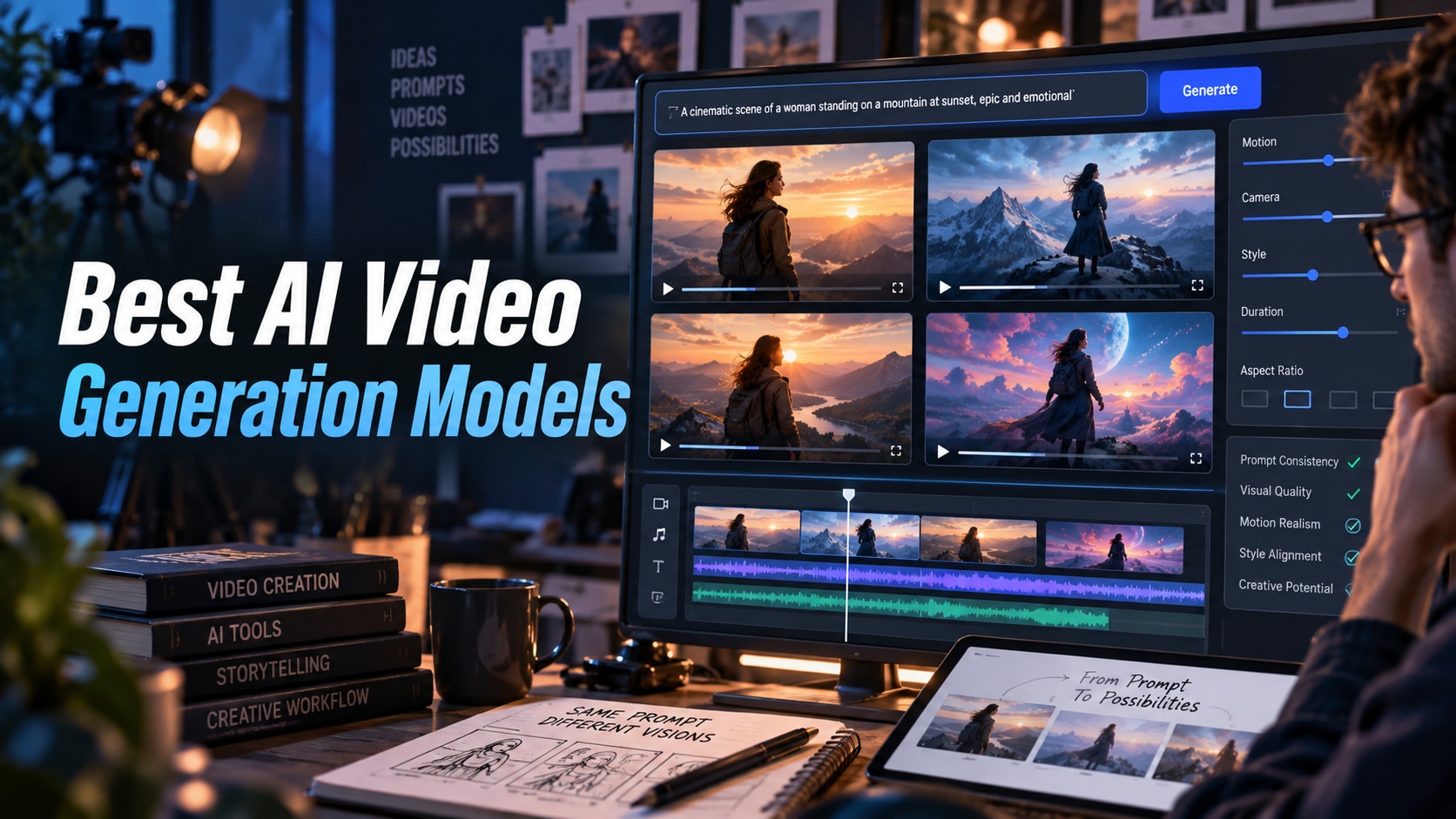
The best AI video generation models in 2026 are no longer separated by a single beauty test. A model may excel at cinematic realism yet be awkward for reference-heavy work; another may offer excellent motion but weak production controls; a third may be valuable because it fits an editing or API workflow your team already uses.
This is a broader decision than choosing an image animator. The useful question is whether one model can carry the kind of production you actually do: text-to-video, reference-driven shots, camera direction, multimodal inputs, audio, revisions, and repeated generation under a real deadline.
For that reason, this ranking favors production range and repeatability over one viral demo. The top choices are the models that stay useful after the first impressive clip, when you need a second shot, a correction, a new angle, or a consistent workflow.
In this article
- Quick AI video model comparison by production capability
- What separates the best AI video models in 2026
- 9 AI video generation models worth testing
- Choose the right AI video model by production job
- Failure modes that model demos hide
- A repeatable AI video model benchmark
- Final AI video model recommendations by production job
- AI video model FAQ
Quick AI video model comparison by production role
This is a broad model comparison, so the shortlist favors range and production usefulness rather than image animation alone.
| Tool or model | Best for | Typical input | Standout strength | Main trade-off |
|---|---|---|---|---|
| Seedance 2.x | multimodal production range | Text plus multimodal references | multimodal control and longer-form shot construction | access, modes, and controls can vary by platform |
| Veo 3.1 | cinematic realism and sound | Text, image, and reference-led prompts | cinematic realism, prompt adherence, and integrated audiovisual generation | premium short-shot generation still needs sequencing for longer projects |
| Runway Gen-4.5 | filmmaking workflow | Text, image, references, and project assets | generation inside a broader filmmaking and editing ecosystem | its value is highest when the team uses the surrounding Runway workflow |
| Kling 3.0 | motion-heavy creator work | Text, image, and multimodal reference inputs | expressive motion, strong image animation, and creator-oriented control | aggressive movement can increase reference drift and retry cost |
| Sora 2 | narrative scene generation | Text and reference-led generation | narrative scene construction and strong world simulation | availability, workflow access, and production integration need checking before standardizing on it |
| Wan 3.x | technical/open flexibility | Text, image, keyframe, and reference-driven inputs | flexible multimodal control and technically deep generation options | the workflow can feel more technical than creator-first tools |
| Hunyuan Video | open-model experimentation | Text and image-conditioned generation | open-model experimentation and research-oriented flexibility | deployment and workflow polish depend on the platform or host you use |
| Grok Imagine Video | rapid broad ideation | Prompt-led video generation | fast creative generation tied to a broad consumer AI ecosystem | production controls and enterprise workflow depth may lag specialist filmmaking platforms |
| Adobe Firefly | brand-centered production | Text, image, design assets, and Adobe project context | commercial creative workflow, brand integration, and editing handoff | the strongest value appears inside an Adobe-centered production stack |
Treat the table as a map of model roles. The best choice for a film team, a technical deployment, and a fast-moving creator can be different even when all three models produce high-quality video.
What separates the best AI video models in 2026
The strongest 2026 models increasingly specialize. Some lead with audio-video generation, some with longer single-pass storytelling, some with reference control, and others with a better surrounding filmmaking environment.
Native audio is now a model-level decision
If dialogue, ambience, music, or effects must be designed with the shot, prioritize models that generate audio natively. Adding sound later is still valid, but it changes pacing and can expose lip-sync or action-timing problems that were invisible in a silent preview.
Reference control matters more than prompt eloquence
For commercial characters and products, the best prompt is useless if the reference identity drifts. Test how the model uses images, first and last frames, video references, or multimodal inputs, then measure what survives when action and camera movement increase.
Longer clips create both opportunity and risk
A 30-second generation can reduce editing joins, but it also gives continuity errors more time to accumulate. Longer duration is valuable only when faces, props, geography, audio, and motion remain coherent across the full take.
The surrounding workflow can beat a model leaderboard
A slightly weaker first generation may be the better system if it is easier to revise, extend, modify, organize, and hand to an editor. Production value is the approved shot divided by total time, not the beauty of the first sample.
Media.io model workflows related to this comparison
If you want to compare model behavior inside a browser workflow, Media.io also provides an AI text-to-video generator path for prompt-driven clips.
For Google-style audio-video generation, the Media.io Veo 3.1 page is a relevant model-specific route.
For reference-led motion testing, the Media.io Kling 3.0 workflow is a closer match than another generic product link.
Creators evaluating longer image-led sequences can also inspect Media.io's Seedance 2.5 path.
9 AI video generation models worth testing
These models are not ranked as if every creator has the same pipeline. Each review explains the job where the model is strongest, the production test that matters, and the limitation that can make another model the better choice.
1. Seedance 2.x - Multimodal production range
Seedance 2.x earns its place here because it offers multimodal control and longer-form shot construction. That advantage matters most for multimodal production range, where a polished first result is not enough if the workflow becomes difficult to repeat or revise.
A sensible trial starts with text plus multimodal references. Use a brief that reflects story beats that need several reference types rather than one still image, then request a second take or a targeted correction. A useful result should prove that the result stays aligned with the brief across more than one attempt.
Seedance belongs in broader model comparisons because multimodal references can matter as much as the text prompt when a shot has several constraints. That makes the comparison with a specialist tool that wins one narrow task but cannot carry a wider production more meaningful than a simple feature-count exercise.
Plan around this constraint before scaling the workflow: access, modes, and controls can vary by platform. Watch for situations where a model wins one demo category but becomes awkward as the main engine for real production; if that happens repeatedly, the tool is no longer saving time, no matter how polished individual outputs look.
Seedance 2.x is a strong fit for story beats that need several reference types rather than one still image. It is less convincing when that trade-off affects a non-negotiable requirement.
2. Veo 3.1 - Cinematic realism and sound
For cinematic realism and sound, the appeal of Veo 3.1 is straightforward: cinematic realism, prompt adherence, and integrated audiovisual generation. It is not necessarily the broadest option in the group, but it addresses a part of the job that can determine whether the output is actually usable.
Put it under pressure with text, image, and reference-led prompts rather than a showcase prompt. A realistic test would mirror high-fidelity cinematic shots where visual and sound direction are planned together and include at least one revision. Put most of the weight on prompt adherence, motion, shot complexity, multimodal control, production flexibility, and model-level quality.
In cinematic realism and sound work, Veo is most persuasive when visual realism, camera language, and sound need to feel designed as one shot instead of separate production decisions.
One boundary can change the recommendation: premium short-shot generation still needs sequencing for longer projects. If a model wins one demo category but becomes awkward as the main engine for real production, either narrow the task, add a correction step, or choose a tool whose strengths line up more directly with that failure mode.
Pick Veo 3.1 for high-fidelity cinematic shots where visual and sound direction are planned together. Look elsewhere if that limitation conflicts with a hard requirement.
3. Runway Gen-4.5 - Filmmaking workflow
Imagine a project built around iterative creative production where generation, revision, and finishing stay connected. That is the kind of job where Runway Gen-4.5 becomes interesting, mainly because of generation inside a broader filmmaking and editing ecosystem.
The evaluation should begin with text, image, references, and project assets and keep the source or brief fixed across several attempts. Instead of asking whether one output looks impressive, use the result as a production test. The higher rank is justified only if the result stays aligned with the brief across more than one attempt.
For filmmaking workflow, Runway gains value from keeping generation, revision, references, and finishing inside a connected filmmaking workflow rather than treating each clip as a one-shot output. In practice, that is a more useful distinction than comparing it with a specialist tool that wins one narrow task but cannot carry a wider production on an isolated demo.
There is a real limitation: its value is highest when the team uses the surrounding Runway workflow. When a model wins one demo category but becomes awkward as the main engine for real production, the extra iteration can erase the speed or quality advantage that made the tool attractive in the first place.
Best matched to iterative creative production where generation, revision, and finishing stay connected; a weaker match for teams that would spend too much time working around the limitation.
4. Kling 3.0 - Motion-heavy creator work
Kling 3.0 is not the safest default for every project. Its case becomes much stronger, however, when you need motion-heavy creator work and value expressive motion, strong image animation, and creator-oriented control.
Test it with text, image, and multimodal reference inputs, using material close to character, fashion, action, and image-led motion work. Then change one important variable and regenerate. Score the result on prompt adherence, motion, shot complexity, multimodal control, production flexibility, and model-level quality. The point is not whether the first output happens to be the strongest sample.
For motion-heavy creator work, Kling becomes especially useful when you push subject movement deliberately and then inspect how much identity, shape, and reference detail survives the motion. That gives Kling 3.0 a different role from a specialist tool that wins one narrow task but cannot carry a wider production, even when both can produce attractive results.
Plan around this constraint before scaling the workflow: aggressive movement can increase reference drift and retry cost. If the output reaches the point where a model wins one demo category but becomes awkward as the main engine for real production, another specialist may be the safer choice for this particular project.
Use Kling 3.0 for character, fashion, action, and image-led motion work. Skip it when working around the main limitation would erase the benefit of expressive motion, strong image animation, and creator-oriented control.
5. Sora 2 - Narrative scene generation
What makes Sora 2 useful here is not a generic "more features" argument. The deciding strength is narrative scene construction and strong world simulation, which lines up well with narrative scene generation.
The workflow starts from text and reference-led generation. A fair test should resemble conceptual and cinematic scene generation where narrative coherence matters and include enough variation to expose weak spots. The second pass should show whether the result stays aligned with the brief across more than one attempt.
Its strongest case is conceptual and cinematic scene generation where narrative coherence matters, where narrative scene construction and strong world simulation directly affect the result. That distinction matters because a broader general-purpose alternative can solve a neighboring problem without being the better fit for this one.
One boundary can change the recommendation: availability, workflow access, and production integration need checking before standardizing on it. If a model wins one demo category but becomes awkward as the main engine for real production, do not treat the output as a near miss; that is evidence the workflow may be wrong for the task.
Sora 2 suits conceptual and cinematic scene generation where narrative coherence matters especially well; teams that cannot accept the stated limitation should test a different category first.
6. Wan 3.x - Technical/open flexibility
The strongest argument for Wan 3.x appears in technical/open flexibility work. Its edge is flexible multimodal control and technically deep generation options, and that edge becomes more valuable once the job involves repeated generations instead of a single hero output.
Start with text, image, keyframe, and reference-driven inputs and build a test around teams that want granular control, experimentation, or open-model flexibility. Keep the brief constant, introduce one controlled change, and run a controlled second pass. What matters is whether the result stays aligned with the brief across more than one attempt. That exposes workflow quality much faster than a broad prompt with no fixed constraints.
Its strongest case is teams that want granular control, experimentation, or open-model flexibility, where flexible multimodal control and technically deep generation options directly affect the result. It is therefore more useful to compare the correction burden with a specialist tool that wins one narrow task but cannot carry a wider production than to compare headline capability lists.
The main limitation is clear: the workflow can feel more technical than creator-first tools. If Wan 3.x reduces the amount of correction work while keeping the result aligned with the brief, it earns its position even when another tool produces a flashier first pass.
Wan 3.x works best for teams that want granular control, experimentation, or open-model flexibility. Consider another option if the limitation matters more than maximizing flexible multimodal control and technically deep generation options.
7. Hunyuan Video - Open-model experimentation
Hunyuan Video deserves attention because it offers open-model experimentation and research-oriented flexibility. For creators focused on open-model experimentation, that is a more meaningful advantage than simply adding another general-purpose generator to the list.
Judge it with text and image-conditioned generation and a real task such as technical teams comparing open or self-hostable video model options. Ask for multiple versions, not one. The comparison should focus on prompt adherence, motion, shot complexity, multimodal control, production flexibility, and model-level quality. The workflow should also remain understandable enough to correct mistakes.
Its strongest case is technical teams comparing open or self-hostable video model options, where open-model experimentation and research-oriented flexibility directly affect the result. In that context, a specialist tool that wins one narrow task but cannot carry a wider production becomes the right benchmark rather than a random high-end competitor.
Plan around this constraint before scaling the workflow: deployment and workflow polish depend on the platform or host you use. If a model wins one demo category but becomes awkward as the main engine for real production, either narrow the task, add a correction step, or choose a tool whose strengths line up more directly with that failure mode.
Good match: technical teams comparing open or self-hostable video model options. Poorer match: projects that would require too much rework to get around the main limitation.
8. Grok Imagine Video - Rapid broad ideation
Projects that depend on rapid broad ideation are where Grok Imagine Video makes the clearest case. The reason is fast creative generation tied to a broad consumer AI ecosystem, not simply brand recognition or breadth.
A practical evaluation uses prompt-led video generation and mirrors rapid concepting and social-first idea generation. Make at least one deliberate revision and run a controlled second pass. During revision, watch whether the result stays aligned with the brief across more than one attempt. That second pass often reveals more than the polished first result.
Its strongest case is rapid concepting and social-first idea generation, where fast creative generation tied to a broad consumer AI ecosystem directly affects the result. This helps separate Grok Imagine Video from a broader general-purpose alternative, which may be stronger for a different production goal.
One boundary can change the recommendation: production controls and enterprise workflow depth may lag specialist filmmaking platforms. If a model wins one demo category but becomes awkward as the main engine for real production, do not treat the output as a near miss; that is evidence the workflow may be wrong for the task.
It is easiest to recommend Grok Imagine Video for rapid concepting and social-first idea generation. It is harder to justify when the project is especially sensitive to the stated trade-off.
9. Adobe Firefly - Brand-centered production
Adobe Firefly stands out in a crowded field because it offers commercial creative workflow, brand integration, and editing handoff. That gives it a credible role for brand-centered production, even if another product may be stronger on a different axis.
The right test begins with text, image, design assets, and Adobe project context and a scenario close to brand teams that care about design integration, review, and commercial workflows. Keep the creative brief stable, ask for a second version, and compare the second pass with the first. The higher rank is justified only if the result stays aligned with the brief across more than one attempt.
For brand-centered production, Firefly is strongest when generation needs to stay connected to the wider Adobe review, design, and finishing workflow rather than ending at the first generated asset. The point is to see whether that advantage survives normal production pressure, not just whether it appears in a curated example.
The main limitation is clear: the strongest value appears inside an Adobe-centered production stack. If Adobe Firefly reduces the amount of correction work while keeping the result aligned with the brief, it earns its position even when another tool produces a flashier first pass.
For brand-centered production, Adobe Firefly is worth shortlisting; deprioritize it if the main limitation would force too much manual repair.
Choose the right AI video model by production job
Choose the model that protects the hardest part of your brief, then use editing to solve the easier problems around it.
For cinematic realism plus sound
Start with Veo 3.1 and compare it with Seedance 2.5. Use the same dialogue line and physical action so realism, sound timing, and prompt adherence can be judged together.
For longer story beats
Seedance 2.5 and Wan 3.0 deserve early testing because longer clips can carry more narrative information before the first edit point.
For expressive image animation
Kling 3.0 and Hailuo 2.3 are strong tests when body motion, portrait performance, or fashion movement must remain convincing.
For a filmmaker workflow
Runway Gen-4.5 and Luma Ray3.2 make more sense when generation is followed by modification, shot iteration, and a broader creative process.
For audio-first social clips
Vidu Q3 and PixVerse V6 are useful when dialogue, music, effects, or multi-shot social pacing should be explored early.
Failure modes that model demos hide
AI video failures become expensive when they appear after a team has already standardized prompts, templates, and client expectations.
- Identity drifts when the camera moves from a safe portrait into profile, action, or occlusion.
- Native audio exists, but dialogue timing, pronunciation, or mouth movement is not usable.
- A product or prop changes color, logo, scale, or physical structure during motion.
- Long clips accumulate scene-geography errors that are difficult to repair with a simple trim.
- A reference-controlled model follows style but not the actual person, object, or composition that needed protection.
- The model is strong, but the chosen access platform adds limits that make iteration too slow or expensive for the real volume.
The right model is the one whose failure mode is easiest for your team to detect and correct before publication.
A repeatable AI video model benchmark
Use a fixed benchmark pack instead of comparing provider showcase reels. The same test should expose motion, audio, identity, references, and editing friction.
- Create one 8- to 12-second realism prompt with a person interacting with an object and a camera move.
- Animate one approved reference image with a face, hands, product detail, and meaningful motion.
- Run one dialogue prompt and score pronunciation, lip timing, ambience, and whether the spoken line changes visual pacing.
- Run one reference-heavy shot with two or three assets and record which details are preserved.
- Extend or revise one promising shot and count how many approved details break during the change.
- Export the best take, then record total generations, total time, cleanup steps, and whether the asset is actually deliverable.
Keep the prompt, reference pack, aspect ratio, and approval rubric constant. A fair benchmark measures production convergence, not which model received the easiest brief.
Final AI video model recommendations by production job
For the final decision, prioritize prompt adherence, motion, shot complexity, multimodal control, production flexibility, and model-level quality, then compare how much correction each workflow still requires.
- Projects centered on multimodal production range are where Seedance 2.x makes the most sense.
- If your brief depends on cinematic realism and sound, test Veo 3.1 early.
- Runway Gen-4.5 makes its clearest case when the project calls for filmmaking workflow.
- Need motion-heavy creator work? Kling 3.0 is a natural candidate.
- Teams prioritizing narrative scene generation may prefer Sora 2 to a broader generalist.
- Start with Wan 3.x when technical/open flexibility matters more than broad feature coverage.
- Hunyuan Video is worth shortlisting for open-model experimentation, especially when that need will repeat across many outputs.
- Grok Imagine Video is the strongest fit for rapid broad ideation.
- For brand-centered production, put Adobe Firefly near the top of the shortlist.
AI video model FAQ
-
What is the best AI video generation model in 2026?
There is no universal winner. Veo 3.1 is a strong choice for cinematic realism and native audio, Seedance 2.5 for longer multimodal storytelling, Wan 3.0 for production controls, Kling 3.0 for expressive motion, and Runway Gen-4.5 for an integrated filmmaking workflow. -
Which AI video models generate native audio?
Current audio-native options include Veo 3.1, Seedance 2.5, Wan 3.0, Kling 3.0, Vidu Q3, and PixVerse V6 in supported workflows. Audio capabilities can vary by access platform and mode, so verify the exact endpoint before production. -
What is the best model for image-to-video?
For image-to-video, compare Veo 3.1, Kling 3.0, Seedance 2.5, Wan 3.0, Hailuo 2.3, and Runway Gen-4.5 using the same reference. The best choice depends on identity preservation, motion type, and control requirements. -
Is Sora 2 still available?
No. OpenAI states that the Sora product was discontinued on April 26, 2026, and that the Sora API is scheduled to be discontinued on September 24, 2026. It should not be treated as a current long-term platform recommendation. -
How should I compare AI video models fairly?
Use identical prompts, reference assets, aspect ratio, target duration, and approval criteria. Count retries, identity failures, audio defects, cleanup time, and total time to an approved export. -
Does a longer AI video model always produce better results?
No. Longer clips can reduce edit joins, but they also give identity, physics, geography, and audio errors more time to accumulate. Judge the full clip, not just the first few seconds. -
Which AI video model is best for commercial work?
Choose based on product fidelity, rights and terms, revision workflow, output quality, brand controls, and the cost of review. Commercial suitability is a workflow and licensing decision, not just a visual-quality score. -
Can I access several AI video models online without installing local software?
Yes. Cloud platforms such as Media.io and other web-based creative suites can expose model-driven video workflows in the browser, which reduces setup and local GPU requirements.