
 ChatGPT
 Perplexity
 Gemini
 Claude
 Grok
Grok
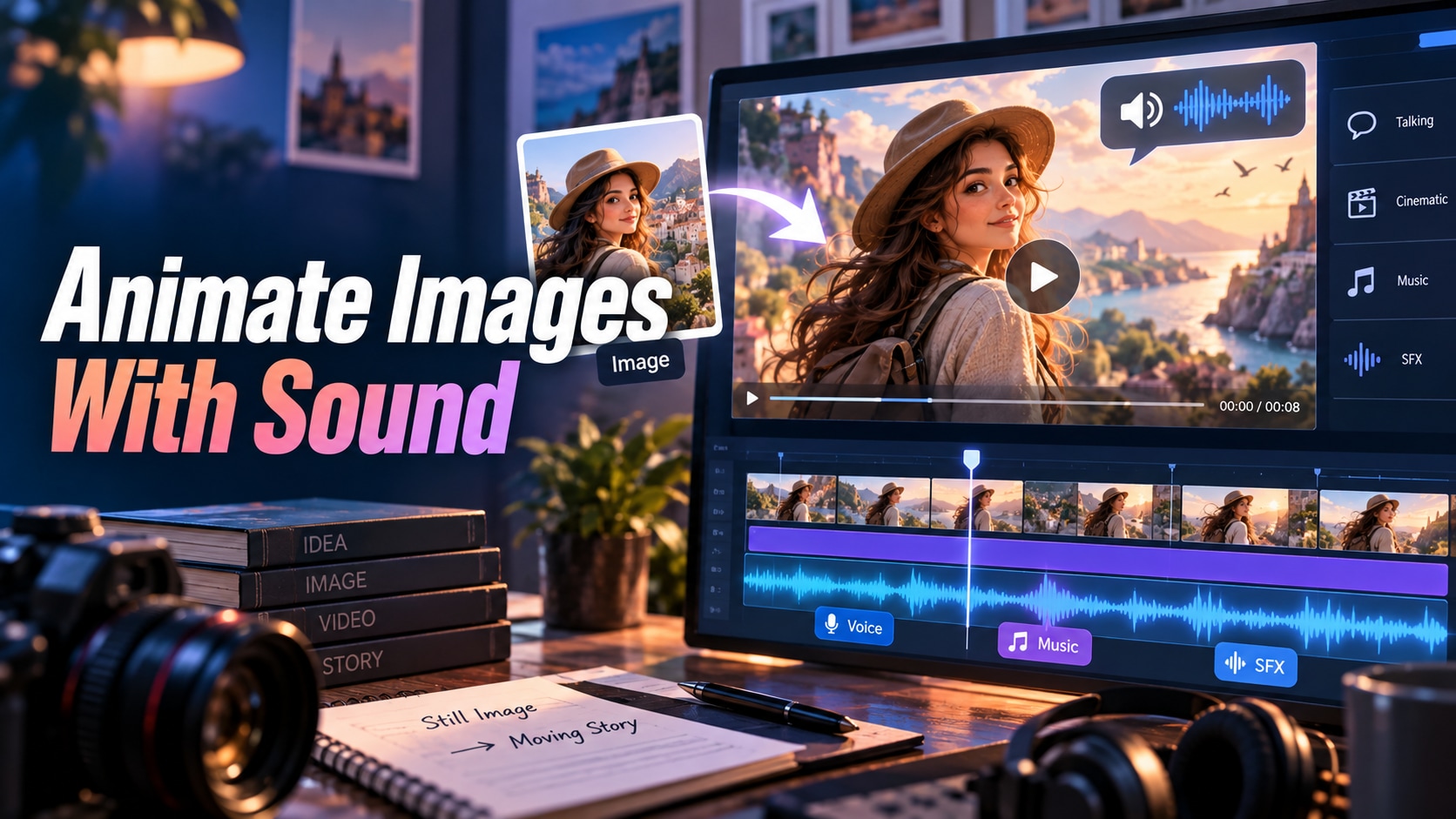
A silent image animation can look convincing and still feel unfinished. The best AI image to video generators with audio have to solve two jobs at once: protect the source image while creating motion, then add dialogue, ambience, effects, or music that belongs to that motion.
This matters most when the image already carries identity or brand value. A portrait cannot suddenly become a different person when it speaks; a product shot cannot warp when sound-driven action begins; and a cinematic still should not gain generic audio that ignores what is happening on screen.
The tools below are compared as image-first audiovisual workflows, not as general video generators. Some create sound natively, while others are stronger because they make the animation and audio-editing stages easier to control in one practical path.
In this article
- Quick comparison for turning an approved image into a synchronized audiovisual clip
- Native audio versus added soundtrack workflows
- 7 I2V generators with sound worth testing
- Choose by the kind of sound your image needs
- Audio-video failures to inspect before export
- A synchronized I2V benchmark
- Final recommendations for turning an approved image into a synchronized audiovisual clip
- Image-to-video with audio FAQ
Quick comparison
These picks are for creators who start with an image and need motion plus usable sound, not for general text-to-video generation.
| Tool or model | Best for | Typical input | Standout strength | Main trade-off |
|---|---|---|---|---|
| Media.io | best browser hub for I2V plus sound | Text, image, audio, and browser project inputs | multi-model browser workflow and adjacent editing tools | the strongest choice depends on which underlying model or workflow you select |
| Veo 3.1 | cinematic native audio | Text, image, and reference-led prompts | cinematic realism, prompt adherence, and integrated audiovisual generation | premium short-shot generation still needs sequencing for longer projects |
| Vidu Q3 | dialogue and music in short clips | Text, image, and audiovisual prompts | short-form audio-video generation with dialogue, effects, and music intent | longer productions still require external sequencing and continuity control |
| Kling 3.0 | motion-led image animation | Text, image, and multimodal reference inputs | expressive motion, strong image animation, and creator-oriented control | aggressive movement can increase reference drift and retry cost |
| PixVerse V6 | fast social effects with sound | Text, image, templates, and effect-driven prompts | fast social video creation, effects, and accessible image animation | speed and effect variety can matter more than fine production control |
| CapCut | editing and audio finishing | Video, audio, text, templates, and AI-assisted assets | social-first editing, effects, captions, and fast finishing | specialist generation quality depends on the specific feature or integrated model |
| Pika | lightweight image effects | Text, image, and effect-oriented prompts | fast experimentation and creator-friendly transformations | it is stronger for quick creative effects than long-form production consistency |
Pay attention to where sound enters the workflow. Native audiovisual generation can improve scene coherence, while an editor-led approach may be easier when dialogue, music, or effects need several rounds of revision.
Native audio versus added soundtrack workflows
Audio changes how an animated image should move. A speaking subject needs timing around mouth motion. A product shot may need impacts or mechanical sound. A music-led clip needs cuts and movement that respect rhythm rather than a random soundtrack placed underneath.
Native dialogue needs visual timing
If the subject speaks, evaluate phoneme timing, mouth shape, head motion, emotion, and pronunciation together. A good voice with poor facial synchronization is still unusable.
Ambience should belong to the scene
Room tone, traffic, wind, crowd noise, or nature ambience should match the location implied by the source image. Listen for abrupt loops or an acoustic space that contradicts the picture.
Effects need an identifiable event
Footsteps, impacts, engines, doors, and object interactions should occur when the visual event happens. An effect that sounds realistic but lands several frames late makes the whole clip feel synthetic.
Music changes pacing
If a generator adds music, judge whether movement and edit rhythm respond to it. A soundtrack that ignores the visual beat is an integrated feature in name only.
Media.io paths for image animation and audio-capable models
Start with Media.io's AI Image to Video workflow when the source is a still image and you want to compare motion options in the browser.
For audio-native image animation, the Media.io Vidu Q3 page is a relevant model-specific path.
Longer audio-video scenes can also be explored through Media.io's Seedance 2.5 workflow.
When expressive motion matters, the Media.io Kling 3.0 page provides a more specific route than another generic product link.
7 I2V generators with sound worth testing
Each review looks at the handoff between image fidelity, motion, and sound. The strongest option is the one that keeps those three parts coherent with the least repair work.
1. Media.io - Best browser hub for I2V plus sound
Media.io stands out in a crowded field because it offers multi-model browser workflow and adjacent editing tools. That gives it a credible role for browser hub for I2V plus sound, even if another product may be stronger on a different axis.
The right test begins with text, image, audio, and browser project inputs and a scenario close to projects that need browser hub for I2V plus sound. Keep the creative brief stable, ask for a second version, and compare the second pass with the first. What matters is whether the result stays aligned with the brief across more than one attempt.
For browser hub for I2V plus sound, the practical advantage is fewer handoffs: generation and adjacent editing stay close together, so a correction does not automatically require another export-import cycle. The point is to see whether that advantage survives normal production pressure, not just whether it appears in a curated example.
The trade-off is not hidden: the strongest choice depends on which underlying model or workflow you select. If sound is present but feels detached from the motion or the image identity changes once audio-led action begins, do not treat the output as a near miss; that is evidence the workflow may be wrong for the task.
For browser hub for I2V plus sound, Media.io is worth shortlisting; deprioritize it if the main limitation would force too much manual repair.
2. Veo 3.1 - Cinematic native audio
Veo 3.1 earns its place here because it offers cinematic realism, prompt adherence, and integrated audiovisual generation. That advantage matters most for cinematic native audio, where a polished first result is not enough if the workflow becomes difficult to repeat or revise.
A sensible trial starts with text, image, and reference-led prompts. Use a brief that reflects high-fidelity cinematic shots where visual and sound direction are planned together, then request a second take or a targeted correction. A useful result should prove that the result stays aligned with the brief across more than one attempt.
In cinematic native audio work, Veo is most persuasive when visual realism, camera language, and sound need to feel designed as one shot instead of separate production decisions. That makes the comparison with a broader general-purpose alternative more meaningful than a simple feature-count exercise.
Plan around this constraint before scaling the workflow: premium short-shot generation still needs sequencing for longer projects. If that limitation affects a non-negotiable part of the project, a more specialized option may be safer.
Veo 3.1 is a strong fit for high-fidelity cinematic shots where visual and sound direction are planned together. It is less convincing when that trade-off affects a non-negotiable requirement.
3. Vidu Q3 - Dialogue and music in short clips
For dialogue and music in short clips, the appeal of Vidu Q3 is straightforward: short-form audio-video generation with dialogue, effects, and music intent. It is not necessarily the broadest option in the group, but it addresses a part of the job that can determine whether the output is actually usable.
Put it under pressure with text, image, and audiovisual prompts rather than a showcase prompt. A realistic test would mirror social, narrative, and localized short-form clips with sound and include at least one revision. During revision, watch whether the result stays aligned with the brief across more than one attempt.
Its strongest case is social, narrative, and localized short-form clips with sound, where short-form audio-video generation with dialogue, effects, and music intent directly affect the result.
One boundary can change the recommendation: longer productions still require external sequencing and continuity control. If sound is present but feels detached from the motion or the image identity changes once audio-led action begins, do not treat the output as a near miss; that is evidence the workflow may be wrong for the task.
Pick Vidu Q3 for social, narrative, and localized short-form clips with sound. Look elsewhere if that limitation conflicts with a hard requirement.
4. Kling 3.0 - Motion-led image animation
Imagine a project built around character, fashion, action, and image-led motion work. That is the kind of job where Kling 3.0 becomes interesting, mainly because of expressive motion, strong image animation, and creator-oriented control.
The evaluation should begin with text, image, and multimodal reference inputs and keep the source or brief fixed across several attempts. Instead of asking whether one output looks impressive, use the result as a production test. The higher rank is justified only if the result stays aligned with the brief across more than one attempt.
For motion-led image animation, Kling becomes especially useful when you push subject movement deliberately and then inspect how much identity, shape, and reference detail survives the motion. In practice, that is a more useful distinction than comparing it with a silent image animator that requires a separate sound workflow on an isolated demo.
There is a real limitation: aggressive movement can increase reference drift and retry cost. When sound is present but feels detached from the motion or the image identity changes once audio-led action begins, the extra iteration can erase the speed or quality advantage that made the tool attractive in the first place.
Best matched to character, fashion, action, and image-led motion work; a weaker match for teams that would spend too much time working around the limitation.
5. PixVerse V6 - Fast social effects with sound
PixVerse V6 is not the safest default for every project. Its case becomes much stronger, however, when you need fast social effects with sound and value fast social video creation, effects, and accessible image animation.
Test it with text, image, templates, and effect-driven prompts, using material close to high-volume social content, quick transformations, and trend-led clips. Then change one important variable and regenerate. Check whether the result stays aligned with the brief across more than one attempt. The point is not whether the first output happens to be the strongest sample.
Its strongest case is high-volume social content, quick transformations, and trend-led clips, where fast social video creation, effects, and accessible image animation directly affect the result. That gives PixVerse V6 a different role from a broader general-purpose alternative, even when both can produce attractive results.
Plan around this constraint before scaling the workflow: speed and effect variety can matter more than fine production control. If sound is present but feels detached from the motion or the image identity changes once audio-led action begins, do not treat the output as a near miss; that is evidence the workflow may be wrong for the task.
Use PixVerse V6 for high-volume social content, quick transformations, and trend-led clips. Skip it when working around the main limitation would erase the benefit of fast social video creation, effects, and accessible image animation.
6. CapCut - Editing and audio finishing
What makes CapCut useful here is not a generic "more features" argument. The deciding strength is social-first editing, effects, captions, and fast finishing, which lines up well with editing and audio finishing.
The workflow starts from video, audio, text, templates, and AI-assisted assets. A fair test should resemble short-form production where editing and publishing speed matter most and include enough variation to expose weak spots. The second pass should show whether the result stays aligned with the brief across more than one attempt.
For editing and audio finishing, CapCut is most useful when generation is only one step in a fast social workflow that also needs timing, captions, music, effects, and export. That distinction matters because a broader general-purpose alternative can solve a neighboring problem without being the better fit for this one.
One boundary can change the recommendation: specialist generation quality depends on the specific feature or integrated model. If the project hits that boundary early, another tool may provide a cleaner path even if its best demo is less striking.
CapCut suits short-form production where editing and publishing speed matter most especially well; teams that cannot accept the stated limitation should test a different category first.
7. Pika - Lightweight image effects
The strongest argument for Pika appears in lightweight image effects work. Its edge is fast experimentation and creator-friendly transformations, and that edge becomes more valuable once the job involves repeated generations instead of a single hero output.
Start with text, image, and effect-oriented prompts and build a test around viral effects, lightweight I2V experiments, and rapid social iterations. Keep the brief constant, introduce one controlled change, and run a controlled second pass. What matters is whether the result stays aligned with the brief across more than one attempt. That exposes workflow quality much faster than a broad prompt with no fixed constraints.
Its strongest case is viral effects, lightweight I2V experiments, and rapid social iterations, where fast experimentation and creator-friendly transformations directly affect the result. It is therefore more useful to compare the correction burden with a silent image animator that requires a separate sound workflow than to compare headline capability lists.
The main limitation is clear: it is stronger for quick creative effects than long-form production consistency. Watch for situations where sound is present but feels detached from the motion or the image identity changes once audio-led action begins; if that happens repeatedly, the tool is no longer saving time, no matter how polished individual outputs look.
Pika works best for viral effects, lightweight I2V experiments, and rapid social iterations. Consider another option if the limitation matters more than maximizing fast experimentation and creator-friendly transformations.
Choose by the kind of sound your image needs
Choose based on the audio event that must stay synchronized with the picture.
For a talking portrait
Prioritize native audio and lip-sync behavior. Veo 3.1, Vidu Q3, Seedance 2.5, Kling 3.0, and Wan 3.0 deserve direct tests with the same spoken line.
For cinematic ambience
Use a model that can generate atmosphere with the visual and compare it against a silent generation finished later with custom sound design.
For music-led image animation
PixVerse V6, Vidu Q3, and integrated-editor workflows can be practical when music and short-form pacing are central.
For product or action effects
Test whether the sound corresponds to the actual visual event and whether product identity survives the movement that triggers the effect.
For maximum editing control
A browser workflow such as Media.io can be useful when generation is only the first step and the final mix still needs music, captions, or other edits.
Audio-video failures to inspect before export
Audio-video generation introduces failure modes that are easy to miss when a clip is judged only for visual novelty.
- The voice sounds plausible but mouth movement is delayed, exaggerated, or unrelated to phonemes.
- The generated ambience changes abruptly when the camera moves or the subject crosses the frame.
- An impact or object sound occurs before or after the visual event.
- Music masks speech or important effects because the automatic mix has no hierarchy.
- A model preserves the audio idea but changes the source face, product label, or scene detail during motion.
- The tool generates sound, but the audio cannot be replaced or edited easily when only one element is wrong.
Always watch once with headphones, once muted, and once with your eyes away from the screen. Those three passes reveal visual, synchronization, and pure audio defects separately.
A synchronized I2V benchmark
Use one still image with a person, one product, and one atmospheric scene. Ask every generator to produce the same motion and sound requirement.
- Generate a talking portrait using the same short sentence and score pronunciation, mouth timing, face identity, and expression.
- Animate a product interaction with a specific sound event and check whether the effect lands exactly on the action.
- Animate an environmental still with ambience and listen for spatial consistency and loop artifacts.
- Create one music-led variation and judge whether motion responds to rhythm rather than simply playing under it.
- Replace or revise one audio element without changing the approved visual where the workflow allows it.
- Record retries, audio fixes, visual fixes, and total time to a publishable clip.
The winner should be the workflow that reaches a synchronized, approved export with the fewest compromises, not the one that produces the loudest first impression.
Final recommendations for turning an approved image into a synchronized audiovisual clip
For the final decision, prioritize reference preservation plus dialogue, ambience, effects, or music that fits the animated image, then compare how much correction each workflow still requires.
- If your brief depends on browser hub for I2V plus sound, test Media.io early.
- Veo 3.1 makes its clearest case when the project calls for cinematic native audio.
- Need dialogue and music in short clips? Vidu Q3 is a natural candidate.
- Teams prioritizing motion-led image animation may prefer Kling 3.0 to a broader generalist.
- Start with PixVerse V6 when fast social effects with sound matters more than broad feature coverage.
- CapCut is worth shortlisting for editing and audio finishing, especially when that need will repeat across many outputs.
- Pika is the strongest fit for lightweight image effects.
Image-to-video with audio FAQ
-
What is the best AI image-to-video generator with audio?
Media.io is a strong browser-first option when you want image animation plus access to audio-capable workflows. Veo 3.1, Vidu Q3, Seedance 2.5, Kling 3.0, Wan 3.0, and PixVerse V6 are also important options depending on native audio and motion needs. -
Can AI animate a photo and add sound automatically?
Yes. Current audio-video models can animate a still and generate dialogue, ambience, music, or effects in supported modes. Other editors animate first and then add sound as a separate layer. -
Which AI image-to-video tools support dialogue?
Audio-native models such as Veo 3.1, Vidu Q3, Seedance 2.5, Kling 3.0, and Wan 3.0 can support spoken or audio-video workflows in current supported modes. -
Is native audio better than adding sound later?
Not always. Native audio can improve timing and lip sync, while post-production sound gives an editor more control. Choose based on whether synchronization or editability is harder to achieve for the project. -
How do I test lip sync in an AI image video?
Use one short sentence with clear consonants, then inspect mouth timing, pronunciation, head movement, and facial identity. Repeat the same line across tools. -
Can an image-to-video generator add background music?
Many tools can generate or add music, but the workflow varies. Some audio-native models create music with the clip, while editors can add a separate track after visual generation. -
What should I check before publishing an AI video with sound?
Review visual identity, lip sync, pronunciation, effect timing, ambience continuity, music level, captions, rights, and whether any generated audio misrepresents a real person or product. -
Can I create image-to-video with audio online?
Yes. Browser platforms such as Media.io and other cloud tools let you animate images and work with audio without installing local generation software.