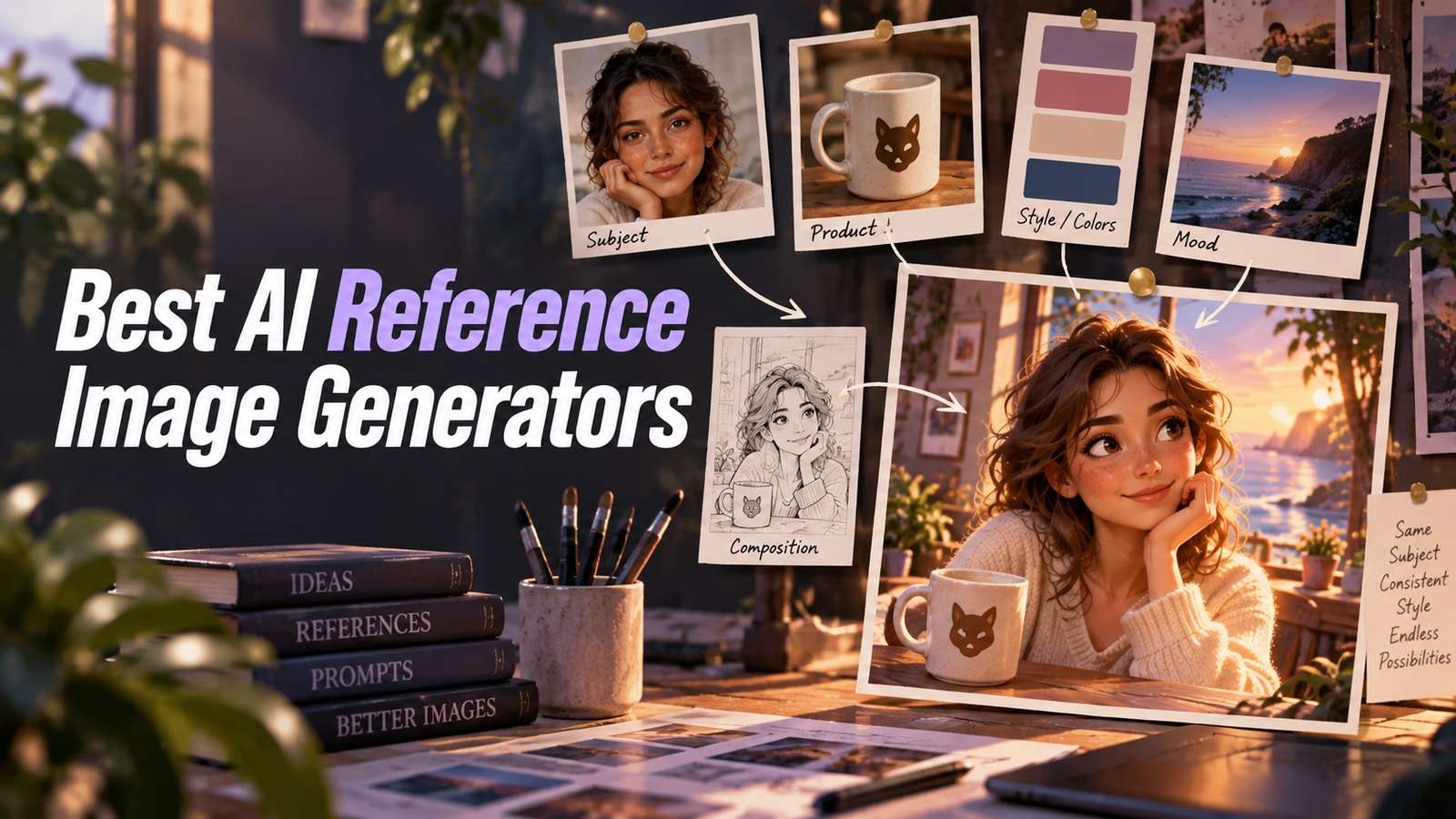
You uploaded a reference for a reason, but the model may only copy the lighting and ignore the person, the product, or the camera. If you want the best AI reference image generators, the useful question is not which output looks nicest. It is what your upload actually controlled.
I split that into four jobs: style, identity, product, and composition. Media.io, Midjourney, Ideogram, Leonardo, Krea, Flux, Reve, and ChatGPT can win one of those and miss the others. That is normal. The mistake is treating "reference" as one feature.
If you have ever uploaded a packshot and gotten a pretty scene with a melted logo, you already know the feeling. This review helps you pick a tool for the job you actually have, then gives you a fast way to check whether the upload did any real work.
In this article
- A Reference Image Can Mean Style, Identity, Product, or Composition
- Best AI Reference Image Generators by Binding Type
- 8 Reference-Based AI Image Tools Worth Testing
- How to Tell Whether the Model Used Your Reference or Just Your Prompt
- The Reference Binding Test
- When to Upload One Reference vs a Set
- Final AI Generator With Reference Image Recommendations
- Reference Image AI Generator FAQ
A Reference Image Can Mean Style, Identity, Product, or Composition
Start by naming what the upload is supposed to do. If you send a face and the tool only keeps the color grade, the reference worked and still missed your job. Pick the generator after you pick that job, not before.
- Style bind: palette, medium, line quality, lighting grammar.
- Identity bind: the same person, character, or creature across new poses.
- Product bind: the same SKU, logo, or object in a new scene.
- Composition bind: camera, staging, and spatial layout from the reference frame.
Prompt editors change an existing photo. Reference generators create a new image that is supposed to obey an upload. Keep those jobs apart even when the same vendor offers both.
Best AI Reference Image Generators by Binding Type
Use this map to stop asking every model to bind everything.
| Tool | Strongest bind | Weaker bind | Reference input | Skip when |
|---|---|---|---|---|
| Media.io | Product and character-asset workflows in the browser | Automatic composition lock without direction | Image-to-image, character sheets, @character | You only need a Discord-native style blender |
| Midjourney | Style and mood | Exact product graphics | Style and image references | Legal needs a conservative commercial story |
| Ideogram | Text plus a visual reference | Strict identity sheets | Image plus prompt | The job is a turnaround, not a poster |
| Leonardo | Image guidance on a canvas | Strict identity lock | Image guidance and canvas | You refuse to tune strength |
| Krea | Realtime style exploration | Locked product labels | Live reference steering | You need a still, spec-true packshot |
| Flux | Prompt-faithful generations with references in supporting tools | Vendor-standard character systems | Varies by host | You need an official character library UI |
| Reve | Reference-first generation | Mature enterprise workflows | Upload-led | You need a long-proven production pipeline |
| ChatGPT | Conversational use of uploaded refs | Repeatable sheet production | Images in chat | You need deterministic batch output |
8 Reference-Based AI Image Tools Worth Testing
Each review is a bind/ignore diagnosis: what the tool is likely to bind, what it is likely to ignore, and how to catch the ignore in one glance.
Media.io
If the upload is a product, a character, or a still you want interpreted rather than casually restyled, Media.io is the browser reference desk. The image to image workspace is the core reference surface, with current models including Nano Banana 2, Nano Banana Pro, GPT Image 2, Seedream 5.0, ToMoviee Lite/Pro, and Imagen 4. For characters, Media.io supports @character, character sheets, and saving outputs to assets, which is a different bind from a one-off style reference.
What it usually copies: likely to bind the uploaded still when you stay in image-to-image and name the bind. Likely to ignore composition unless you describe camera and staging. For game-adjacent sheets, the character generator is the sheet path rather than a generic style blender.
Choose Media.io when reference work has to stay in a browser marketing or character workflow. Skip it if you only want Midjourney's community style grammar.
Midjourney
If you mainly need mood, medium, and lighting from a reference, Midjourney is the style-bind specialist. Exact logos, readable packaging, and strict identity sheets often do not land.
What it usually copies: bind style; suspect product graphics and legal identity. If the output keeps the color grade but loses the SKU, the reference "worked" on the wrong bind.
Ideogram
If the new image must still say something readable, Ideogram is the reference-plus-text option. Pure style engines do not earn that slot.
What it usually copies: bind text layout more than a full character bible. Check spelling every time, including on the referenced words you thought were locked.
Leonardo
If you need to see how hard the reference is binding, Leonardo is image guidance you can see. Strength sliders make the bind/ignore diagnosis operational: high strength can over-copy, low strength can ignore the upload and follow the prompt.
What it usually copies: bind whatever the guidance strength is actually set to. If you do not look at the slider, you do not have a reference workflow.
Krea
If you want to watch the bind appear and disappear while you move, Krea is realtime steering. That is invaluable for style exploration and dangerous for product lock, because the live picture can seduce you past a warped label.
What it usually copies: bind mood quickly; freeze and inspect before you trust a product or face.
Flux
If your team already has a host that accepts image conditioners, Flux-class models can stay in the stack. They are often prompt-faithful. Reference behavior depends on the host's implementation more than on a single official character studio.
What it usually copies: diagnose per host. Do not assume a Discord-less Flux UI binds identity the way a character-sheet product does.
Reve
If you want a reference-first generator rather than a text-first model with an image slot bolted on, Reve is the bind experiment. Run the same four-bind test you run on the majors, and keep it if a bind you care about actually sticks.
What it usually copies: unknown until you test; do not skip the diagnosis because the positioning says "reference."
ChatGPT
If you can say "keep this product, use that style reference, ignore the background," ChatGPT with uploaded images is the conversational reference path. The model may still collapse two binds into one pretty compromise.
What it usually copies: bind the bind you repeat. If you mention style more than identity, identity will lose. Separate turns beat mixed briefs.
How to Tell Whether the Model Used Your Reference or Just Your Prompt
Run a trap. Give a prompt that disagrees with the reference on one axis. If you upload a red product and prompt "blue bottle," the output tells you which input won. If you upload a wide shot and prompt "macro," you learn whether composition bound.
Other tells:
- The output keeps palette but loses silhouette: style bound, identity did not.
- The output keeps face but changes medium: identity bound, style did not.
- The output looks like the prompt's cliche and shares nothing measurable with the upload: the reference was ignored.
If you cannot name a measurable leftover from the upload, do not credit the reference. Credit the prompt.
Mixed references are how binds leak
Uploading a style image and a product image together without saying which one owns which axis is the most common production error. The model will average them. You will get a product that picked up the painting's brushwork on the logo, or a style frame that inherited the packshot's hard commercial lighting. Split the jobs. Bind style in one generation, bind product in another, then composite in an editor if you must combine them.
Character @mentions and sheet systems exist because identity is a long-running bind. A single pretty reference portrait is closer to a style image than to a character bible. If you need the same adventurer tomorrow, save a sheet and call that sheet, do not re-upload yesterday's hero crop and hope. Media.io's character assets are for that persistence. Midjourney style references are not a character database even when the community is good at repeating a vibe.
Composition binds are the least tested and the most useful for storyboards. If you need the same camera, say so. If you only needed the color grade, do not upload a carefully staged frame; you will fight the model when it copies the blocking. Pick the cheapest reference that contains only the bind you want. Extra pixels are extra instructions you did not mean to give.
When a vendor UI has a strength slider, treat it as the bind control, not as a quality control. High strength is not "better." It is "copy more of the upload." Low strength is not "worse." It is "follow the prompt more." If you cannot explain which way you moved the slider, you cannot explain why the reference failed.
The Reference Binding Test
Use four references, one bind each. Do not use one moodboard and hope.
- Style reference: a painting or photo with a distinct medium. Prompt a different subject.
- Identity reference: a character or person. Prompt a new pose and camera.
- Product reference: a packshot. Prompt a new environment.
- Composition reference: a storyboard frame. Prompt different content in the same staging.
- Score each output 0-2 on the intended bind and 0-2 on unwanted binds (leaks).
- Fail any product bind that changes label or geometry.
- Fail any identity bind that only copied hair color.
- Record which tool won which bind. There may be four different winners.
The point of the test is specialization. A stack of two tools is a valid result.
Legal and marketplace teams should treat product binds as rights objects, not as style toys. A generated scene that almost copies a competitor's pack, or that warps a registered mark, is a clearance problem even if the prompt was innocent. The binding test is also a risk test: if the model is too willing to copy, you may have a copyright issue; if it is too willing to invent, you may have a SKU issue. Neither extreme is "more AI." Both are production outcomes you can measure.
For identity binds used in entertainment, keep a do-not-generate list: living actors, existing copyrighted mascots, and your own unreleased costume details you are not ready to put on a vendor server. Reference uploads are still uploads.
When to Upload One Reference vs a Set
One reference is enough for style or composition. Identity and product usually need a set: front, three-quarter, detail. A single pretty portrait teaches hair, not structure. A single packshot teaches one face of the box, not the sides.
Upload a set when:
- The character must turn.
- The product has important side panels.
- The style reference is inconsistent and you need a median, not an outlier.
Stay at one image when you are isolating a bind and extra images would leak a second bind into the result.
A worked four-bind morning
Bring four files: a gouache painting, a character three-quarter, a cereal box packshot, and a storyboard frame. Do not put them in one zip and ask for "the same energy." Run style on the painting with a prompt for a train station. Run identity on the character with a prompt for a sitting pose. Run product on the cereal box with a kitchen table. Run composition on the storyboard with different actors.
You will usually get four different winners. Midjourney may take the gouache. Media.io or a character-sheet path may take identity. A product-aware image-to-image path should take the cereal box if the logo survives. Composition may go to Leonardo or ChatGPT if you describe the camera. That split is a successful test, not an indecisive one.
When a stakeholder says "just use the reference," make them pick a bind. Otherwise you will optimize a pretty compromise that is not usable in production. Compromises are how logos melt while everyone praises the lighting.
Final AI Generator With Reference Image Recommendations
Name the bind, then pick the tool. Do not buy a "reference" feature in the abstract.
- Use Media.io for browser image-to-image references, product stills, and character-sheet assets.
- Use Midjourney for style binds you will legally review later.
- Use Ideogram if the new image must keep readable text.
- Use Leonardo or Krea if you need visible strength or realtime steering.
- Use Flux or Reve if your host or test shows a bind the majors miss.
- Use ChatGPT if the reference brief will be negotiated in conversation.
Reference Image AI Generator FAQ
-
What is the best AI reference image generator in 2026?
Media.io is a strong browser option for image-to-image and character-asset references. Midjourney often wins style. Ideogram helps when text must survive. Leonardo, Krea, Flux, Reve, and ChatGPT cover canvas, realtime, host-based, reference-first, and conversational binds. -
What does a reference image actually control?
It may control style, identity, product, composition, or some mix. You have to name the intended bind and test it. The upload does not automatically lock everything in the photo. -
How can I tell if the AI ignored my reference?
Use a trap prompt that disagrees with the upload on one axis. If nothing measurable from the upload remains, the model followed the prompt. -
Should I use one reference or several?
One image is enough to isolate style or composition. Identity and product usually need a small set of views. Extra images can leak a bind you did not want. -
Is image-to-image the same as a prompt editor?
No. A prompt editor changes an approved photo in place. A reference generator creates a new image that should obey an upload. They fail differently. -
Can I use a product photo as a reference for a new scene?
Yes, that is a product bind. Fail the output if labels, geometry, or colorway change. Style from a second reference should not restyle the SKU. -
Do character references need a special tool?
Often yes. Character sheets, @character systems, and asset libraries bind identity better than a generic style reference slider. -
What is a reference binding test?
It is a four-upload test that scores style, identity, product, and composition binds separately, including leaks of the wrong bind.