

 ChatGPT
 Perplexity
 Gemini
 Claude
 Grok
Grok
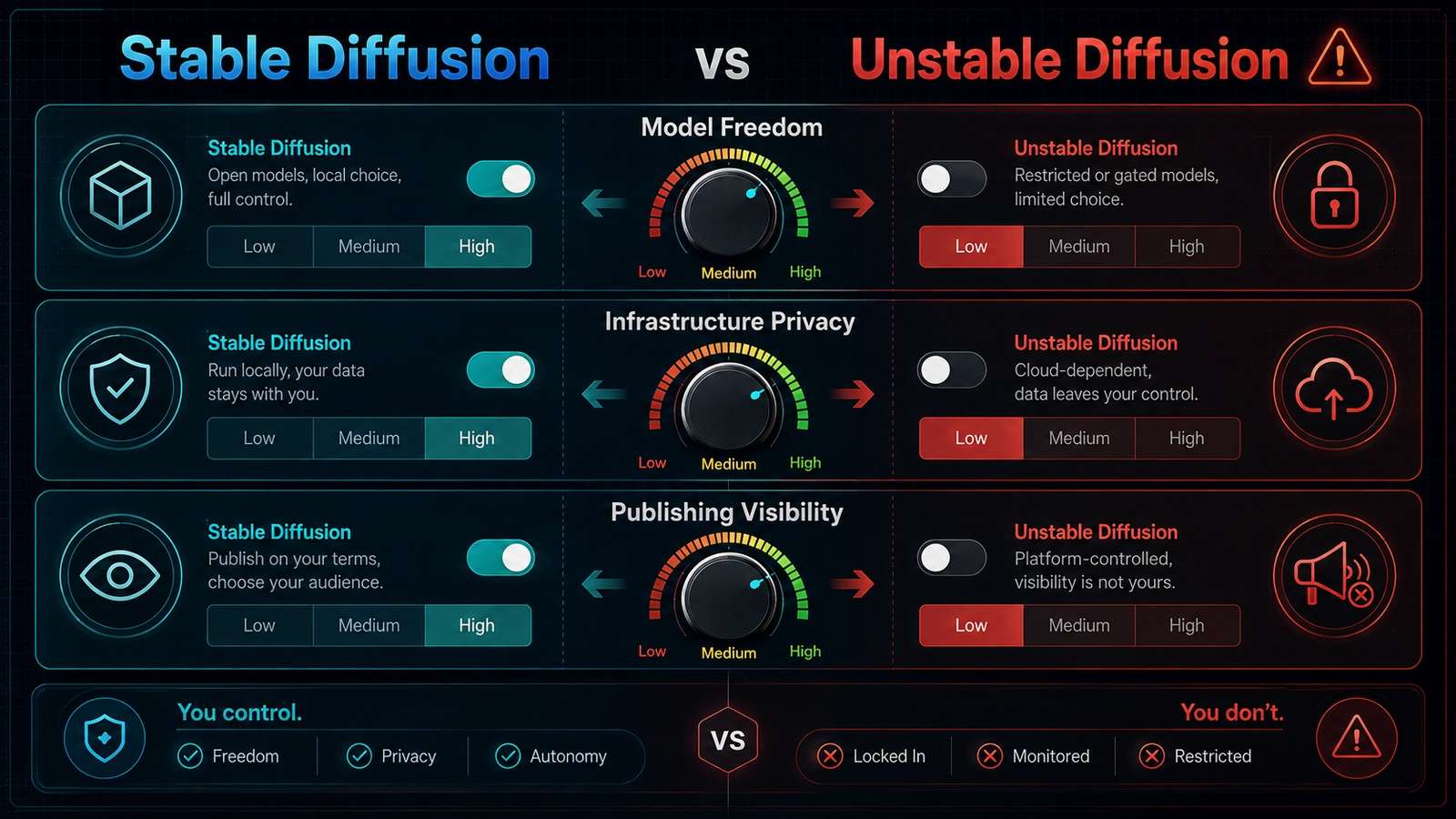
The names suggest a technical contest, but Stable Diffusion vs Unstable Diffusion is mainly a comparison of governance. Stable Diffusion refers to Stability AI's model family and the broad ecosystem built around downloadable weights, local interfaces, and third-party services. "Unstable Diffusion" has been used for a hosted service and community positioned around fewer creative restrictions. The decisive questions are who controls the model, where the prompt runs, what becomes public, and who is responsible for the output.
In this article
Do Not Confuse a Model Family with a Platform Brand
Stability AI releases official Stable Diffusion models such as the SD3.5 family under defined licenses. Depending on the variant and license, creators can download weights, run them on consumer hardware, fine-tune them, or access related models through APIs and applications. The surrounding ecosystem also includes thousands of community checkpoints and LoRAs with their own provenance and license terms.
Unstable Diffusion is not a "less stable" edition of the official model. Treat it as a separate provider or community experience. Its available models, content rules, visibility defaults, commercial terms, and privacy controls can change independently of Stability AI. Confirm the exact domain and current terms before signing in; the name has also been used loosely in third-party directories.
Creative Freedom Has Three Independent Switches
| Freedom | What it actually means | Common mistake |
|---|---|---|
| Model freedom | Choose or modify weights, LoRAs, samplers, and safety components | Assuming a hosted prompt box exposes its underlying model |
| Infrastructure freedom | Choose local hardware, private cloud, or a provider | Calling a generation private because it is not shown in a gallery |
| Publishing freedom | Control whether prompts and outputs are public, remixable, or retained | Ignoring community-feed defaults and account settings |
A local Stable Diffusion workflow can offer all three, but only when the user configures it carefully and has lawful models and inputs. A hosted service may offer broad prompt latitude while keeping the model and infrastructure closed. That is creative access, not ownership.
Privacy Is a Data Path, Not a Marketing Label
Trace a sensitive image from upload to deletion. On a local installation, ask whether extensions call external APIs, whether outputs sync to cloud storage, and whether the web interface is exposed outside the machine. On a hosted platform, ask whether prompts appear publicly, how long source images and outputs are retained, whether staff or subprocessors can access them, and how deletion works.
- Use a non-sensitive test image first.
- Check gallery visibility before the first generation.
- Read the current privacy policy and model-specific license.
- Remove metadata that is unnecessary for the task.
- Never upload a confidential client asset or a real person's image without authority.
- Save evidence of settings and terms for commercial work.
If privacy is the main reason for choosing Stable Diffusion, run locally without remote custom nodes and keep the interface behind a firewall. If convenience matters more, use a mainstream hosted tool with explicit retention and visibility controls. Media.io Image to Image is one browser-based option for reference transformations, but it should still be evaluated under the same data-handling checklist.
Choose by Risk Scenario, Not by the Word "Unrestricted"
Trace one sensitive prompt from keyboard to deletion
Imagine a creator uploads an unreleased character sheet and asks for a provocative variation. In a local Stable Diffusion setup, the prompt and image may remain on the workstation, but telemetry, cloud-synced folders, remote extensions, and automatic previews can still create external paths. In a hosted service, the browser sends the material through the operator's infrastructure; the relevant questions become encryption, employee access, retention, model-improvement use, deletion, and subcontractors.
A useful privacy review draws that path as a sequence of systems and assigns an owner to each step. If the Unstable Diffusion provider's current documentation cannot explain one of those steps, mark it "unknown," not "private." If the local installation uses unreviewed extensions, mark that risk too. This method avoids granting trust based on the word local, open, private, or unrestricted.
| Scenario | Better route | Why |
|---|---|---|
| Private concept art for an unreleased game | Controlled local Stable Diffusion | Models and references can remain within the studio environment |
| Exploring many public community styles | Hosted model community | Discovery and remixing are built into the experience |
| Client campaign requiring approval and audit | Governed commercial platform | Clear accounts, terms, retention, and review matter more than prompt latitude |
| Custom research on model behavior | Downloadable Stable Diffusion variant | Weights and inference pipeline can be inspected and controlled |
| Fast everyday image generation | Media.io or another mainstream service | No local environment or community model selection is required |
Fewer filters do not transfer legal or ethical responsibility away from the creator. Rights of publicity, privacy, copyright, trademark, defamation, harassment, and platform rules still apply. A tool's willingness to render a prompt is not evidence that the result is safe to publish or sell.
Stable Diffusion also does not guarantee safety by itself. Community checkpoints can have unclear training history, restrictive licenses, or undocumented behavior. Audit the exact artifact, not the family name.
A Safer Local Open-Model Setup
- Download models from known repositories and record hashes and licenses.
- Separate experimental workflows from production environments.
- Review extensions and custom nodes as executable code.
- Disable public network exposure and unnecessary telemetry.
- Maintain an approved model list for client work.
- Keep human review between generation and publication.
- Store consent and source rights for identifiable people and private assets.
For creators who need a standard image-generation workflow rather than a policy experiment, Media.io Text to Image provides a lower-complexity route. It does not promise open weights or unlimited model customization; that limitation is precisely why the comparison should begin with the user's real requirement.
Apply a governance gate before creative testing
| Gate | Evidence to collect | Stop condition |
|---|---|---|
| Operator identity | Legal entity, contact route, current domain | Ownership cannot be verified |
| Input handling | Retention, training use, deletion, access controls | Sensitive inputs may be reused without clear consent |
| Model rights | Base model and fine-tune licenses | Commercial scope is absent or contradictory |
| Output rules | Publishing policy and prohibited uses | The intended project conflicts with written terms |
| Incident response | Abuse, copyright, and security reporting process | No practical escalation channel exists |
Only after these gates pass should image quality enter the comparison. This order matters because an unrestricted service can produce the preferred image and still be unusable for a company, client, or paid campaign. Conversely, a locally governed Stable Diffusion workflow can support broader experimentation while preserving auditability - provided the team documents models and applies its own content rules.
Separate personal experimentation from publishable work
Create two lanes with different controls. The private experimentation lane can permit broader prompts while keeping inputs isolated, disabling public galleries, and preventing automatic sharing. The publishable lane should add identity and consent checks, intellectual-property review, disclosure requirements, client restrictions, and a named approver. An image moves between lanes only after review; the generator's willingness to produce it is not approval to publish it.
This model is especially useful for teams attracted to "unstable" or low-restriction branding. It preserves legitimate exploration without allowing the loosest generation policy to become the organization's publication policy. Stable Diffusion's composability makes such separation technically possible on controlled infrastructure, but governance still has to be designed and enforced.
If a hosted provider cannot support private experimentation without public exposure or unclear reuse, the service belongs only in the public, low-sensitivity lane - or outside the workflow entirely. That conclusion can be reached before anyone compares aesthetics.
Treat unverifiable claims as missing features
When a platform's ownership, policies, model provenance, or retention practices cannot be confirmed from current documentation, do not fill the gap with community assumptions. Mark the capability unknown and test only with non-sensitive material. This standard is stricter than reading a marketing page, but it matches the risk created by uploading prompts and references.
Stable Diffusion's published model information gives teams more material to inspect, yet third-party checkpoints and interfaces still require separate review. The comparison therefore ends with evidence quality: choose the system whose operational claims can be verified to the level the project requires, and keep higher-risk work in a controlled environment until they can.
Before adopting any "unrestricted" hosted service, map four questions to written evidence: who operates the service, what happens to prompts and uploads, which model license governs output use, and how abuse reports are handled. If the current site cannot answer them clearly, treat that uncertainty as a product limitation. A permissive prompt policy does not establish privacy, ownership, or operational reliability.
For local Stable Diffusion, freedom depends on the operator as well. Downloaded checkpoints can carry different licenses, extensions can introduce security risk, and a private workstation still needs access controls and deletion rules. The advantage is that each layer can be selected and audited. The responsibility is that the team must actually perform that audit instead of treating "local" as an automatic guarantee.
Stable Diffusion vs Unstable Diffusion FAQ
-
Is Unstable Diffusion an official Stable Diffusion version?
No. Stable Diffusion is Stability AI's model family. Unstable Diffusion is a separate name associated with a hosted service or community and should be evaluated independently. -
Does Stable Diffusion have no restrictions?
No. Model licenses, acceptable-use rules, local law, third-party rights, and the policies of any hosting service still apply. -
Is local Stable Diffusion completely private?
It can keep data on-device, but remote extensions, cloud synchronization, exposed web interfaces, or third-party APIs can change the data path. -
Can an unrestricted generator be used commercially?
Only if the relevant model and platform terms permit the use and the inputs and outputs do not violate third-party rights or law. Prompt acceptance is not a commercial license. -
Which option is easier for a beginner?
A hosted service is easier to start. Local Stable Diffusion requires hardware, installation, model selection, security, and maintenance, but provides more control.


