

 ChatGPT
 Perplexity
 Gemini
 Claude
 Grok
Grok
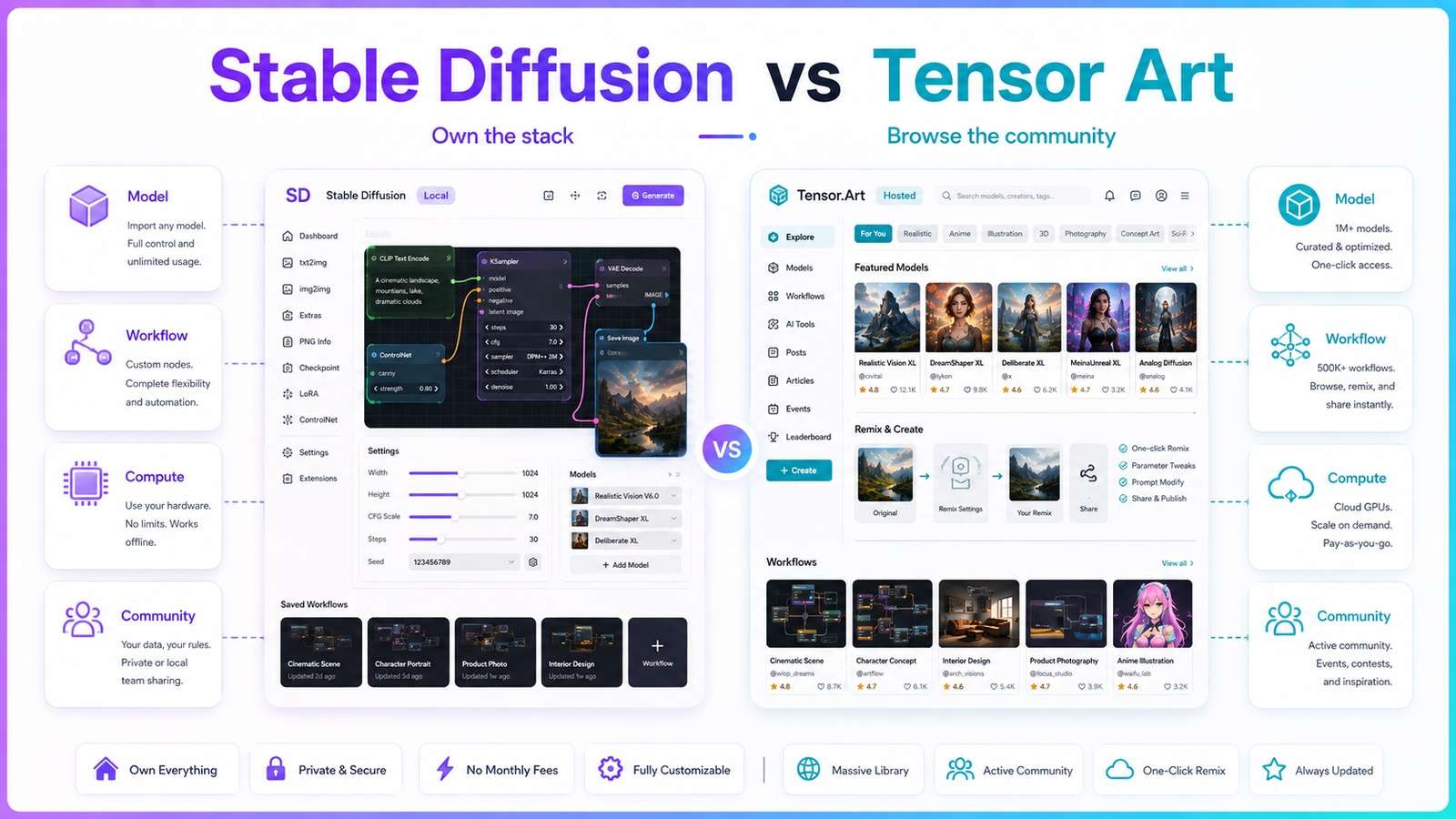
Stable Diffusion and Tensor.Art are not direct substitutes. Stable Diffusion is a family of image models and an ecosystem you can run through local interfaces, APIs, or third-party services. Tensor.Art is a hosted creation platform and community that gives you access to many models, LoRAs, ControlNet tools, and reusable workflows without building the machine underneath. The useful comparison is therefore not "which makes better art?" but "which parts of the stack do you want to own?"
In this article
One Is a Model Ecosystem; the Other Is a Place to Use Models
"Stable Diffusion" can mean the official Stability AI models, a local ComfyUI or Forge installation, a community checkpoint derived from SDXL, or a hosted API. The current family includes Stable Diffusion 3.5 variants and the efficient SD3.5-Flash research direction. The defining advantage is not one website interface. It is the ability to download selected weights, customize a pipeline, train adapters, choose hardware, and preserve a workflow outside one service.
Tensor.Art sits higher in the stack. Its value is access: browse example outputs, select a model or LoRA, copy a recipe, use ControlNet, open a visual workflow, and spend credits on hosted compute. It can run Stable Diffusion-based assets, but it also supports other model families and platform-specific tools. Saying "Tensor.Art is better than Stable Diffusion" is like saying a cloud IDE is better than a programming language; the answer depends on the job.
The Four Ownership Layers That Decide the Winner
| Layer | Local Stable Diffusion route | Tensor.Art route |
|---|---|---|
| Model | You keep compatible weights and select exact versions | You use models available or uploaded under platform rules |
| Workflow | You store graphs, presets, nodes, and dependencies | You save or remix hosted workflows and platform settings |
| Compute | Your GPU or a cloud machine you manage | Platform-managed GPUs metered through credits |
| Community | Distributed across repositories, model hubs, and forums | Integrated discovery, posts, examples, and remixing |
Stable Diffusion wins when the first three layers must remain portable. Tensor.Art wins when the fourth layer - the discovery loop - is central to your work. A creator learning pose control from public examples may progress faster on Tensor.Art than in an empty local interface. A studio preserving a product-generation pipeline for two years may prefer files and model hashes it can archive.
Turn "ownership" into an inventory, not a slogan
For one production workflow, list every dependency that must still exist six months from now: base checkpoint, VAE, LoRAs, embeddings, ControlNet models, custom nodes, sampler, scheduler, seed, post-processing model, and font or reference assets. Mark each dependency as locally archived, externally hosted, replaceable, or unknown. This inventory often changes the answer. A Tensor.Art workflow can feel self-contained while relying on community assets that the project owner has never downloaded. A local installation can feel durable while depending on an extension that has no maintained replacement.
Licensing belongs in the same inventory. Stability AI's community license for current Stable Diffusion releases, third-party checkpoint licenses, creator restrictions on LoRAs, and Tensor.Art platform terms are separate layers. The fact that a file is technically downloadable does not establish that it can be used for every commercial purpose. Record the license and source URL at the moment an asset enters the workflow; retroactive archaeology is slow and unreliable.
Stable Diffusion vs Tensor.Art by Real Workflow
| Need | Better starting point | Reason |
|---|---|---|
| Try many community styles quickly | Tensor.Art | Models, LoRAs, examples, and generation are connected |
| Keep client references off a third-party platform | Local Stable Diffusion | Inputs can remain on controlled hardware |
| Build repeatable ComfyUI graphs | Depends | Tensor.Art lowers setup; local files improve long-term ownership |
| Fine-tune a private product or character style | Local or private infrastructure | Dataset handling and model custody are easier to govern |
| Generate without installing models | Tensor.Art | Hosted compute removes driver and VRAM decisions |
| Create one campaign image and continue editing | Media.io | A simpler browser workflow may avoid model administration entirely |
Tensor.Art's workflow builder can chain models, LoRAs, ControlNet modules, and post-processing steps. That makes it more than a prompt box. Yet convenience does not guarantee portability. A workflow may refer to assets, custom components, or platform identifiers that do not exist in your local setup.
If you only need text-to-image and reference-based transformations, Media.io Text to Image and Image to Image provide a lower-maintenance path. They are not replacements for checkpoint training or node graphs; they are useful when the business requirement is an editable output rather than an owned diffusion environment.
Run a Five-Minute Portability Test Before Moving a Project
Do not compare only finished JPEGs. Pick one representative Tensor.Art generation and ask whether you can reconstruct it elsewhere. Record the model name and version, model hash when available, LoRAs and weights, prompt and negative prompt, sampler, steps, seed, dimensions, ControlNet inputs, upscaler, and any post-processing stage.
- Export the visible recipe and save every reference image.
- Confirm that each model and LoRA license permits your intended use.
- Rebuild the simplest text-to-image stage locally before adding controls.
- Match model version, resolution, seed, and sampler where possible.
- Add LoRAs and guidance one at a time and document differences.
If the recreation fails, identify the missing dependency instead of "prompt engineering" at random. Hidden defaults, unavailable private models, incompatible nodes, or a different VAE can matter more than the wording. A hosted workflow is production-ready only when you understand what happens if the platform, model page, or creator account disappears.
Credits and GPU Costs Measure Different Things
Tensor.Art meters hosted work through credits whose use can vary with dimensions, steps, count, model factor, and additional stages. A local Stable Diffusion installation has no per-image platform credit, but it still costs hardware, electricity, storage, setup time, and maintenance. Cloud GPU rental introduces another meter. Compare cost per approved asset, not cost per generation.
- Count rerolls and discarded experiments.
- Include time spent downloading and organizing models.
- Estimate storage for checkpoints, LoRAs, outputs, and backups.
- Price the recovery time after an extension or dependency breaks.
- For client work, include privacy review and license documentation.
Privacy follows architecture. A local workflow can keep data on-device only if it does not call remote nodes or APIs. A hosted platform can offer private generations, yet files still pass through its systems. Review current settings and terms before uploading an unreleased product, confidential reference, or identifiable person.
Use an exit-cost score
| Exit question | Low-risk evidence | Warning sign |
|---|---|---|
| Can the model be recovered? | Exact file, hash, license, and source are archived | Only a display name or community post remains |
| Can the workflow run elsewhere? | Dependencies and versions are documented | It depends on private nodes or platform-only settings |
| Can inputs remain confidential? | Storage path, retention, and access are controlled | Uploads and reuse rules are unclear |
| Can a teammate reproduce it? | A clean-machine test succeeds | Only the original creator knows the missing steps |
Score these questions before committing a recurring client workflow. Tensor.Art can still win when discovery speed and collaboration outweigh exit risk. Local Stable Diffusion can still lose when no one has the time to maintain the environment. The point is to price the dependency honestly rather than assuming that hosted means locked-in or local means portable.
Run the portability test in both directions. Export a Tensor.Art workflow and ask whether a new operator can identify every model, custom node, trigger word, and version needed to reproduce it elsewhere. Then take a local Stable Diffusion recipe and measure how much preparation is required before a collaborator can use it through Tensor.Art. A workflow is portable only when its dependencies, licenses, and files are available - not merely because the graph can be downloaded.
That distinction matters for client retention. A hosted project may be easy to share today but fragile if a community model disappears or a node changes. A local archive may be durable but difficult for nontechnical reviewers to access. Choose the ownership layer that matches the expected lifetime of the asset and write an exit plan before the campaign depends on it.
For a short social experiment, the exit plan can be minimal: exported images, prompts, and model names. For a recurring character or product pipeline, preserve hashes, licenses, workflow files, control references, and a rendered baseline for regression testing. Rebuild the workflow once on a clean environment. If it cannot be reproduced, the archive is a collection of clues rather than a production backup.
Decide what must survive the platform
Exported images may be enough for a completed campaign, but an evolving character, catalog, or visual product requires the generation recipe to survive. Tensor.Art should not be chosen for that work until the team proves it can retrieve every permitted dependency. Local Stable Diffusion should not be chosen until a second operator proves the archive can run. The survival requirement, not the number of available models, sets the correct ownership boundary.
Stable Diffusion and Tensor.Art FAQ
-
Is Tensor.Art the same as Stable Diffusion?
No. Stable Diffusion is a model family and ecosystem. Tensor.Art is a hosted platform that provides access to models, LoRAs, controls, workflows, and community content, including Stable Diffusion-based resources. -
Can Tensor.Art workflows run in local ComfyUI?
Some concepts and exported graphs may transfer, but successful migration depends on nodes, model files, versions, paths, and platform-specific components. Test each dependency. -
Which is better for privacy?
A fully local, correctly configured Stable Diffusion workflow gives the most direct control over inputs. Hosted services require review of current privacy, storage, and visibility settings. -
Is local Stable Diffusion free?
The software and many model weights may be available without per-image fees, but hardware, power, storage, maintenance, and model licenses still matter. -
Which is easier for beginners?
Tensor.Art is easier for browsing examples and generating without installation. Local Stable Diffusion becomes more valuable when a beginner is ready to manage models and repeatable workflows.


