

 ChatGPT
 Perplexity
 Gemini
 Claude
 Grok
Grok
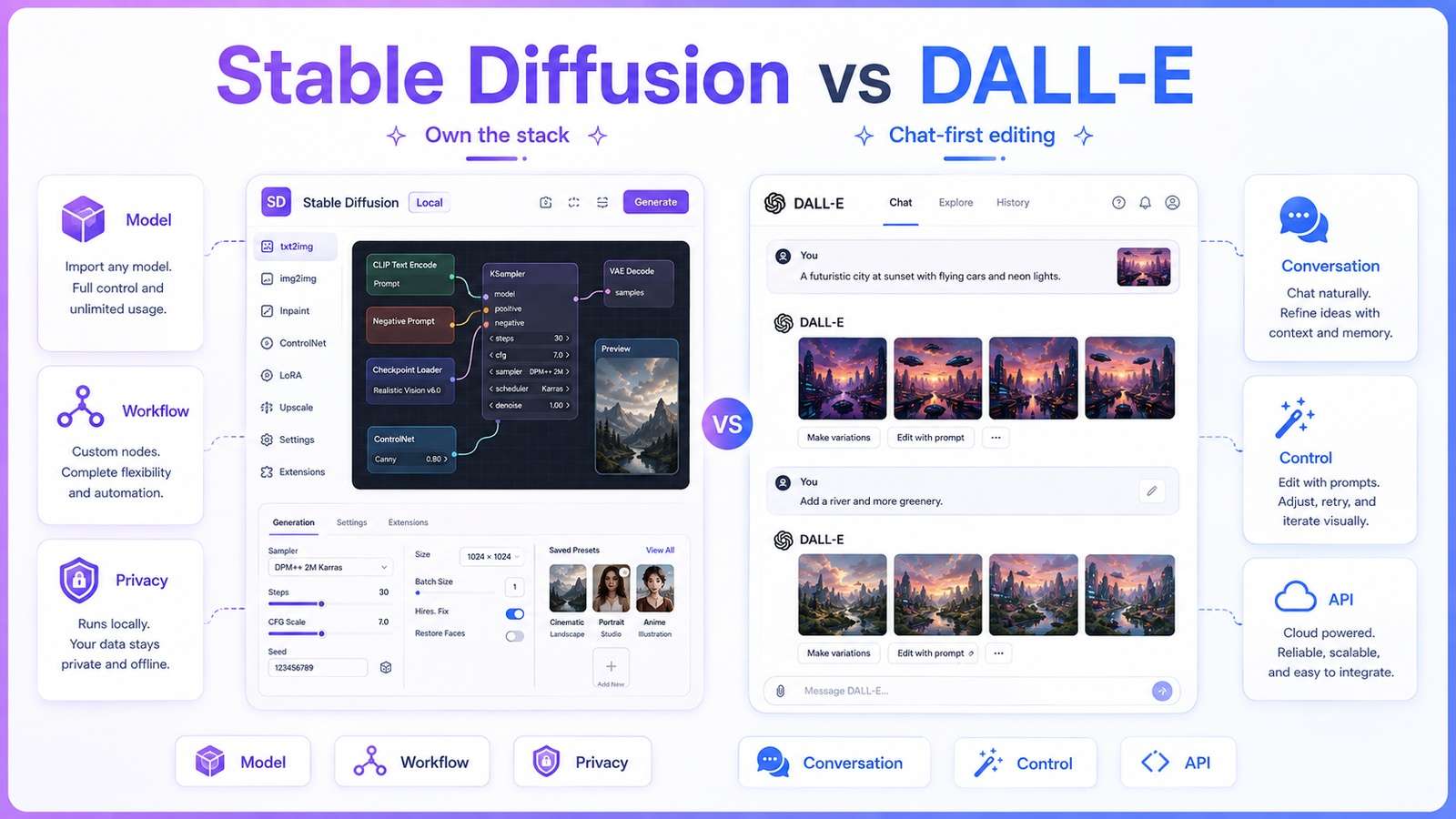
A 2026 comparison needs one correction before discussing image quality: the official DALL-E GPT has been retired from ChatGPT. People still search for "Stable Diffusion vs DALL-E," but the current OpenAI choices are ChatGPT Images 2.0 and GPT-Image-2 in the API. Stable Diffusion remains a family of downloadable and hosted models. The decision is now a model ecosystem versus a conversational image service.
In this article
"DALL-E" Is Now a Search Term for a Newer OpenAI Image Product
ChatGPT Images can generate a new image, edit an uploaded image, add text, produce transparent backgrounds, and continue revisions in conversation. Developers can use GPT-Image-2 through image generation and editing endpoints. This workflow hides samplers, guidance scales, model files, and VRAM behind natural-language instructions.
Stable Diffusion exposes a different value proposition. Official Stability AI models such as SD3.5 can be downloaded under applicable licenses, accessed through APIs, or run in interfaces such as ComfyUI, Invoke, and Forge. Creators can choose checkpoints, LoRAs, ControlNet-style guidance, seeds, nodes, and hardware. That flexibility can create a precise production system - or a maintenance burden.
A Service Remembers Intent; an Ecosystem Preserves Components
| Decision area | Stable Diffusion route | ChatGPT Images / GPT-Image-2 |
|---|---|---|
| Setup | Ranges from simple hosted app to full local stack | Ready in ChatGPT or through an API |
| Creative control | Models, LoRAs, nodes, samplers, seeds, and masks | Natural-language instructions and image references |
| Repeatability | Strong when versions, seeds, and dependencies are pinned | Strong for iterative intent, less about exposing diffusion parameters |
| Text inside images | Varies by model and workflow | A major use case of current OpenAI image generation |
| Privacy architecture | Can be local and self-governed | Cloud service with account and API data controls |
| Customization | Fine-tunes and community models | No downloadable weights or community checkpoint market |
Stable Diffusion preserves the ingredients of a render. ChatGPT preserves the conversation around the asset. A technical art team may prefer a saved graph with exact model hashes. A marketer may prefer saying "keep the bottle, move it left, change the headline, and make the background warmer" without rebuilding a node graph.
Use Five Briefs That Fail in Different Ways
A single fantasy portrait rewards whichever system has the stronger default aesthetic. Use a compact benchmark that exposes business-relevant differences:
- Typography: a poster with an exact eight-word headline, date, and price.
- Identity preservation: place the same person into a new setting without changing face, age, or clothing details.
- Product consistency: show one labeled package across three scenes while retaining geometry and copy.
- Spatial control: arrange four named objects in specified positions with open space for design text.
- Style production: reproduce a defined illustration look across six related scenes.
Score prompt adherence, number of rerolls, time to correct, consistency after the second edit, export resolution, and whether another teammate can repeat the result. Stable Diffusion often becomes stronger as the workflow is engineered. ChatGPT Images often becomes stronger as the instruction history accumulates.
Editing Is Where the Philosophies Separate
Score failure recovery, not only first-pass quality
Give each brief a planned defect: one misspelled label, one incorrect hand-object interaction, one composition with insufficient copy space, one identity drift across variants, and one prohibited background element. After the first output, issue the smallest possible correction. Record whether the system fixes the target, changes unrelated pixels, or forces a restart. This produces an edit-survival rate: successful local corrections divided by attempted corrections.
ChatGPT Images may understand a correction through conversation, but the model can reinterpret earlier decisions. Stable Diffusion can restrict a change with masks, ControlNet, regional prompting, or a node graph, but achieving that control requires preparation and operator skill. The useful metric is minutes from detected defect to approved revision, including mask creation, rerolls, node adjustments, and manual cleanup.
Stable Diffusion editing can use masks, inpainting, outpainting, ControlNet-style structure, reference adapters, regional prompting, and composable nodes. This is powerful when a studio knows exactly which controls it needs. It can also fail when model versions, extensions, or preprocessors change.
ChatGPT Images supports direct conversational editing and an editor with selection tools. The creator can describe the change rather than tune a pipeline. Selection boundaries are not always exact, and edits can affect areas outside the selected region, so a production team should compare revisions rather than assume pixel locking.
For a browser-first middle path, Media.io Image to Image supports prompt-driven reference transformations, while Text to Image handles new generation. It does not replace Stable Diffusion's custom model stack or ChatGPT's conversation memory; it fits creators who want a straightforward generate-edit-export workflow.
Choose the Deployment Boundary Before the Model
- Choose local Stable Diffusion for private inputs, custom models, offline work, inspectable pipelines, or high-volume jobs on owned hardware.
- Choose hosted Stable Diffusion when you want ecosystem controls without maintaining a GPU.
- Choose ChatGPT Images for conversational creation, precise instruction changes, integrated reasoning, and non-technical collaboration.
- Choose GPT-Image-2 API when a product needs OpenAI image generation and editing behind an application workflow.
- Use a two-tool stack when one system creates the art direction and another handles layout, typography, or deterministic finishing.
Review licensing at the exact model and service level. Stability AI's community license has revenue and use conditions, and community checkpoints can add their own restrictions. OpenAI's service terms and usage policies govern ChatGPT and API use. Neither product name removes the need to clear trademarks, people, source images, and client rights.
Estimate the twelve-month ownership burden
| Cost center | Stable Diffusion ecosystem | ChatGPT Images / GPT-Image-2 |
|---|---|---|
| Setup | Environment, models, nodes, GPU, security | Account or API integration |
| Creative iteration | Explicit controls and reusable graphs | Natural-language revisions and managed inference |
| Maintenance | Version pinning, model storage, compatibility fixes | Service changes, prompt adaptation, usage monitoring |
| Portability | High when all components and licenses are archived | Prompts and assets move; model behavior does not |
| Privacy | Can be local, depending on the complete toolchain | Requires review of service and API data handling |
A small creative team may rationally pay more per generated image to avoid maintaining infrastructure. A product company producing millions of controlled variants may justify engineering a Stable Diffusion stack. The break-even point is not a universal number: it depends on volume, acceptance rate, specialist labor, security requirements, and how often the workflow must be changed.
Use a boundary test for private and regulated work
Take the most sensitive realistic input - not a public stock image - and map where it travels. A local Stable Diffusion stack can keep source material on controlled hardware, but only if model managers, extensions, logging, backups, and remote access are also governed. A managed OpenAI workflow removes local infrastructure but requires the organization to evaluate the applicable service or API data terms, account controls, retention choices, and access patterns.
Next, separate privacy from model capability. A weaker local checkpoint with a controlled workflow may be the only acceptable choice for an unreleased design. A managed service may be acceptable for public campaign concepts and dramatically reduce operator burden. This is not an abstract policy question; it determines which briefs can enter each lane.
Document a fallback for rejected inputs and model-policy changes. The fallback might replace sensitive references with approved composites, route the job to the local stack, or require human editing. A comparison that ignores the fallback will overstate both convenience and automation.
Do not confuse inspectability with reliability
A Stable Diffusion workflow can expose every node and still be operationally fragile if model files are missing, extensions update independently, or the GPU environment cannot be rebuilt. Inspectability creates the opportunity for control; versioning, tests, and ownership create reliability. Include a clean-install recovery exercise in the evaluation.
ChatGPT's managed interface can feel reliable because infrastructure is invisible, but the team does not pin the full service behavior. Maintain golden briefs and accepted-output criteria so product changes are detected. Stop using either route for a critical pipeline if no one owns regression testing, incident handling, and the conventional editing fallback.
Archive one accepted result from each route, then try to recreate it thirty days later. For Stable Diffusion, preserve the checkpoint, VAE, LoRAs, extensions, workflow graph, seed, sampler, dimensions, and software versions. For ChatGPT Images, preserve the source assets, full conversation, selected output, and subsequent edit instructions. The exercise reveals the difference between component reproducibility and intent continuity.
Teams should also score maintenance. Stable Diffusion ownership includes security updates, model storage, compatibility breaks, GPU capacity, and license review. OpenAI's managed route shifts that burden to the service but ties the workflow to current product behavior and policy. These costs are invisible in a one-prompt comparison yet often determine which choice remains usable after the first project.
Stable Diffusion vs DALL-E FAQ
-
Did OpenAI discontinue DALL-E?
The official DALL-E GPT in ChatGPT has been retired. Current image creation uses ChatGPT Images, while developers can use current GPT Image models through the API. -
Which is better for text in images?
Current OpenAI image generation is designed for instruction following and text rendering. Stable Diffusion results vary by model and may need a specialized workflow or later design step. -
Can Stable Diffusion run offline?
Compatible models and interfaces can run locally after setup. Confirm that extensions and nodes do not call remote services if offline privacy matters. -
Which is cheaper?
It depends on volume and labor. Local Stable Diffusion avoids per-image platform charges but requires hardware and maintenance. OpenAI usage is metered through a plan or API pricing. -
Which is better for custom characters?
Stable Diffusion supports specialized models, LoRAs, and structured pipelines. ChatGPT Images can preserve references through edits, but does not offer the same downloadable customization ecosystem.


