

 ChatGPT
 Perplexity
 Gemini
 Claude
 Grok
Grok
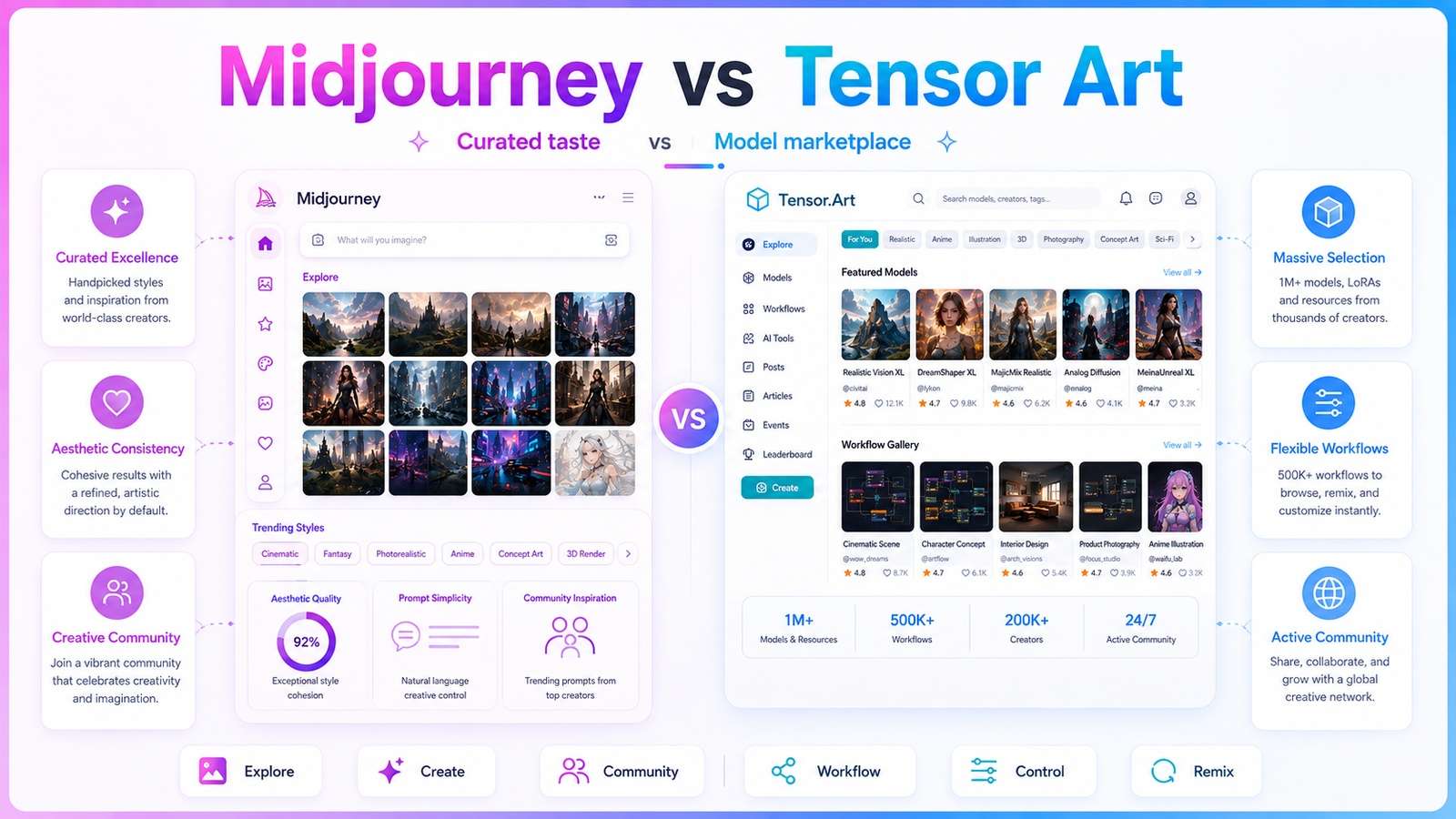
Midjourney and Tensor.Art optimize opposite sides of AI art creation. Midjourney gives creators a curated model experience, strong aesthetic defaults, personalization, and a unified editor. Tensor.Art gives creators a marketplace-like universe of models, LoRAs, ControlNet recipes, visual workflows, and community examples. The choice is one powerful point of view versus thousands of possible recipes.
In this article
Midjourney Reduces Decisions; Tensor.Art Expands Them
Midjourney V8.2 is the current default model and emphasizes aesthetics, image quality, personalization, style references, and a new Edit Model. The service encourages users to develop taste through moodboards and ratings rather than assemble a model pipeline. You can work on the web or through Discord without choosing checkpoints or resolving node dependencies.
Tensor.Art connects model browsing with generation. A creator can study example images, inspect settings, use checkpoints and LoRAs, add ControlNet guidance, train models, or build a visual workflow. This makes it easier to discover a niche anime, illustration, game, or realistic style. It also creates more opportunities to choose the wrong combination.
The Hidden Cost of Tensor.Art Is Model-Selection Debt
Abundance looks like creative freedom until a team must reproduce an image six weeks later. A Tensor.Art result can depend on a base model, VAE, LoRAs and weights, sampler, scheduler, seed, dimensions, ControlNet inputs, upscaler, and workflow version. Every dependency must remain available and licensed for the intended use.
Midjourney shifts that burden to the provider. You choose a version and creative parameters, but not the underlying checkpoint graph. The trade-off is dependency on Midjourney's service, model updates, content rules, and public-by-default community. Simplicity is real, but it is not ownership.
| Question | Midjourney | Tensor.Art |
|---|---|---|
| How many model decisions before generating? | Few | Potentially many |
| Can I use community LoRAs? | No comparable open marketplace | Yes, subject to model availability and licenses |
| Can I build a node workflow? | No | Yes, through the workflow builder |
| Does the platform supply a strong default style? | Yes | Depends on selected model and recipe |
| Can the community remix discoveries? | Yes, through Midjourney's open community | Yes, through models, posts, and workflows |
Measure search entropy
Give the creator a fixed forty-five-minute session and record how many minutes are spent producing images versus deciding what to load. In Tensor.Art, count checkpoint comparisons, LoRA combinations, trigger-word research, workflow inspection, and failed dependencies. In Midjourney, count time spent refining the prompt, moodboard, personalization, style references, and candidate selection. The ratio reveals where each platform places complexity.
High search entropy is not automatically bad. A specialist can turn Tensor.Art's breadth into a durable advantage by building a small approved stack for anime, product scenes, or portrait control. The problem arises when every brief restarts model discovery. Midjourney lowers that discovery burden through a narrower product surface, but creators can become dependent on its current aesthetic behavior and private personalization history.
The Better Community Depends on What You Want to Discover
Midjourney's gallery teaches composition and aesthetic direction. Search, style references, moodboards, and personalization make visual taste the organizing layer. Tensor.Art's community teaches model recipes. Examples help users find which checkpoint, LoRA, pose control, or workflow produces a particular look.
- Choose Midjourney discovery to find visual directions and refine personal taste.
- Choose Tensor.Art discovery to find models, LoRAs, and technical recipes.
- Check whether prompts and outputs are public by default on either platform.
- Review creator licenses before reusing a model or LoRA commercially.
- Preserve attribution and dependency details outside the platform.
Privacy is not a side note. Midjourney's Stealth Mode is tied to Pro and Mega plans, while shared spaces can still expose creations. Tensor.Art has its own visibility and private-workflow controls. Test settings with a harmless image before uploading a client reference.
Use a Six-Scene Consistency Trial
Do not choose from one hero image. Define a character or product with five anchors - silhouette, color palette, face or geometry, signature detail, and material - and request six scenes:
- Neutral studio view.
- Wide environmental composition.
- Close-up with small details visible.
- New pose or camera angle.
- Different lighting while preserving color.
- One edit that changes only a specified object.
Midjourney may reach a polished direction faster through personalization and references. Tensor.Art may achieve tighter control after you locate the correct model and build a repeatable recipe. Track rerolls, accidental changes, and how easily another creator can reproduce the sequence.
Audit why continuity succeeds
After scoring the six scenes, remove one control at a time. In Midjourney, compare the result without personalization, without the style reference, and without the image prompt. In Tensor.Art, remove the character LoRA, ControlNet condition, or selected checkpoint. This ablation test shows which dependency actually preserves the character and whether the recipe can be simplified.
| Continuity dimension | What to inspect | Typical false positive |
|---|---|---|
| Identity | Face shape, age, hairline, distinctive features | Similar lighting hides a different face |
| Wardrobe | Cut, fasteners, patterns, accessories | Color matches while garment structure changes |
| Style | Line, texture, lens, palette, contrast | A filter creates cohesion without subject fidelity |
| Edit locality | Requested region changes and all others remain | A successful pose change silently alters identity |
The ablation result also improves handoff. A team can document the minimum control set instead of sharing a fragile pile of parameters. That is particularly valuable in Tensor.Art, where community workflows can accumulate components whose contribution is unclear.
Build a creative stack that can be taught
Ask the most experienced operator to prepare a one-page recipe for a recurring visual style. A Midjourney recipe should include version, personalization state, moodboard, style or image references, Raw choice, aspect ratios, and a curation example showing why one candidate was selected. A Tensor.Art recipe should include model identifiers, LoRA weights and triggers, sampler, seed policy, ControlNet inputs, workflow version, and license links.
Give each recipe to a new creator and measure the gap between the expert's result and the newcomer's result. Midjourney may be easier to start but harder to transfer when quality depends on tacit taste. Tensor.Art may look complicated but become teachable once the organization narrows the marketplace to an approved stack. The training result is more useful than counting buttons or community models.
Also decide who owns maintenance. Midjourney updates can change default behavior, so teams need regression prompts and reference examples. Tensor.Art dependencies can disappear or become incompatible, so teams need archived assets and version records. The winning platform is the one whose maintenance work matches the organization's actual skills.
Stop when the community becomes the workflow
Tensor.Art is a poor fit when creators spend more time copying attractive community recipes than understanding whether those recipes meet the brief, carry appropriate licenses, or can be reproduced. Set an exploration budget and require every production component to have a recorded purpose. If a dependency cannot be explained, remove it and retest.
Midjourney is a poor fit when its coherent house behavior repeatedly overrides exact layout, identity, or brand constraints and the team cannot export the control system into another environment. A curated experience is valuable only while its opinion aligns with the work. The stopping rule is repeated manual reconstruction after generation, not the absence of advanced controls on a feature list.
Which Creator Should Choose Each Platform?
| Creator profile | Recommended start | Reason |
|---|---|---|
| Art director exploring campaign moods | Midjourney | Strong defaults and personalization reduce setup |
| Anime creator using specific LoRAs | Tensor.Art | Model community and recipe controls are central |
| Technical artist building reusable pipelines | Tensor.Art | Visual workflows and components can be assembled |
| Solo creator who dislikes model management | Midjourney | One service supplies the creative environment |
| Marketer needing a quick browser asset | Media.io | Generation and image transformations avoid both ecosystems' complexity |
Media.io Text to Image is a practical third route when the user does not need Midjourney personalization or Tensor.Art's model marketplace. Reference-based changes can continue in Media.io Image to Image. The limitation is lower model-level control; the advantage is a shorter path to a finished social or campaign asset.
A useful Tensor.Art test begins before generation: limit the evaluator to a fixed amount of model-search time. The platform's range is an advantage only if the creator can find and understand the right checkpoint, LoRA, trigger words, and workflow. Record time spent browsing, reading examples, resolving incompatible components, and recreating a result. That is the platform's model-selection debt.
Then repeat the six-scene trial with a second operator. Midjourney may transfer through a moodboard, personalization profile, and concise style vocabulary. Tensor.Art may transfer through explicit model and workflow components. The better collaboration system is the one whose creative intent survives the handoff with fewer unexplained choices - not necessarily the one with more community assets or the most striking single image.
Midjourney vs Tensor.Art FAQ
-
Is Tensor.Art a free Midjourney alternative?
Tensor.Art offers hosted model generation and a community ecosystem, but usage is credit-based and features differ. It is not a replica of Midjourney's curated model and personalization system. -
Which is better for LoRAs?
Tensor.Art is the relevant choice because it supports community models, LoRAs, training, and workflow components. Midjourney does not expose a comparable LoRA marketplace. -
Which is easier to learn?
Midjourney is easier if you want strong results without choosing model components. Tensor.Art becomes easier when example recipes match your exact style or control need. -
Which is better for anime art?
Tensor.Art offers many anime checkpoints and LoRAs, while Midjourney provides Niji models and a curated experience. Test character consistency and required style specificity. -
Can I keep generations private?
Both require checking current plan and visibility settings. Midjourney limits Stealth Mode to qualifying plans; shared spaces may remain visible.


