

 ChatGPT
 Perplexity
 Gemini
 Claude
 Grok
Grok
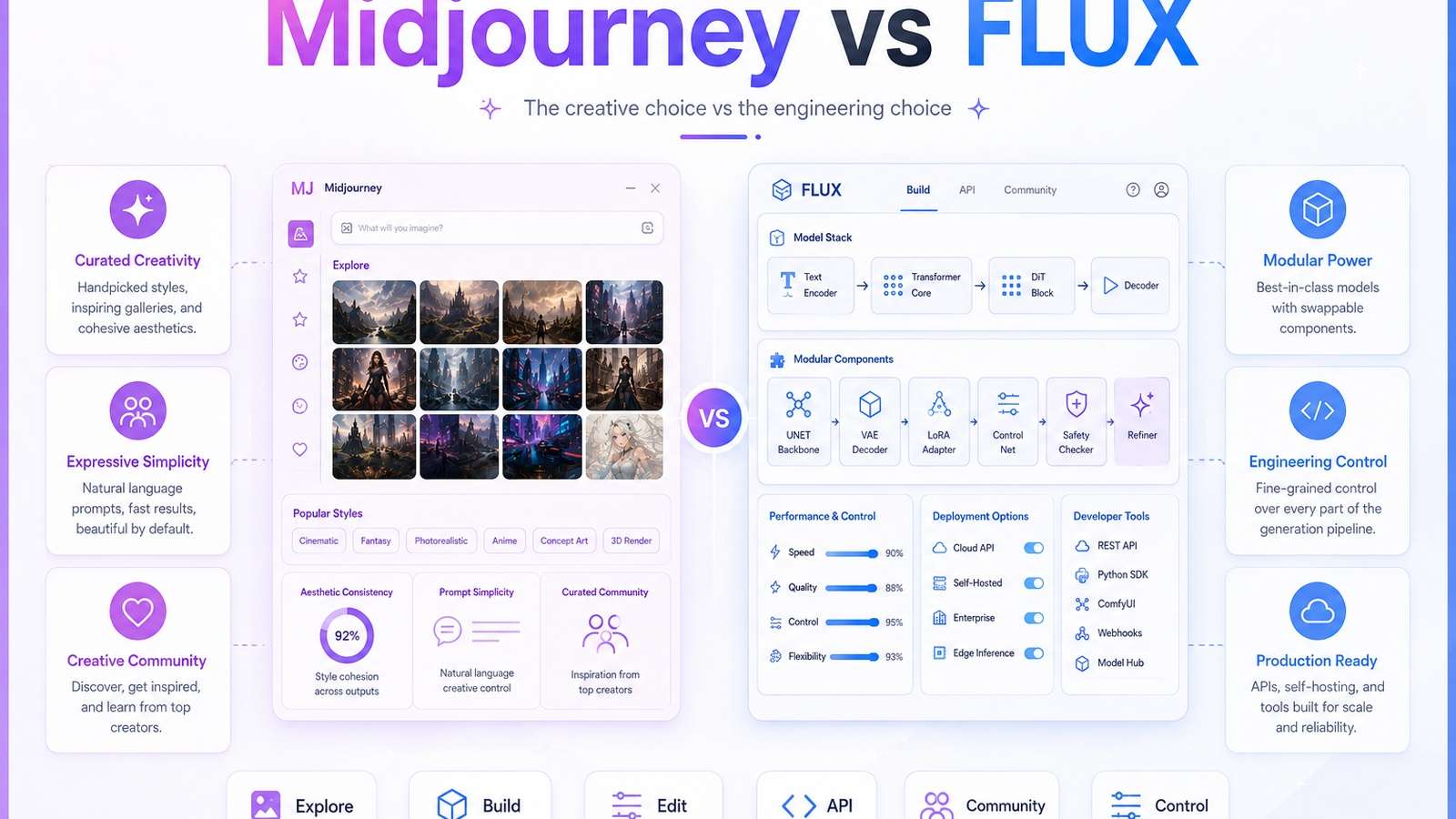
Midjourney vs FLUX is a choice between two operating philosophies. Midjourney V8.2 is a subscription creative service with a strong aesthetic point of view, personalization, style references, and an integrated Edit Model. FLUX.2 is a family that spans high-end hosted APIs, specialized variants, multi-reference editing, and selected open-weight models. One behaves like a guided art director; the other can become infrastructure.
In this article
Midjourney Sells Taste; FLUX Sells a Range of Deployment Choices
Midjourney's default results are deliberately opinionated. V8.2 emphasizes aesthetics, image quality, and personalization; users can steer style through moodboards, style references, image prompts, Raw mode, and the current Edit Model. The service hides model hosting and rewards rapid visual exploration.
Black Forest Labs positions FLUX.2 as its recommended image generation and editing family. Hosted variants target quality, typography, speed, or flexibility, while FLUX.2 Klein includes open-weight options for consumer GPUs and LoRA training. The advantage is not one universal "FLUX look." It is choosing an endpoint or deployment that matches the production requirement.
Compare Midjourney V8.2 with the Right FLUX.2 Variant
| Need | Midjourney V8.2 | Relevant FLUX.2 route |
|---|---|---|
| Fast aesthetic exploration | Strong defaults, personalization, moodboards | Hosted FLUX.2 Pro or Max with explicit art direction |
| Typography and small details | Test current V8.2 behavior | FLUX.2 Flex is specialized for text and detail |
| Multi-reference composition | Image/style references and Edit Model | FLUX.2 supports multi-reference editing |
| Local or controlled deployment | Not offered as downloadable weights | Selected FLUX.2 Klein open-weight variants |
| Personal taste profile | Native personalization system | Prompt systems, references, or LoRA training |
| Application integration | No general public image-generation API | Official API endpoints and deployment routes |
Do not compare Midjourney against an unspecified "FLUX." A FLUX.2 Max API call, a Flex typography job, and a local Klein 4B model solve different problems. Record the exact version in every evaluation.
Art Direction, References, and the Second Edit
Midjourney is excellent when a creator wants the system to contribute taste. A short prompt plus a developed personalization profile can deliver polished compositions quickly. That same aesthetic prior can become friction when a brand needs a deliberately plain catalog image, an exact layout, or a style that should not be "improved." Raw mode reduces some default styling but does not turn the service into an open pipeline.
FLUX.2 accepts detailed instructions, exact colors, and multiple references for editing. It can preserve a product or character across variations when the prompt and references are well designed. The creator must supply more of the art direction and choose the correct model. Open-weight variants also require hardware and a reproducible inference setup.
Use the second edit as the real test. Generate one product scene, replace the background, change one prop, then correct a line of packaging text. Score which system preserves geometry, label, color, and lighting. The best first render can be the weaker production model if every revision rebuilds the subject.
Distinguish taste consistency from subject consistency
A sequence can look cohesive because every image shares a cinematic grade, even while the product, character, or garment changes. Midjourney's personalization and style references are strong tools for taste consistency. FLUX.2's multi-reference routes can be used to anchor concrete identity and product details. Score these dimensions separately: palette and photographic language on one line; face, silhouette, packaging, and logo geometry on another.
For a campaign, create one "do not drift" sheet containing the attributes that must survive every generation. Include reference crops and tolerances for color, proportions, texture, and typography. The winner is not the system that produces the most similar-looking gallery. It is the one that protects the attributes the brand cannot afford to change.
GPU Minutes, API Credits, and Local Compute Are Not Comparable Prices
Midjourney subscriptions meter Fast GPU time and offer Relax Mode on qualifying plans. Privacy through Stealth Mode is limited to higher tiers, and public content rules matter for client assets. FLUX can be billed through official API credits, a partner platform, or your own compute for open-weight variants. These units cannot be compared by dividing two prices.
- Choose a monthly production volume and representative resolution.
- Measure accepted assets, not total generations.
- Add rerolls, edits, and upscales.
- For local FLUX, include GPU, power, storage, setup, and maintenance.
- For Midjourney, include plan tier required for privacy and throughput.
- Price designer time needed to finish text, layout, or masks.
A campaign team may accept higher generation cost if the output reaches approval faster. A product platform may prefer FLUX even with engineering overhead because API automation, model selection, and data architecture are core requirements.
Normalize to one approved campaign set
| Input to the calculation | Midjourney | FLUX.2 |
|---|---|---|
| Generation capacity | Plan, Fast GPU allowance, Relax availability | Endpoint price or local inference throughput |
| Privacy requirement | Eligible plan and correct creation context | Hosted provider controls or private deployment |
| Operator labor | Prompting, curation, Edit Model, external finish | Prompting, references, endpoint tuning, engineering |
| Acceptance rate | Approved assets per generation session | Approved assets per API or compute batch |
| Reuse value | Personalization and style-reference knowledge | Reusable API code, LoRAs, or local workflow |
Calculate these inputs for the same deliverable: one hero, three crops, two product variations, and one corrected-text revision. This prevents a cheap local inference from appearing free after engineering labor is ignored, and it prevents a subscription from appearing unlimited when privacy, Fast time, and finishing determine the useful capacity.
Use a Four-Asset Studio Benchmark
- Editorial hero: judge composition, lighting, novelty, and emotional direction.
- Product ad: judge geometry, exact brand colors, label text, and negative space.
- Character sequence: judge identity across pose, wardrobe, and environment changes.
- Revision chain: perform three edits and record what unintentionally changes.
If neither system's workflow fits a small creator team, Media.io Text to Image offers multi-model browser generation without local deployment, while Image to Image continues with reference-led transformations. It is a workflow simplification, not an open-weight or Midjourney-personalization replacement.
Ask different reviewers to score the benchmark before revealing which system made each image. Midjourney's recognizable polish can otherwise receive credit even when it misses the brief, while a technically faithful FLUX result can be underrated because it looks less immediately dramatic. Blind scoring should separate visual appeal, prompt compliance, edit stability, and delivery readiness.
For FLUX, record the exact variant and hosting route beside every output; "made with FLUX" is too vague to reproduce. For Midjourney, record the version, personalization state, style references, Raw setting, and visibility requirements. These notes turn an aesthetic shootout into a production decision and expose whether the winning result depends on one operator's private profile or on a portable recipe.
Choose where the creative system should live
Midjourney concentrates value in the creator's interaction with its service: curation, personalization, moodboards, and a fast loop for discovering a look. FLUX can concentrate value in the organization's own system: reusable reference preparation, endpoint routing, LoRAs, prompt schemas, approval tests, and application code. This difference affects ownership more than any one visual sample.
For an agency, ask whether a style can be transferred when the original art director leaves. A Midjourney process may depend on that person's taste profile and curation habits; document the moodboard, references, version, and selection logic. A FLUX process may depend on code, model files, adapters, and dataset rights; document those dependencies and who maintains them. Both can create institutional knowledge, but the knowledge lives in different places.
If the project is a one-off editorial concept, building infrastructure may be wasteful. If generation is part of a product, content operation, or recurring catalog, the ability to test, route, and deploy models can outweigh a more immediately attractive default. This strategic boundary should be decided before comparing minor prompt tricks.
Identify the point where aesthetic speed becomes lock-in
Midjourney's value compounds when a creator develops a reliable taste profile, but that asset cannot be evaluated like a downloadable model or shared API configuration. If client work depends on it, run the same brief with a clean profile and another operator. A large quality drop signals that the workflow is tied to personal history.
FLUX has a different lock-in pattern: reference preparation, prompts, endpoint-specific parameters, LoRAs, and acceptance tests can accumulate around one variant or host. Test substitution before production. If neither route can survive the departure of one operator or provider without a documented recovery plan, the team has discovered a business-continuity risk rather than a model preference.
Midjourney vs FLUX FAQ
-
Is FLUX open source?
Do not apply one label to the entire family. Some FLUX.2 Klein variants have open weights, while hosted Pro, Max, and Flex offerings have different access and license conditions. -
What is the current Midjourney model?
Midjourney lists V8.2 as its current default version, with updated aesthetics, personalization, and the Edit Model. -
Which is better for an API?
FLUX provides official API and deployment options. Midjourney is primarily a subscription creative service and does not offer the same general public generation API workflow. -
Which is better for text in images?
FLUX.2 Flex specifically targets typography and detail. Midjourney V8.2 should still be tested on the exact layout and edit sequence rather than judged from showcase images. -
Which is better for privacy?
A controlled open-weight FLUX deployment can keep data within your environment. Midjourney's Stealth Mode requires an eligible plan, and creations in shared spaces can still be visible.


