

 ChatGPT
 Perplexity
 Gemini
 Claude
 Grok
Grok
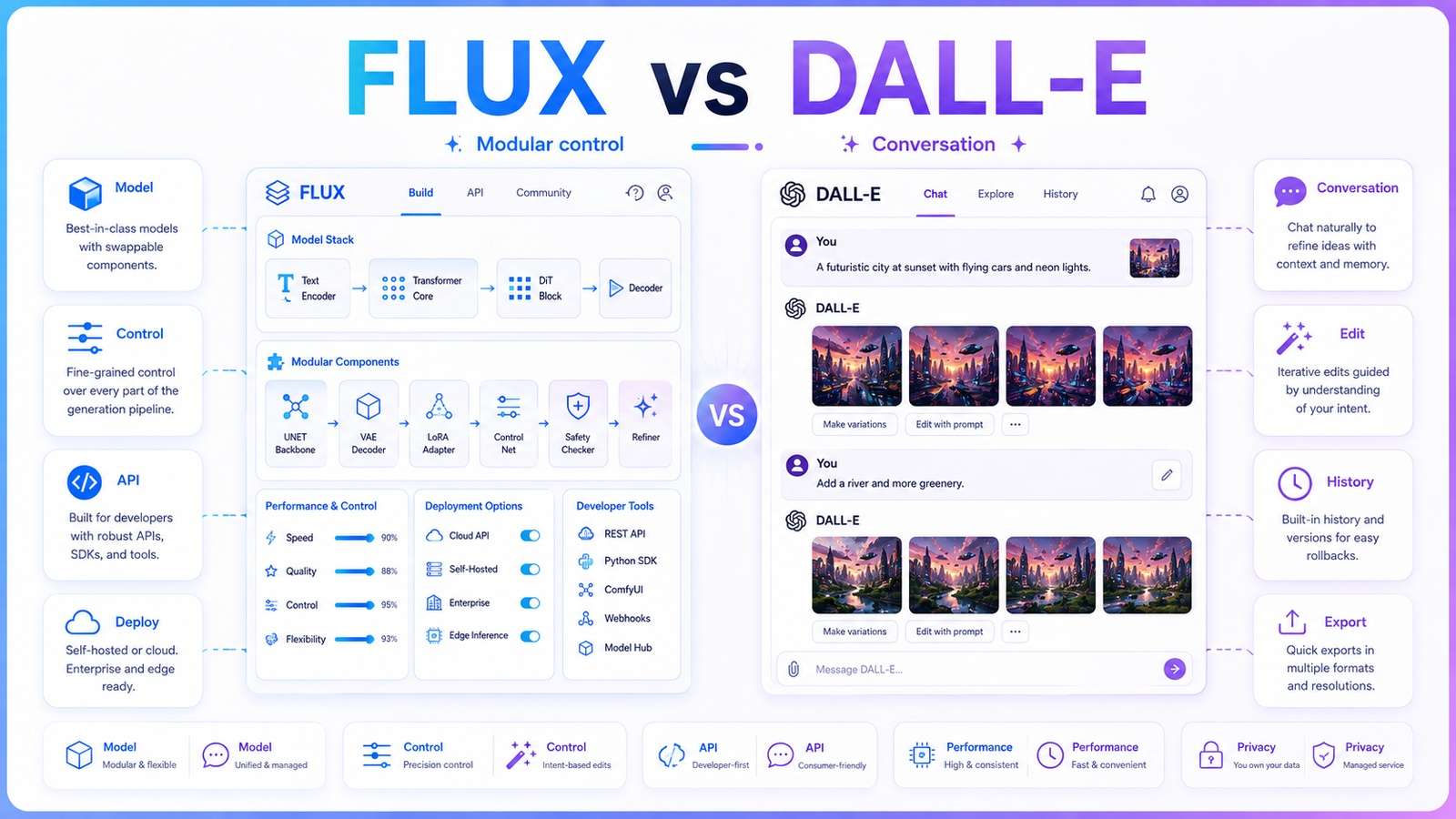
FLUX vs DALL-E should be tested after the first attractive image. In 2026, the relevant models are FLUX.2 and GPT-Image-2, not only FLUX.1 against DALL-E 3. Both can generate and edit images, follow detailed instructions, and handle text. Their difference becomes clearer when a product, person, layout, and brand color must survive several revisions.
In this article
Compare FLUX.2 with GPT-Image-2, Not Old Brand Memories
Black Forest Labs recommends FLUX.2 for current text-to-image and editing projects. The family includes quality-focused Pro and Max options, Flex for typography and small details, and Klein variants designed for speed and selected open-weight deployment. FLUX.2 supports multi-reference editing, exact color instructions, flexible aspect ratios, and outputs up to 4MP on supported routes.
OpenAI's current developer model is GPT-Image-2, while ChatGPT users interact with ChatGPT Images 2.0. It supports image generation and editing with high-fidelity image inputs and a conversational interface in ChatGPT. The DALL-E keyword remains useful for search, but production decisions should name the current model and endpoint.
FLUX Exposes a Model Family; OpenAI Connects Images to Conversation
| Capability | FLUX.2 | GPT-Image-2 / ChatGPT Images |
|---|---|---|
| Multi-reference editing | Explicit support for combining multiple input images | High-fidelity image inputs and conversational editing |
| Exact color control | Supports instructions such as HEX colors on relevant workflows | Describe the target color and revise conversationally |
| Typography route | Flex variant specializes in typography and detail | Current OpenAI image generation emphasizes accurate text |
| Open-weight path | Available for selected Klein variants under their licenses | No downloadable GPT-Image-2 weights |
| API | Official model-specific endpoints | OpenAI image generation and edit endpoints |
| Consumer workflow | Access through providers and applications | ChatGPT conversation and image editor |
FLUX.2 can be treated as a component selected for a job: maximum quality, fast iteration, typography, or local control. OpenAI offers a more unified interaction model: discuss the brief, upload references, generate, and continue changing the asset in context. Developers still need to convert that creative logic into repeatable API calls.
Run a Three-Round Product Campaign Benchmark
Use a real package or device rather than a generic portrait. Prepare a clean product reference, logo and label crop, palette, background reference, and layout sketch.
- Round one - creation: place the product in a new scene with exact camera, surface, lighting, and empty copy space.
- Round two - adaptation: create square and vertical variants while preserving product scale, geometry, label, and material.
- Round three - correction: change one prop, one HEX color, and one line of text without altering anything else.
Score each round independently. A model can win creation and lose correction. Record product-shape drift, label mutations, unexpected crop changes, face or hand changes, lighting mismatch, rerolls, and the number of manual fixes needed before approval.
FLUX.2's multi-reference and color controls are directly relevant to product consistency. GPT-Image-2's strength is interpreting complex natural-language revision intent. The result will depend on the exact variant, quality level, references, and prompt design - not the company name.
Make round three intentionally difficult
Round one should establish the approved product and art direction. Round two should adapt it to a new channel and viewpoint. Round three should request a narrow correction after those changes - for example, repair one line of text, replace a prop reflected in glass, or change a model's sleeve while keeping pose and packaging fixed. This exposes accumulated drift that a first-generation benchmark cannot see.
Score each round for prompt compliance, product geometry, reference identity, exact color, legible text, unintended change area, latency, and manual repair minutes. Keep outputs anonymous during review. A model that wins round one but loses the brand after round three may be ideal for concept art and unsuitable for an automated campaign pipeline.
The API Decision Is an Architecture Decision
Choose the provider only after answering where files live, how prompts are versioned, whether results are polled or streamed, how failures are retried, which model alias is pinned, and how cost and moderation are monitored. A prototype that works in a web interface can fail in production because its hidden conversation, reference ordering, or manual selection was never captured.
- Pin model snapshots or stable endpoints when available.
- Store input order and the role of every reference image.
- Version prompts and negative constraints with the asset.
- Log latency, retries, safety failures, and rejected outputs.
- Retain a human approval step for people, brands, claims, and packaging text.
FLUX offers several endpoints and selected self-hostable routes, creating more architecture choices. OpenAI provides a single broader platform with current image endpoints and ChatGPT as an interactive front end. More choice improves optimization but increases configuration and maintenance.
Keep a Second-Edit Failure Log
Design for endpoint change before launch
| Architecture layer | Portable design choice | Lock-in warning |
|---|---|---|
| Brief | Structured requirements independent of prompt syntax | Business logic lives inside one long prompt |
| References | Normalized storage, consent, crop, and color metadata | Assets are prepared only for one endpoint |
| Generation | Adapter maps shared fields to FLUX or GPT Image | Application calls are scattered through the codebase |
| Evaluation | Model-neutral acceptance tests and human review | Success is defined by one model's aesthetic |
| Audit | Model, version, inputs, output, and edits are logged | Approved files cannot be traced to a request |
FLUX.2's family structure makes explicit model routing attractive: Flex for typography-heavy work, Max or Pro for quality, and selected Klein variants for controlled deployment. GPT-Image-2 offers a simpler managed route inside the OpenAI platform. In either case, an adapter and model-neutral evaluation layer reduce the cost of changing endpoints when quality, policy, latency, or price changes.
Create a table for every test asset with the requested change, preserved elements, unintended changes, rerolls, latency, cost, and manual repair time. Review it after ten tasks. This prevents a memorable first render from outweighing repeated production failures.
For teams that do not need direct model APIs or open weights, Media.io Text to Image offers browser-based multi-model creation, and Image to Image supports reference transformations. It is a shorter creator workflow, not a replacement for endpoint-level control.
Separate the creative benchmark from the systems benchmark. A creative lead should score the anonymous images for brief accuracy, hierarchy, legible copy, subject continuity, and repair effort. An engineer should score latency, failure handling, reference-image limits, output size, moderation behavior, logging, and the work required to reproduce an accepted result. Combining those scores prevents either visual preference or infrastructure convenience from deciding alone.
Also test model substitution. Run the same request through two FLUX.2 variants and through GPT-Image-2, then replace one component in the application. If changing the model forces prompt rewrites, asset-pipeline changes, or new review rules, that migration cost belongs in the decision. An apparently flexible API stack can still create lock-in through prompts, reference preparation, and acceptance thresholds.
Model uncertainty explicitly
A production estimate should contain ranges, not one showcase number. Measure median and worst-case latency, accepted outputs per request, additional edits per accepted asset, moderation or validation failures, and the percentage of jobs that require a human fallback. Repeat the measurement for typography, product fidelity, people, and multi-reference composition because one aggregate score can hide a critical failure class.
Then create routing rules. A typography-heavy banner might use a FLUX.2 endpoint specialized for text; an ambiguous creative brief may go to a conversational GPT Image flow; a sensitive or high-volume job may justify a controlled deployment. Routing is more realistic than declaring one model the universal winner, but it only works if evaluation data and audit logs use the same definitions across endpoints.
Finally, budget for current-model drift. Hosted providers improve and replace systems, while open-weight deployments preserve a chosen artifact but require maintenance. Pin what can be pinned, retain golden test briefs, and rerun them after any model, prompt, or preprocessing change.
Know when multi-model routing is overengineering
A routing layer makes sense when volume, failure cost, or task diversity can repay engineering work. It is unnecessary for a small team producing a few campaign images by hand. In that case, ChatGPT's managed conversational flow or one hosted FLUX endpoint may deliver more value than an abstraction designed for hypothetical scale.
Reject the FLUX route if the organization cannot maintain the selected open-weight deployment or cannot document the exact hosted variant behind accepted assets. Reject the OpenAI route if the workflow requires model custody, a deployment boundary it cannot provide, or deterministic component-level control. These are architecture constraints, not prompt-quality complaints.
FLUX vs DALL-E FAQ
-
Is DALL-E still the current OpenAI image model?
No. The current consumer experience is ChatGPT Images, and the current developer model includes GPT-Image-2. DALL-E remains a common comparison keyword. -
Which FLUX model should be compared with DALL-E?
Start with FLUX.2 Pro for a general hosted comparison, then test Max for quality, Flex for typography and detail, or Klein for speed and eligible open-weight deployment. -
Which is better for product consistency?
FLUX.2 provides explicit multi-reference workflows and color controls, while GPT-Image-2 offers strong image inputs and instruction-led edits. Test several revisions on the same product. -
Can FLUX run locally?
Selected FLUX.2 Klein variants have open-weight routes designed for consumer GPUs. Other FLUX models are accessed under different API or license conditions. -
Which is better for an application API?
Both provide current image APIs. Choose after testing required quality, reference handling, latency, pricing, policy, observability, and the amount of endpoint specialization your team can maintain.


