

 ChatGPT
 Perplexity
 Gemini
 Claude
 Grok
Grok
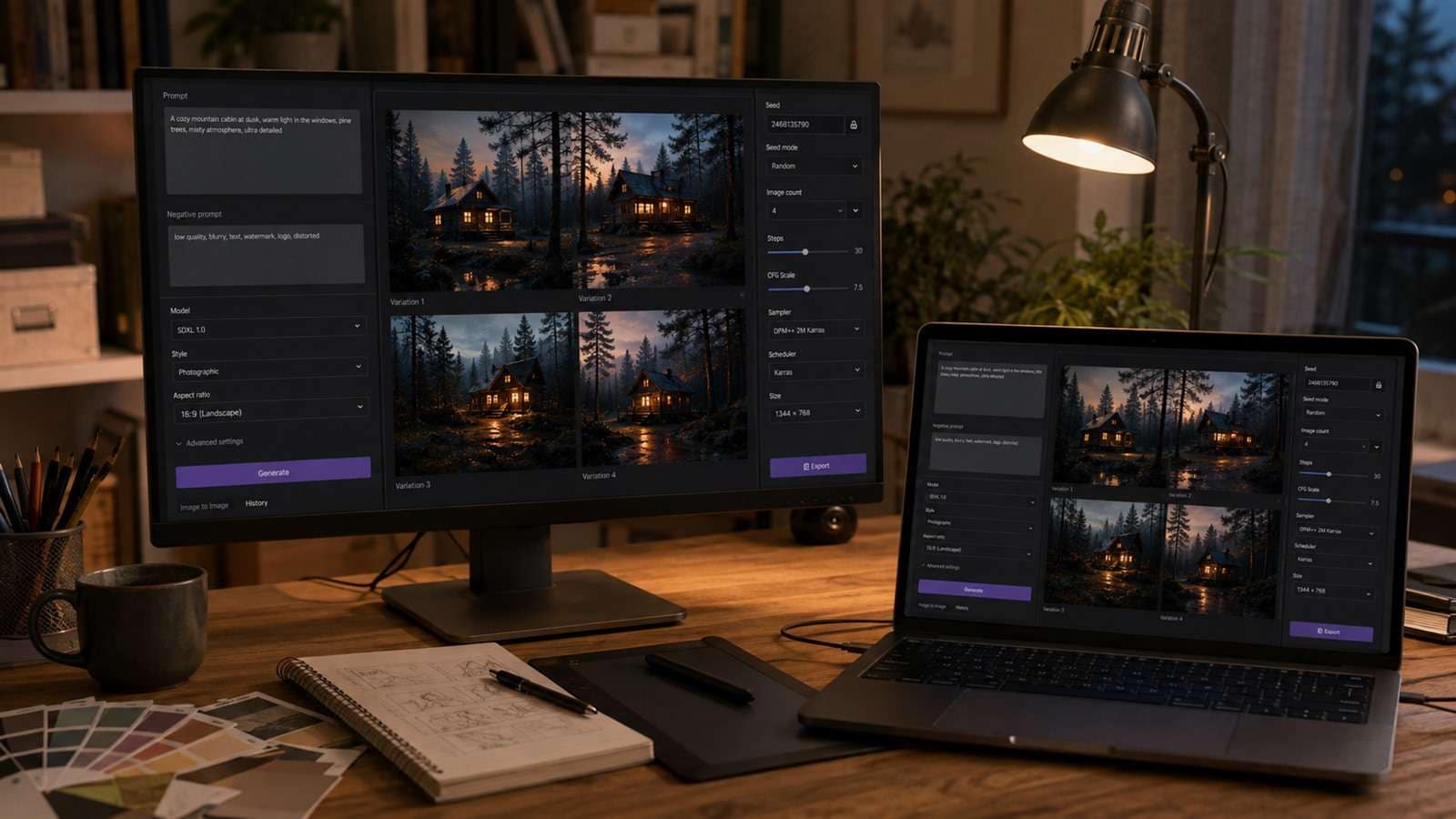
DreamStudio made Stable Diffusion approachable by putting model selection, prompt controls, image dimensions, and credits behind a hosted interface. But "I need a DreamStudio alternative" can point in opposite directions. One person wants fewer parameters and a faster result; another wants LoRAs, ControlNet, private local generation, or a reproducible node graph. The replacement must be chosen by where you want control to live.
In this article
Decide Whether You Are Replacing the App, the Model, or the Infrastructure
DreamStudio is a front end to Stability AI image generation. Stable Diffusion itself can also be accessed through newer Stability applications, APIs, cloud partners, and self-hosted software. Those are not interchangeable products.
- Replace the app: choose another browser interface while keeping a credit-based workflow.
- Replace the model family: compare Midjourney, Ideogram, OpenAI Images, Adobe Firefly, FLUX, and other current models.
- Replace the infrastructure: run Stable Diffusion locally or in a dedicated cloud workspace.
- Replace the whole creative process: use a multi-model editor that continues from generation into retouching, background work, or video.
This distinction prevents a common mismatch: recommending ComfyUI to someone who hates settings, or recommending a polished web app to someone whose main requirement is custom nodes and reproducible automation.
A Map of DreamStudio Alternatives
| Route | Best choice | You gain | You take on |
|---|---|---|---|
| Simple multi-model web creation | Media.io | Generation plus editing in one browser workflow | Less low-level diffusion control |
| Aesthetic exploration | Midjourney | Strong style discovery and personalization | Subscription workflow and less open-model portability |
| Designs with text | Ideogram | Typography and canvas editing | A different model ecosystem |
| Adobe production | Firefly | Photoshop and Express integration | Adobe plan and governance choices |
| Visual ideation at volume | Leonardo.Ai | Model choice, Flow State, editor, training | Credits and platform-specific workflow |
| Maximum workflow control | ComfyUI | Reusable node graphs and model flexibility | Setup, hardware, dependencies, maintenance |
| Creative local canvas | Invoke | Layers, canvas, nodes, local privacy | GPU and installation requirements |
Eight DreamStudio Alternatives for Distinct Creative Priorities
1. Media.io — easier multi-model creation with downstream editing
Media.io Text to Image is a good fit when you want a browser generator without managing checkpoints, samplers, or local dependencies. Its larger advantage is the path after generation: you can move into reference-based image editing, background removal, enhancement, or animation within the same online platform.
Choose it for marketing visuals, social content, portraits, and rapid concept variations. Do not choose it as a substitute for custom Stable Diffusion models, LoRA training pipelines, or exact sampler-level reproducibility.
2. Midjourney — visual direction and aesthetic consistency
Midjourney is strongest when the search is exploratory: moodboards, concept directions, campaign styles, environments, and polished single images. Personalization profiles, style references, and web editing make it easier to develop a recognizable visual taste without building a Stable Diffusion stack.
The trade-off is portability. A Midjourney style workflow does not map directly to open checkpoints, LoRAs, or local node graphs. It is a creative service rather than an open-model workbench.
3. Ideogram — graphics where words are part of the image
Ideogram is particularly relevant for posters, packaging concepts, title cards, signs, and social graphics. Its Canvas, Magic Fill, Extend, and design-oriented models support iterative composition rather than one prompt followed by a download.
Use it when text rendering and layout matter more than diffusion parameters. Keep editable typography in a design tool for final production whenever exact spelling and brand fonts are mandatory.
4. Adobe Firefly — generation that enters a layered Adobe workflow
Firefly suits designers who expect to continue in Photoshop, Illustrator, Express, or GenStudio. Generative Fill and Expand can be more valuable than standalone text-to-image because they operate inside an existing asset. Adobe also emphasizes commercially safe models and enterprise controls.
It is less compelling for users whose priority is downloading community checkpoints or experimenting with unrestricted open-source nodes.
5. Leonardo.Ai — rapid ideation, model choice, and asset refinement
Leonardo combines image models, Flow State exploration, references, editing, upscaling, training, and API access. Flow State is useful when the brief is still vague: generate multiple directions, select one, request related variants, then carry the chosen image into editing or motion.
Monitor how credits are consumed by generation, upscaling, training, and video. A broad platform can feel economical for mixed work and expensive if one premium action dominates the month.
6. Stable Assistant — the current Stability web route
Before leaving the Stability ecosystem, review its current web application and image models. Stability AI now presents Stable Assistant as a browser-based place to access its generation and editing tools, while Stable Diffusion 3.5 can also be deployed through API, cloud, or self-hosting options. This may be the least disruptive route if your dissatisfaction is specifically with the DreamStudio interface.
7. ComfyUI — reproducible graphs and open-model depth
ComfyUI represents each operation as a node: model loading, conditioning, sampling, controls, upscaling, compositing, and output. The graph can be saved and reused, which makes complex experiments more reproducible than remembering a sequence of manual clicks.
That power comes with dependency management, GPU memory constraints, model storage, custom-node security, and a steep mental model. Start from a minimal official template before importing sprawling community workflows.
8. Invoke — local control with a more art-directed canvas
Invoke is a free, open-source creative engine with a unified canvas, layers, node workflows, ControlNet support, and model management. It is a strong DreamStudio alternative for artists who want local privacy and production-oriented editing without living entirely inside a raw node graph.
The Hidden Criterion Is Prompt and Asset Portability
A prompt is not portable if its result depends on a proprietary model version, a hidden style system, or parameters another service does not expose. Open-model workflows can preserve checkpoints, LoRAs, seeds, and graphs, but they also require you to preserve compatible software and dependencies.
Run a Same-Brief Test Across Different Model Families
Use three briefs: a photographic scene with several objects, a graphic containing short text, and an edit that changes one element while preserving the rest. Give every tool the same delivery target and judge:
- Prompt adherence: are the correct objects, relationships, and attributes present?
- Text accuracy: is required wording legible and correctly placed?
- Edit preservation: did untouched faces, products, lighting, and layout remain stable?
- Iteration speed: how many attempts produced an acceptable asset?
- Workflow cost: what did accepted outputs cost, including retries and premium actions?
- Handoff quality: can the result be edited, layered, enlarged, or automated as needed?
This test often shows that the best generator and best editor are different products. A lightweight web tool may win early ideation, while Photoshop, Invoke, or ComfyUI wins the final controlled edit.
DreamStudio Alternatives FAQ
-
What is the best free DreamStudio alternative?
ComfyUI and Invoke are free and open source, but they require compatible hardware and setup. Browser services may provide trial credits; current limits should be checked before relying on them. -
Can I still use Stable Diffusion without DreamStudio?
Yes. Stability AI offers APIs, web applications, cloud options, and licenses for self-hosting, while third-party interfaces such as ComfyUI and Invoke can run compatible models. -
Which alternative is easiest for beginners?
Media.io, Midjourney, Ideogram, Adobe Firefly, and Leonardo are easier starting points than a local node workflow. Choose according to the output: general creative assets, aesthetic art, typography, Adobe editing, or rapid ideation. -
Is ComfyUI better than DreamStudio?
ComfyUI is more controllable and reproducible, but DreamStudio-style hosted apps are easier to start and maintain. Better depends on whether you value convenience or workflow ownership. -
What should I save before switching platforms?
Save prompts, settings, seeds, model names, reference images, output rights, and high-resolution exports. For local work, also save workflow files, model hashes, dependencies, and licenses.


