
 ChatGPT
 Perplexity
 Gemini
 Claude
 Grok
Grok
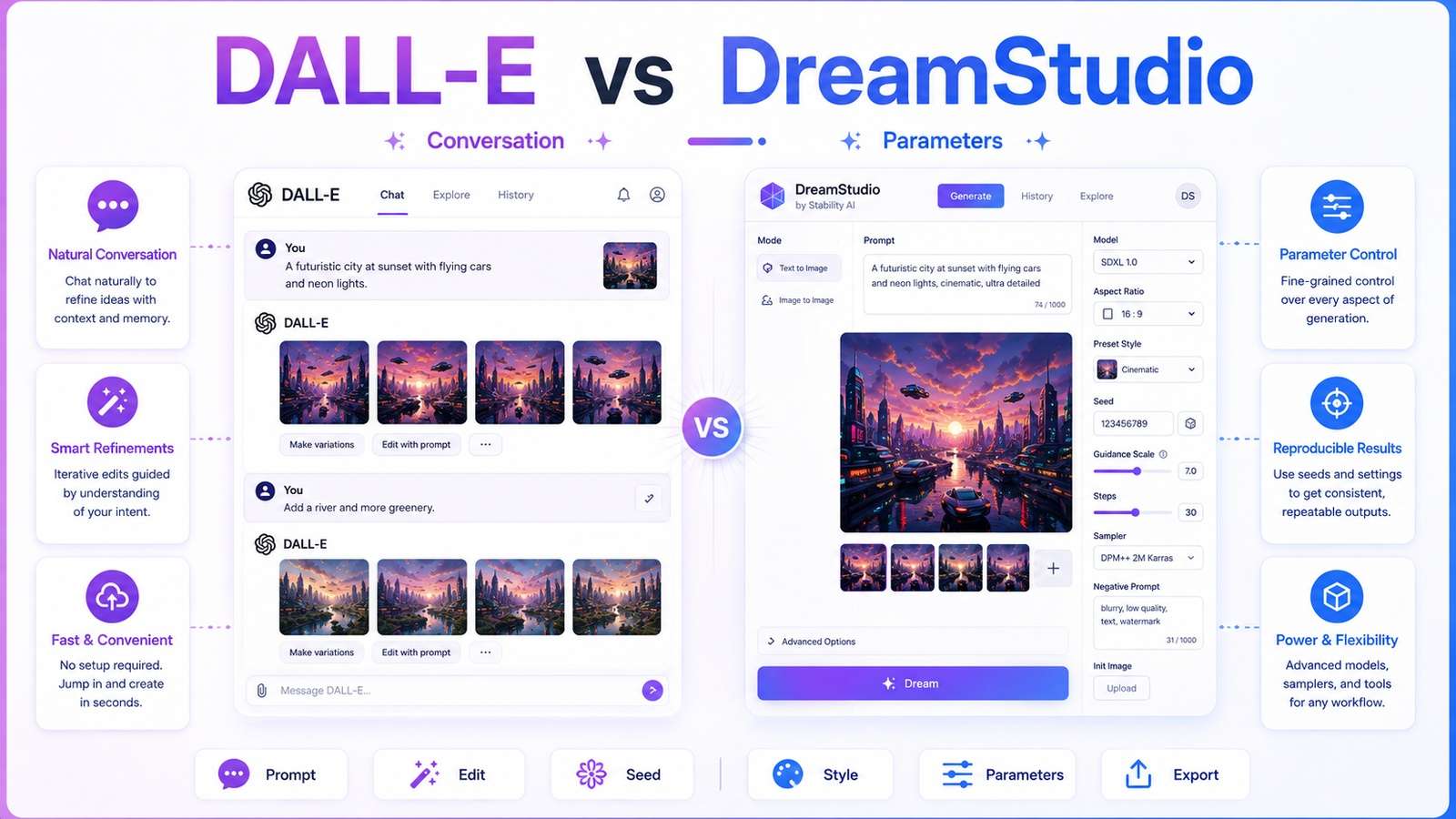
DALL-E vs DreamStudio is best understood as two editing loops. The familiar DALL-E name now refers in practice to ChatGPT Images and GPT-Image-2: describe the image, inspect it, and continue revising in natural language. DreamStudio is Stability AI's hosted interface for its image models: define the prompt, model, seed, dimensions, negative instructions, and other generation settings. One preserves the conversation; the other preserves the run.
In this article
ChatGPT Carries Instructions Forward; DreamStudio Exposes the Recipe
ChatGPT Images 2.0 can generate, edit uploaded images, add or correct text, create transparent backgrounds, and respond to follow-up instructions. A creator can say, "Keep the subject and camera, remove the chair, change the wall to navy, and move the headline higher." The interface is designed around intent rather than diffusion terminology.
DreamStudio gives browser access to Stability AI's image models and a credit-based workflow without installing a local GPU stack. It appeals to users who want more explicit generation controls and a first-party route into the Stability ecosystem. The user is expected to understand that seed, prompt, negative prompt, model, dimensions, and strength settings shape reproducibility.
Build a Control Ledger Before Comparing Outputs
| Control | ChatGPT Images | DreamStudio |
|---|---|---|
| Creative direction | Natural-language conversation | Prompt fields and model settings |
| Repeatability record | Conversation and source images | Seed, model, prompt, dimensions, and parameters |
| Negative instructions | Describe what should not appear | Dedicated negative prompt where supported |
| Regional editing | Selection tool plus instructions | Mask/inpainting workflow where available |
| Model choice | Current OpenAI image model | Available Stability AI image models |
| Local migration | No downloadable GPT Image weights | Related Stability models may have self-hosted routes under their licenses |
The ledger prevents a common error: calling a result "reproducible" because the same words were saved. In DreamStudio, a prompt without the model version and settings is incomplete. In ChatGPT, an exported image without the instruction history and source references loses the reasoning that shaped it.
Define what "the same prompt" means
A literal prompt copy is not a neutral test. ChatGPT Images can use context from preceding messages and uploaded references, while DreamStudio interprets a prompt through the selected Stability model and its exposed parameters. Create a control ledger with two columns: semantic requirements that both systems must satisfy and system-specific controls that are allowed. Semantic requirements might include product shape, camera angle, materials, exact text, palette, and excluded objects. System-specific controls might include DreamStudio's seed or guidance settings and ChatGPT's conversational clarification.
Lock the acceptance criteria before generating. Otherwise the evaluator tends to reward whatever each system does best after seeing the outputs. A valid comparison judges the same delivery requirement while allowing each product to use its intended interaction model.
Run a Paired Revision Test That Measures Edit Drift
Start with a product scene containing a package, human hand, table, window light, and short headline. Generate one acceptable baseline in each system. Then perform four edits in order:
- Change only the wall color.
- Remove one background object.
- Correct one word in the headline.
- Create a vertical version while preserving product scale and hand position.
After every round, compare the original and revised image. Record unintended changes to label text, hand anatomy, lighting direction, camera, materials, and product geometry. ChatGPT's conversational loop may make the request easier to express. DreamStudio's explicit mask and run settings may make the experiment easier to document. Neither should be declared the winner from the baseline image alone.
If both workflows are more technical than your delivery requires, Media.io Image to Image provides prompt-driven transformations in a browser, and Text to Image handles new concepts. It is useful for fast creator work but does not expose DreamStudio's diffusion recipe or ChatGPT's extended conversation.
A Team Needs Either an Art-Direction Log or a Reproducibility Sheet
For ChatGPT Images, save the final prompt sequence, uploaded references, approved output, and a short note explaining which visual details must remain locked. Another teammate should be able to open a new task and reconstruct the creative intent without relying on memory.
For DreamStudio, record the model name and version, prompt, negative prompt, seed, dimensions, sampling settings exposed by the interface, source image, mask, and strength. Store exported assets outside the web account. A model update or unavailable option can otherwise make an old recipe impossible to repeat.
- Use versioned filenames for every approved round.
- Separate exploration from the locked production recipe.
- Record the exact model rather than "DALL-E" or "Stable Diffusion."
- Keep source rights and consent with the asset.
- Re-test before a large batch or automated campaign.
Prototype-to-API Paths Are Different
OpenAI provides GPT-Image-2 through current image-generation and editing endpoints, so a successful ChatGPT brief can inform an application workflow. The API is not simply an export of the conversation; developers still need prompts, image inputs, quality settings, error handling, moderation, storage, and cost controls.
DreamStudio is a first-party creative interface, while Stability AI's Platform API is billed and managed separately. The related model family can also have self-hosted routes. Do not assume DreamStudio subscription credits, Platform API credits, and local model licenses are interchangeable.
Separate creative continuity from technical continuity
| Continuity question | ChatGPT Images evidence | DreamStudio evidence |
|---|---|---|
| Can intent be understood? | Brief, conversation, uploaded references | Prompt notes and reference assets |
| Can the render be revisited? | Saved thread and selected output | Model, seed, dimensions, and parameters |
| Can a correction stay local? | Region selection plus explicit instruction | Masking or parameterized diffusion workflow |
| Can production move to code? | Rebuild with GPT-Image API behavior in mind | Translate the Stability model recipe to Platform API |
DreamStudio credits and Stability Platform API credits are separate according to current Stability guidance, so a successful prototype does not automatically carry its billing or interface into an application. The same caution applies to ChatGPT and the OpenAI API: a productive chat demonstrates an interaction pattern, not a drop-in production implementation. Test the developer path before promising automation.
The two workflows also leave different evidence behind. A ChatGPT thread records natural-language intent and successive corrections, which is useful when an art director wants to understand why the image changed. A DreamStudio record is more valuable when the production team needs the prompt, seed, aspect ratio, model, and parameters required to revisit a result. Neither record is complete unless the team deliberately saves it.
For the benchmark, ask a second operator to reproduce an approved image without verbal help. Give that person only the saved conversation in one case and the saved DreamStudio recipe in the other. Record which details can be reconstructed, which depend on hidden context, and how much exploration is necessary. This handoff test exposes whether the chosen workflow scales beyond the original prompt author.
Use a drift budget for iterative production
Define which pixels are allowed to change in every revision. A background replacement can alter lighting and reflections, but it should not redesign the product. A wardrobe edit can affect folds and shadows, but it should not change the person's identity. Mark these permitted regions before editing and compare the result against the approved baseline. Count every unrequested change that needs another correction.
In ChatGPT Images, the art director can describe the intent and preserve the thread, which lowers the language barrier for nontechnical collaborators. In DreamStudio, explicit diffusion controls can make experiments easier to log, but a parameter recipe does not guarantee semantic continuity through a complex series of edits. The drift budget gives both systems the same production constraint without pretending their controls are equivalent.
When a workflow repeatedly exceeds the budget, stop prompting and change the process: use a tighter mask, composite the unchanged product into a generated background, or move the repair to a conventional editor. A good comparison reveals that boundary instead of awarding points for endless rerolls.
Define the reproducibility stop condition
DreamStudio should not be selected merely because it exposes a seed or familiar diffusion settings. If the team cannot name the model version, preserve the input assets, and reproduce an accepted output closely enough for the job, those controls are decorative rather than operational. Conversely, ChatGPT should not be called reproducible just because the conversation is saved; model updates and nondeterministic generation can prevent an exact rerender.
Choose the type of continuity the project needs. Regulated experiments may require a pinned recipe and archived evidence. Creative campaigns may need teammates to understand and continue the art direction without learning diffusion parameters. If the requirement is exact pixel recovery, neither generative path should replace versioned source files and conventional asset management.
DALL-E vs DreamStudio FAQ
-
Is DreamStudio the same as Stable Diffusion?
DreamStudio is Stability AI's hosted creative interface. Stable Diffusion refers to model families and the wider local, API, and community ecosystem. -
Is DALL-E still available in ChatGPT?
The official DALL-E GPT has been retired. Current ChatGPT image creation uses ChatGPT Images, while current developer models include GPT-Image-2. -
Which is better for reproducible images?
DreamStudio exposes settings such as model and seed that support run-level documentation. ChatGPT preserves iterative intent through conversation. The best record depends on the production need. -
Which is easier for editing?
ChatGPT is easier when users want to describe changes in natural language. DreamStudio suits users comfortable with masks, prompts, and diffusion controls. -
Are DreamStudio and Stability API credits shared?
Stability AI documents these as separate product credit systems. Verify current billing before planning an API migration.


