
 ChatGPT
 Perplexity
 Gemini
 Claude
 Grok
Grok
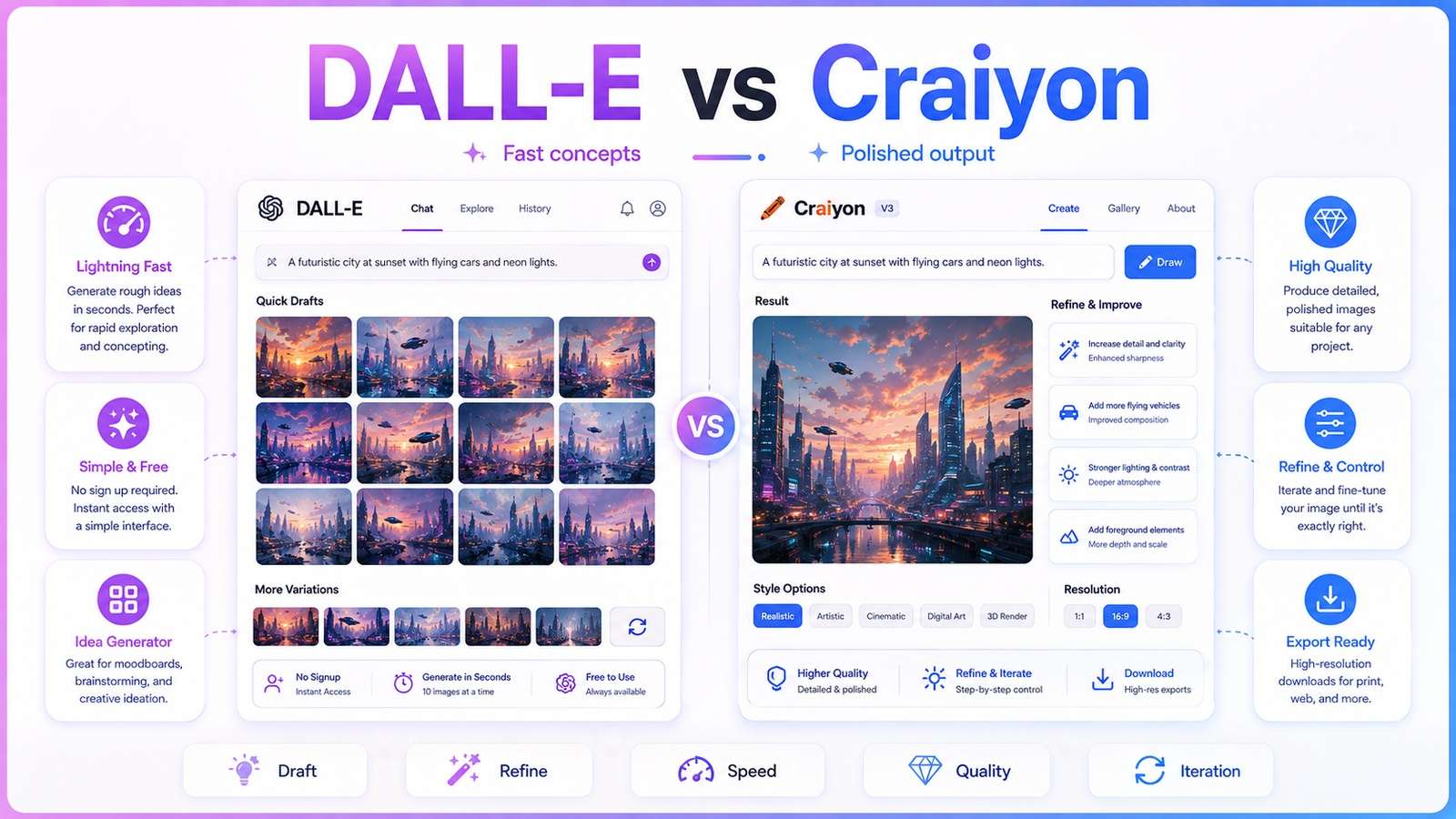
Craiyon can make the first idea inexpensive; ChatGPT Images can make the fifth correction inexpensive. That is the practical difference behind DALL-E vs Craiyon in 2026. The official DALL-E GPT has been retired, so the current comparison is Craiyon's accessible image suite against ChatGPT Images 2.0 and GPT-Image-2. The winner depends on whether the output is a disposable sketch or a deliverable.
In this article
The Free Generation Is Not the Expensive Part
Craiyon lets users try text-to-image generation with a low barrier and offers paid plans with unlimited images, editing credits, animation, upscaling, vectorization, priority features, and privacy options at higher tiers. Its strength is accessible exploration: enter a strange idea, receive variations, and decide whether the concept deserves more work.
ChatGPT Images is built for instruction-led creation and revision. It can generate or edit uploaded images, add text, create transparent backgrounds, and respond to follow-up requests. When the task requires an exact object, corrected copy, preserved identity, or a sequence of changes, the ability to explain the correction may save more than the cost of initial access.
Choose the Lane Before You Choose the Generator
| Lane | Better starting point | Why |
|---|---|---|
| Classroom brainstorming or visual word play | Craiyon | Fast, approachable idea generation with a free route |
| Meme concepts and playful drafts | Craiyon | Quantity and surprise can matter more than precision |
| Client product visual with exact details | ChatGPT Images | Conversational edits and stronger instruction control reduce rework |
| Application or automated workflow | GPT-Image-2 API | Craiyon currently states that it has no public API |
| Simple browser generation plus later transformation | Media.io | Generation and reference editing sit in one creator workflow |
Craiyon should not be dismissed because it serves a lighter job. A rough image can be valuable when a teacher wants visual prompts, a writer is exploring a scene, or a social creator needs unexpected directions. The mistake is asking the same output to carry precise product, typography, privacy, and brand requirements.
Calculate Rework Cost per Approved Asset
Use a simple equation:
generation cost + waiting time + rerolls + editing time + attribution or watermark handling + rejected delivery risk
Suppose a free result needs 25 minutes of cleanup, a second tool for text, and three rerolls to preserve the subject. A paid generation that reaches approval after one correction may be cheaper. Conversely, paying for advanced fidelity is wasteful when the image is only a two-minute brainstorming prop.
- Choose three real tasks: a playful concept, a poster, and a product scene.
- Limit each system to the same total working time.
- Count generations, edits, and external-tool fixes.
- Ask someone else whether the brief is satisfied.
- Record the cost and minutes per accepted asset.
Test the second edit. Many generators can produce an attractive first image; fewer can change one detail while preserving everything else. ChatGPT's conversational model usually has the clearer interaction for this requirement. Craiyon's paid editing credits should be evaluated on your actual image-input workflow.
Public Images, Attribution, and API Availability Can End the Decision
Use a denominator that reflects delivery
Track cost per approved asset, not cost per image. Start with platform fees, then add operator time for prompt attempts, manual retouching, text repair, background removal, resizing, and stakeholder review. Divide that total by the number of assets that actually pass the brief. A free generator can have a high delivery cost if most outputs remain rough concepts; a paid system can be economical if conversational edits raise the acceptance rate.
| Worksheet field | Why it matters |
|---|---|
| Initial candidates | Shows exploration volume but not usefulness |
| Candidates reaching manual edit | Reveals how much weak work enters production |
| Minutes of repair | Prices text, anatomy, masking, and layout fixes |
| Revision rounds | Captures stakeholder and model iteration |
| Approved assets | Creates the only meaningful denominator |
Craiyon's current pricing information distinguishes public and private generation by plan and says free commercial use requires attribution under its terms, while subscribers can use images without attribution. It also states that there is no public API at present. These are not minor feature rows. A confidential campaign, white-label workflow, or automated product can be ruled out before an image test.
ChatGPT and OpenAI API usage follow OpenAI account, service, and data-control terms. A creator still needs rights to uploaded images and must review outputs for people, brands, copyrighted material, and misleading claims. Neither platform guarantees that a generated image is legally safe just because commercial use is allowed under an account plan.
For creators who want an alternative web workflow, Media.io Text to Image can generate new visuals, and Image to Image can transform an uploaded reference. Compare its credits, export, and privacy rules with the same delivery checklist.
A Five-Question Delivery Checklist
- Does the exported image have the required resolution and aspect ratio?
- Is the generation private enough for the source material?
- Are watermark or attribution obligations acceptable?
- Can exact text, product details, and identity survive corrections?
- Can the workflow be repeated manually or through an API?
If the answer to the last four questions is "not required," Craiyon may be the more rational choice. If the image will be sold, automated, localized, revised by a team, or approved by a client, current OpenAI image generation is more likely to justify its cost.
Know when a rough concept is the final product
Craiyon is not merely a weaker production route. In some jobs - an icebreaker, classroom exercise, absurd concept board, or early naming workshop - the roughness and volume are appropriate, and a polished revision loop would add unnecessary friction. The evaluation should not penalize a lightweight tool for refusing to become an enterprise pipeline.
The boundary appears when the image represents a real product, person, client, or promise. At that point, exact corrections, controlled privacy, documented usage rights, and predictable delivery matter. Craiyon's current public/private behavior varies by plan, free commercial use carries attribution requirements under its stated terms, and it does not offer a public API. Those facts can close the decision before visual quality is scored.
Run a concept-to-delivery funnel
Start both tools with twenty deliberately varied concepts for the same brief. Move only candidates that satisfy the core subject and composition into a second round. Then request a controlled product replacement, an exact five-word headline, a vertical crop, and one stakeholder correction. At each stage, count how many candidates remain usable without external reconstruction.
The funnel distinguishes abundance from conversion. Craiyon may be valuable at the wide top because the team can scan many surprising directions. ChatGPT Images may retain more candidates in later stages because instructions and corrections can accumulate. A designer can also choose a hybrid route: use rough generation for ideation, rewrite the selected direction as a clean production brief, and recreate it in a more controllable system. If the concept cannot be reproduced without copying accidental artifacts, it was inspiration - not a production asset.
Document the handoff point. It prevents the team from spending hours repairing an image simply because the initial generation was free, and it prevents a more capable model from being used for brainstorming when speed and variety are the only requirements.
Set a repair ceiling
Before the trial, decide the maximum repair time allowed for each deliverable. If an output exceeds the ceiling, classify it as a rejected generation even if a skilled designer could eventually rescue it. This avoids a common bias in which the human operator quietly compensates for weak text, anatomy, or composition and the generator receives credit for the finished work.
Craiyon should be removed from the shortlist when private inputs, an automated API, exact brand control, or attribution-free free-plan use is mandatory. ChatGPT Images should be reconsidered when the job needs only disposable visual exploration and the conversational revision overhead adds no value. The correct decision can therefore change between ideation and delivery within the same project.
For a classroom, workshop, or low-stakes moodboard, Craiyon's low entry barrier can matter more than edit precision. For a client brief, the calculation changes as soon as a person must preserve a product, repair lettering, or produce coordinated variants. Run the trial with the actual person-hours required after generation. Ten free outputs that each need fifteen minutes of repair are not cheaper than a paid output that needs one controlled revision.
Create two folders during the test: "interesting" and "deliverable." Craiyon may fill the first quickly; ChatGPT Images may move more candidates into the second because the user can describe corrections in context. The ratio between those folders is a more honest measure than prompt count. It captures composition, text accuracy, privacy requirements, attribution, and the cost of moving the image into another editor.
DALL-E vs Craiyon FAQ
-
Is Craiyon the same as DALL-E Mini?
Craiyon was previously known as DALL-E Mini, but it is an independent product and is not affiliated with OpenAI's current image models. -
Can Craiyon be used for free?
Craiyon provides a free route and paid plans. Free and paid experiences differ in quality, speed, privacy, watermarks, attribution, and editing access. -
Can I use Craiyon images commercially?
Craiyon states that commercial use is possible under its terms; free users must provide attribution, while subscribers can use images without attribution. Verify current terms for your account. -
Does Craiyon have an API?
Craiyon's current pricing FAQ says it does not have a public API. GPT-Image-2 provides an official OpenAI API route. -
Which is better for precise edits?
ChatGPT Images is generally better suited to follow-up instructions and controlled revision. Test the exact source image and edit chain before production.


