
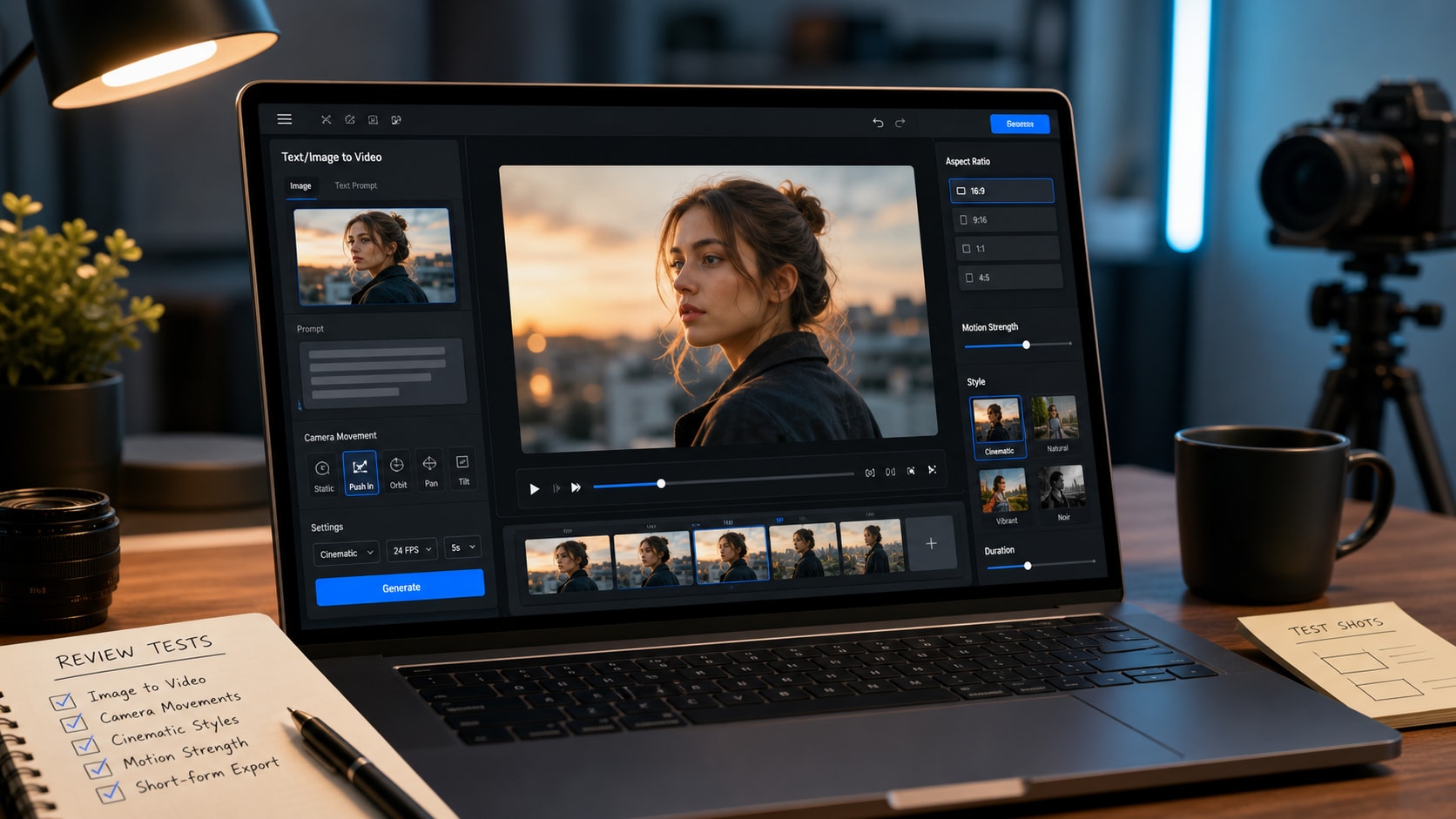
Clipfly AI is an online AI video creation and editing platform for turning text prompts, still images, and existing clips into short videos, then refining those assets with enhancement, cleanup, and editing tools. This Clipfly AI review covers text-to-video, image-to-video, video enhancement, object or text removal, web and mobile workflows, free access, credits, export limits, safety, and commercial-use considerations.
Clipfly AI is especially appealing to creators who want to move from an AI video idea to a more publishable social clip without building a complex editing stack first. The main buying question is whether the current web or mobile workflow provides enough generation capacity, motion quality, editing control, watermark flexibility, and export quality for repeated publishing.
In this article
Part 1: Quick Verdict
How this review was prepared: This review is based on official Clipfly product, pricing, and help information available at the time checked, together with editorial evaluation. It does not claim private hands-on generation testing.
Part 2: What Is Clipfly AI?
Clipfly AI is an online AI video creation and editing tool designed for short-form workflows that start with a prompt, image, or existing clip. Its feature set includes text-to-video, image-to-video, video enhancement, object or text removal, and editing across web or mobile environments.
Clipfly is therefore better understood as a lightweight AI creation-and-finishing platform than as a single-purpose video generator. Its strongest value appears when a creator can generate a short clip, fix visible problems, improve quality, and prepare the asset for social publishing without immediately moving into a more complex editor.
- Best-fit reader
Creators making short social videos, AI effects, image-to-video clips, visual drafts, and simple edited variants for repeated online publishing.
- Decision point
Clipfly works best when its generation credits, motion quality, editing tools, watermark rules, and exports make the complete path from idea to publishable clip efficient.
- What to compare
Compare text-to-video quality, image-to-video consistency, enhancement results, cleanup reliability, export resolution, watermark behavior, and differences between web and mobile pricing.
Part 3: How Clipfly AI Works
Clipfly AI works best as a generate-refine-export workflow rather than a one-click route to a finished video. Start with a prompt, source image, or existing clip, choose the generation or editing tool that matches the task, review the complete result, and use enhancement or cleanup only when it meaningfully improves the asset before export.
| Step | What the user does | What to verify |
| 1. Start with the brief | Use a prompt, still image, or short clip that reflects the type of video you actually plan to publish. | Define the subject, action, visual style, target platform, and any details that must remain stable. |
| 2. Choose the mode | Select text-to-video, image-to-video, enhancement, object removal, text removal, or another editing workflow based on what the asset needs next. | Check whether the feature is available in the current account and whether it uses credits, a paid plan, or an app purchase. |
| 3. Generate and refine | Review motion, subject consistency, visual artifacts, resolution, watermark behavior, and whether enhancement or cleanup can improve the strongest result. | Track how many generations and edits are required before one clip is genuinely usable. |
| 4. Export or finish elsewhere | Download, publish, resize, caption, enhance, or continue editing the selected clip when additional production work is still required. | Confirm watermark, resolution, format, Clipfly credits or in-app purchase allowance, privacy, and commercial-use terms. |
This workflow highlights Clipfly's main practical advantage: generation does not have to be the end of the process. If a promising clip needs better clarity, object cleanup, text removal, or another quick edit, keeping that correction inside the same platform can reduce friction before publishing.
Part 4: Clipfly AI Features
Clipfly AI features are most useful when evaluated as connected stages of short-form video production. Text-to-video and image-to-video create the initial motion asset, while enhancement, removal, and editing tools help determine whether that draft can become publishable without moving immediately into another editor.
| Feature | Best use case | Clear limitation to check |
| Text-to-video | Turning a written prompt into a short motion concept, social clip, visual draft, or AI video experiment without existing footage. | Check prompt adherence, clip length, subject consistency, motion stability, resolution, watermark rules, and credit use before relying on repeated generation. |
| Image-to-video | Animating a selected still image into a short clip for social media, visual testing, campaign ideas, or creative experimentation. | Check whether the original subject remains recognizable, movement looks natural, important details stay stable, and retries fit the available credit allowance. |
| Video enhancement | Improving a generated or uploaded clip when the motion is acceptable but the visual quality needs more clarity before export. | Check whether enhancement improves the image without oversharpening faces, changing textures, or introducing visible artifacts. |
| Object or text removal | Cleaning a near-finished visual when an unwanted object, overlay, or text element prevents the clip from being publishable. | Check whether removal preserves backgrounds, subject edges, motion continuity, and nearby details instead of replacing the unwanted element with another artifact. |
| Web and mobile editing | Creating, reviewing, or refining short AI videos across browser and mobile workflows when creators need flexibility away from a desktop-only setup. | Check whether features, pricing, credits, exports, and purchase options are consistent enough across web and mobile for your normal workflow. |
For a meaningful Clipfly AI test, use one straightforward prompt or source image and one difficult case. A simple motion concept can reveal baseline quality, while a face, product, recurring character, exact movement, text element, or cleanup task can show whether Clipfly's generation and editing tools work together effectively.
Part 5: Clipfly AI Output Quality and Practical Limitations
Clipfly AI output quality should be judged by the percentage of the final clip that remains usable after generation and editing. A visually strong frame is not enough if the subject drifts, motion breaks, enhancement creates artifacts, or the export does not meet the intended social platform's requirements.
| Evaluation area | Expected fit | What to inspect | Practical takeaway |
| Prompt or image-to-video fit | Test first | Use a prompt or source image with specific subject, style, composition, and action requirements, then compare the generated clip with those constraints. | Better prompt or source-image adherence reduces retries and makes the workflow more predictable. |
| Motion stability | Test first | Watch the entire clip for subject drift, unnatural movement, unwanted camera changes, flicker, or visual artifacts. | Motion quality should be judged by the complete exported video rather than the strongest frame or preview moment. |
| Enhancement and cleanup | Test first | Use enhancement or removal on a near-finished clip and compare the edited result with the original for subject detail, backgrounds, edges, and artifacts. | Clipfly adds more value when cleanup can rescue a promising generation without forcing the whole asset to be recreated. |
| Export quality | Test first | Check resolution, watermark, format, duration, compression, credit use, and whether the final file meets the intended publishing requirements. | A successful generation is less useful when the available export does not fit the target channel. |
Practical limitations to check
- Web and mobile pricing can differ: Clipfly's web access, app subscriptions, credit packs, and regional in-app purchase pricing should be compared separately before deciding which workflow is cheaper for repeated use.
- Free access does not guarantee every export condition: Check the exact model, resolution, watermark behavior, credits, and download rules before assuming a successful free test represents the final paid workflow.
- Short AI clips still require full-video review: Characters, products, faces, objects, and movement can drift during the clip even when the initial frames look convincing.

Part 6: Clipfly AI Pricing, Free Access, and Credits
Pricing was checked on 2026-08-05. Use the table below as a dated snapshot, then confirm the live Clipfly account, checkout, or app-store listing before paying because prices, plan names, allowances, renewal terms, and regional offers can change.
| Plan | Displayed price | Highlighted allowance | Best for |
| Free access | Free entry point shown | Clipfly promotes free online generation and editing paths, but users should check the live export screen for watermark and resolution rules. | Trying text-to-video, image-to-video, video enhancement, and editing tools. |
| Credits or web paid access | Check live Clipfly account | Clipfly workflows may use credits for generation, model choice, enhancement, and exports. | Users creating repeated short videos or AI effect clips. |
| Mobile in-app purchases | Varies by App Store region | App-store listings show weekly, yearly, and credit-pack purchases that can differ by region. | Mobile-first users creating Clipfly videos on iOS. |
Credits and usage limits
Clipfly AI may describe usage through Clipfly credits or in-app purchase allowances. The important question is which operations consume those allowances. A workflow that looks inexpensive at the first generation can become more costly when model changes, retries, enhancement, removal, or exports use additional capacity.
- Clipfly supports text-to-video, image-to-video, video enhancement, object removal, text removal, and video editing workflows.
- Web and mobile pricing can differ by region and account state.
- Credit usage should be checked by model and output type before recurring use.
- Do not assume free export covers every model, watermark, resolution, or credit-heavy workflow.
Part 7: Clipfly AI Pros and Cons
Clipfly AI's main advantage is that it connects short-form generation with practical cleanup and enhancement tools. Its main trade-offs are plan and credit clarity, web-versus-mobile pricing differences, variable AI motion quality, and the need to confirm export conditions before relying on it for repeated publishing.
Part 8: Is Clipfly AI Safe? Privacy, Consent, and Commercial Use
Clipfly AI is a public AI video creation and editing platform, but safe and commercially appropriate use depends on current terms, privacy rules, account conditions, and the material uploaded or generated. Professional work should review both the AI-generated result and the rights attached to source images, video, people, voices, music, brands, and other protected assets.
| Question | What to check before use |
| Privacy and uploads | Avoid uploading confidential images, private documents, unreleased brand assets, client footage, or another person's likeness unless current Clipfly policies and your own permissions support that use. |
| Consent | For real people, voices, likenesses, brand marks, music, product images, and copyrighted references, confirm that you have the permission required before uploading, editing, generating, or publishing. |
| Commercial use | Clipfly commercial use should be checked against current terms, uploaded footage rights, music, likenesses, brand assets, and any app-store subscription rules that apply. Downloading a generated or edited file does not automatically clear copyright, trademark, likeness, or other third-party rights. |
| Paid plans and refunds | Check Clipfly's live account, app-store policy, and billing terms for current renewal, cancellation, and refund conditions before purchasing because web and mobile billing paths may differ. |
Personal experiments may require only basic checks. Client videos, ads, ecommerce content, branded social posts, training media, and other commercial projects should use non-confidential test material first and confirm current rights and billing conditions before recurring production.
Part 9: Clipfly AI vs Media.io: Which Workflow Fits the Job?
Clipfly AI and Media.io overlap across AI video creation and finishing, but they can fit different workflow priorities. Clipfly is especially relevant when the creator wants generation and lightweight cleanup inside one environment. Media.io becomes more relevant when the selected clip needs a focused finishing step such as subtitle cleanup, enhancement, or another image-to-video workflow.
| Workflow question | Clipfly AI | When to compare Media.io |
| First creative result | Evaluate Clipfly primarily on prompt or image adherence, motion quality, available editing tools, credits, and export conditions. | Compare Media.io after the creative direction is selected and a specific finishing or alternate-generation step remains. |
| Before publishing | Check credits, watermark rules, export quality, subject consistency, output rights, and whether the clip still needs cleanup. | Use focused follow-up tools for subtitles, enhancement, resizing, cleanup, or another export preparation task. |
| Captions and subtitles | Clipfly is strongest when generation and basic video editing remain inside its own workflow. | Auto Subtitle Generator can add or clean subtitles when caption accuracy is the remaining publishing task. |
| Quality enhancement | Clipfly includes enhancement as part of its broader generation and editing workflow. | Video Enhancer provides another focused route for improving a generated or uploaded video before publishing. |
Part 10: Final Verdict: Is Clipfly AI Worth It?
Part 11: Clipfly AI Review FAQs
-
Is Clipfly AI worth it in 2026?
Clipfly AI is worth trying in 2026 if you want a simple workflow for short AI video generation, image-to-video animation, enhancement, cleanup, and social-ready editing. It is less suitable when deep timeline control, exact subject continuity, or predictable production costs are essential. -
Is Clipfly AI free?
Clipfly promotes a free entry point for online AI video generation and editing. Free export conditions can still depend on the selected workflow, model, watermark, resolution, and current account, so check the live export screen before assuming every use case is free. -
How much does Clipfly AI cost?
As of 2026-08-05, Clipfly promotes free online creation while recurring use may involve Clipfly credits, web paid access, or mobile in-app purchases. Mobile pricing can vary by App Store region, so confirm the current web and app billing screens before purchasing. -
How do Clipfly AI credits or usage limits work?
Clipfly workflows may use credits or app-purchase allowances for generation, model choice, enhancement, and exports. Credit use should be checked by the exact model and output type because web and mobile rules can differ. -
What is Clipfly AI best for?
Clipfly AI is best for text-to-video drafts, image-to-video animation, short social clips, visual experiments, video enhancement, object or text removal, and creators who want lightweight editing alongside AI generation. -
What are the main limitations of Clipfly AI?
Clipfly AI's main limitations are variable motion consistency, current credit and export rules, differences between web and mobile pricing, and less editing depth than a professional long-form video editor. -
Is Clipfly AI safe and legit?
Clipfly AI is a public AI video creation and editing product with official product, pricing, and help pages. Safe use still depends on current privacy terms, account rules, and whether you have permission to upload and publish the people, footage, images, music, or brand material involved. -
Can Clipfly AI be used commercially?
Clipfly commercial use should be checked against current terms, uploaded footage rights, likenesses, music, brand assets, and any web or app-store subscription conditions that apply. Exporting a generated video does not automatically clear third-party rights. -
Does Clipfly AI add a watermark?
The reviewed information does not establish one universal watermark rule for every Clipfly workflow. If watermark-free export matters, check the selected model, current plan, resolution, file format, credits, and live export conditions before publishing. -
What is the best alternative to Clipfly AI?
The best Clipfly AI alternative depends on whether you need another all-in-one generator or a focused finishing tool. Media.io is worth comparing when a selected clip mainly needs subtitle cleanup, enhancement, image-to-video animation, or another publishing-focused processing step.
Part 12: Sources
- Official source: Clipfly AI product and feature overview (official, checked 2026-08-05)
- Official source: Clipfly pricing and plan information (official, checked 2026-08-05)
- Official source: Clipfly help center and usage information (official, checked 2026-08-05)


