
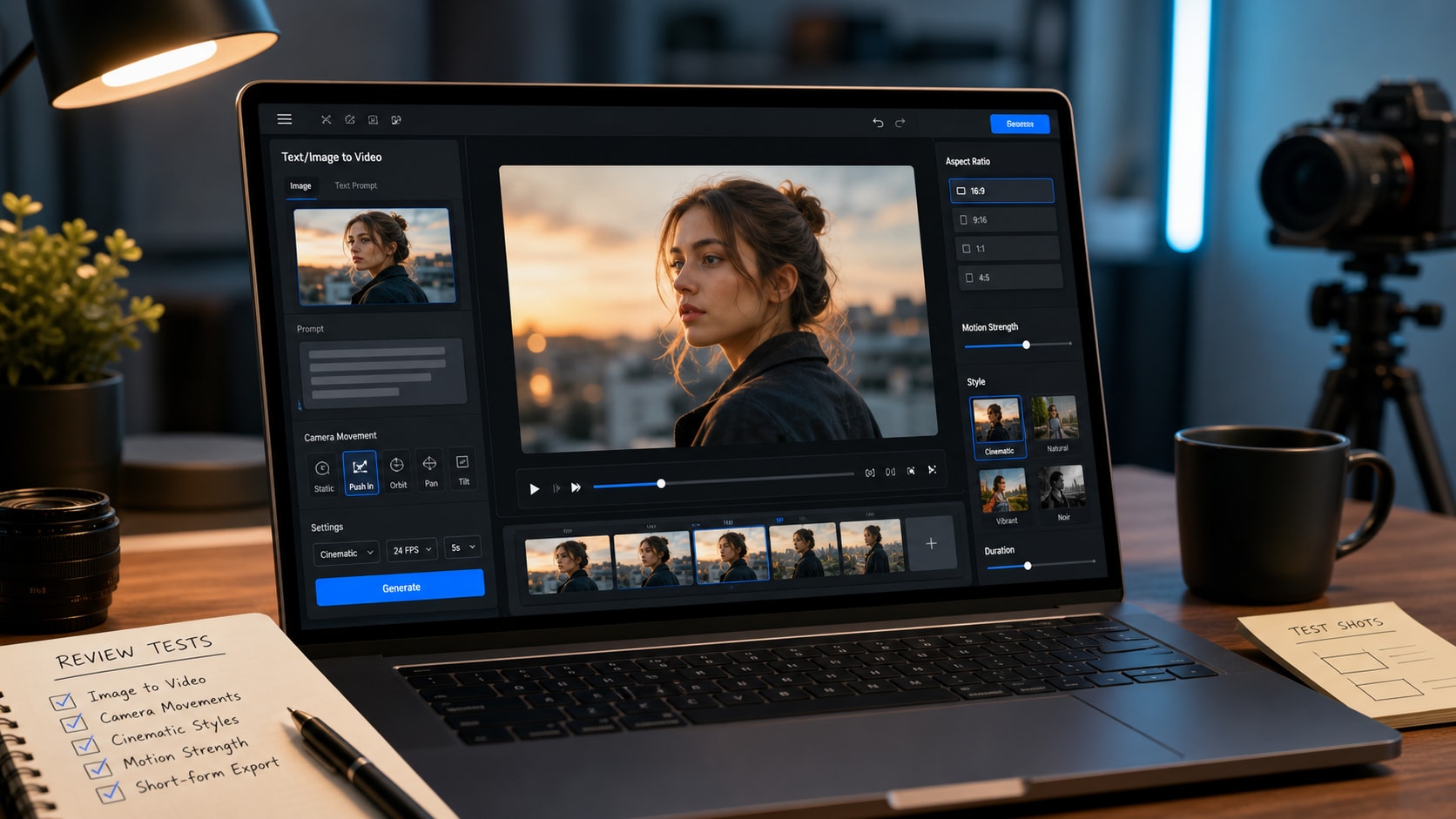
WAN works well when users are comparing raw video generation, model access, local or hosted inference, and the path from generated clip to final media. A wan ai alternatives search usually means the user wants the same end result, but with a better balance of quality, control, access, editing, cost, or delivery.
For video model searches, the strongest comparison starts with the footage: motion, prompt fidelity, references, access, rights, and the steps needed after generation. This guide compares direct competitors and adjacent workflows in the places where they naturally help the project, from first output to final export.
In this article
Part 1: Quick Verdict: What is the Best WAN Alternative?
Part 2: WAN alternatives at a Glance
The table below compares WAN competitors by use case, workflow fit, learning curve, access route, and the production step where each one is strongest.
| Alternative | Best For | Main Advantage Over WAN | Main Tradeoff | Generation + Editing Support | Free Access |
| HunyuanVideo Best Open Video Research |
Researchers and technical creators testing open video generation and custom pipelines | Useful open model comparison point | Less accessible than no-code video apps | Open video model workflow | Free access, trials, or introductory credits may be available; verify current limits, watermark rules, and commercial-use terms. |
| SkyReels Best Open Video Experiment |
Technical users comparing open video generation, local workflows, and reproducible results | Relevant open video model route | Requires technical setup and workflow maintenance | Open video model workflow | Free access, trials, or introductory credits may be available; verify current limits, watermark rules, and commercial-use terms. |
| Seedance Best Proprietary Model Benchmark |
Teams comparing cinematic motion, prompt adherence, and image-to-video behavior | Strong benchmark for generation video quality | Official access and terms need verification | Proprietary video model family | Official access and commercial conditions should be verified from ByteDance Seed, Doubao, Volcano Engine, or other official access points before production. |
| Google Veo Best Frontier Video Benchmark |
Teams benchmarking cinematic video quality, prompt fidelity, and access through Google products | Relevant benchmark for high-end video output | Access and availability can be less predictable than creator apps | Proprietary video model access | Access varies by Google product, plan, region, and developer surface; verify current official availability. |
| Runway Gen-4.5 Best Quality + Direction |
Teams comparing high-end video output with camera direction and revision workflow | Strong mix of model quality and production control | Access, credits, and workflow complexity need review | Proprietary video model access | Availability, credits, and access rules may vary by Runway plan; verify the current official product page before production. |
| Luma Ray2 Best Cinematic Model Tests |
Creators comparing cinematic motion, mood, lighting, and prompt fidelity | Strong cinematic ideation and motion comparison route | Less complete as a full publishing workflow | Cinematic video model access | Free access, trials, or introductory credits may be available; verify current limits, watermark rules, and commercial-use terms. |
| Kling AI Best Realistic Motion |
Creators comparing faces, products, characters, and reference-driven motion | Strong realistic motion and reference testing lane | Less complete for editing, formatting, and final delivery after generation | Realistic video generation | Free access, trials, or introductory credits may be available; verify current limits, watermark rules, and commercial-use terms. |
| Hailuo AI Best Lightweight Video Tests |
Users comparing text-to-video and image-to-video without a heavy editor | Useful for quick model-quality testing | Less complete for editing, formatting, and final delivery after generation | Text-to-video + image-to-video | Free access, trials, or introductory credits may be available; verify current limits, watermark rules, and commercial-use terms. |
| ComfyUI Best Node Control |
Technical creators who need reusable graphs, custom nodes, local models, and batch workflows | Deep workflow control and reproducibility | Higher setup and maintenance burden | Node workflow + local control | Free access, trials, or introductory credits may be available; verify current limits, watermark rules, and commercial-use terms. |
| Media.io Best Finished Media Workflow |
Creators who need generation, enhancement, subtitles, resizing, compression, conversion, ads, and final delivery | Combines generation support with practical finishing tools | Does not replace deep model control, local nodes, or developer infrastructure | Creation + finishing workflow | Free access, trials, or introductory credits may be available; verify current limits, watermark rules, and commercial-use terms. |
Part 3: What Does WAN Do Well?
WAN works well when users are comparing raw video generation, model access, local or hosted inference, and the path from generated clip to final media. It is strongest for technical users comparing open video generation and custom workflows rather than creators who only want a simple editor.
Its limits usually appear when the project needs a different balance of generation quality, control, setup effort, team handoff, editing, commercial-use clarity, or delivery.
Part 4: Why look for a WAN Alternative?
1. Output quality is uneven on real briefs
A different tool may handle your subjects, prompts, references, text, motion, or brand assets with fewer failed attempts.
2. The workflow after generation is too fragmented
A strong first result still has to survive editing, enhancement, resizing, review, localization, or final export.
3. Access or setup slows production
Queues, credits, regional access, hardware, local dependencies, API work, or plan limits can make an otherwise strong tool impractical.
4. The team needs a more specific workflow
Some alternatives are better for ads, avatars, storyboards, local control, model discovery, API integration, or design handoff.
5. Commercial use needs clearer review
Licenses, model terms, likeness rules, asset rights, and export conditions should be checked before moving production work.
Part 5: How We Compared These WAN Alternatives?
We compared WAN alternatives using official product pages, pricing or plan pages where available, help documentation, and the workflow each product is designed to support. Product claims and access models were reviewed in July 2026.
Each product was evaluated against the reason someone would leave WAN, not against a generic feature checklist. A narrower tool can rank highly when it solves one recurring problem better than a broader suite.
- Core workflow fit: how directly the platform solves the main creation job behind the keyword.
- Creative control: prompt control, references, scene structure, editing options, and output correction.
- Production completeness: whether the workflow continues into subtitles, enhancement, resizing, ads, localization, or publishing.
- Use-case clarity: whether the tool has a distinct reason to be selected instead of repeating another option.
- Access and cost risk: free access, plan limits, credit usage, queue speed, watermark rules, and likely retry cost.
Because AI model access, prices, credits, and commercial-use rules change often, readers should verify current official plan details before moving paid production work.
Part 6: Best WAN Alternatives by Use Case
The best WAN alternative depends on what you are trying to improve: raw video quality, reference-image fidelity, public access, open control, or the final editing steps after generation.
1. HunyuanVideo: Best WAN Alternative for Local Video Generation Experiments
HunyuanVideo is the better route when control, customization, and local or hosted generation matter more than a polished web interface. It is useful for checkpoints, LoRAs, reproducible workflows, private experimentation, and teams that want more visibility into how outputs are made.
Its strongest case is useful open model comparison point. The tradeoff is that it is less accessible than no-code video apps. Choose this route only if setup time, hardware, licensing, and workflow maintenance are acceptable parts of the project.
Where HunyuanVideo is stronger
- Local control: Useful open model comparison point.
- Customization: useful for checkpoints, LoRAs, custom pipelines, and repeatable generation settings.
- Workflow freedom: gives technical users more room to combine models, nodes, scripts, and hosted inference.
- License visibility: lets teams review model terms before building a production workflow around it.
Where WAN may still be better
WAN may still be better when its access, pricing, prompt style, or native workflow already gives reliable results. HunyuanVideo is stronger only when its output quality, control, or access route fits the project more clearly.
Pros and Cons:
Choose HunyuanVideo if: model choice, customization, local or hosted workflows, and licensing control matter more than a simple creator interface.
Skip it if: you want a simple browser workflow and do not want to manage models, setup, hosting, or licensing details.
2. SkyReels: Best WAN Alternative for Open Video Model Testing
SkyReels is the better route when control, customization, and local or hosted generation matter more than a polished web interface. It is useful for checkpoints, LoRAs, reproducible workflows, private experimentation, and teams that want more visibility into how outputs are made.
Its strongest case is relevant open video model route. The tradeoff is that it requires technical setup and workflow maintenance. Choose this route only if setup time, hardware, licensing, and workflow maintenance are acceptable parts of the project.
Where SkyReels is stronger
- Local control: Relevant open video model route.
- Customization: useful for checkpoints, LoRAs, custom pipelines, and repeatable generation settings.
- Workflow freedom: gives technical users more room to combine models, nodes, scripts, and hosted inference.
- License visibility: lets teams review model terms before building a production workflow around it.
Where WAN may still be better
WAN may still be better when its access, pricing, prompt style, or native workflow already gives reliable results. SkyReels is stronger only when its output quality, control, or access route fits the project more clearly.
Pros and Cons:
Choose SkyReels if: model choice, customization, local or hosted workflows, and licensing control matter more than a simple creator interface.
Skip it if: you want a simple browser workflow and do not want to manage models, setup, hosting, or licensing details.
3. Seedance: Best WAN Alternative for Cinematic Video Model Quality
Seedance is best evaluated against WAN on the footage itself: motion stability, prompt fidelity, reference-image handling, and how many attempts it takes to produce a usable clip. It is most relevant for cinematic motion, prompt adherence, and image-to-video behavior.
Its strongest case is strong benchmark for generation video quality. The tradeoff is official access and terms need verification. If the clip also needs captions, resizing, review, or campaign delivery, plan for those finishing steps after generation.
Where Seedance is stronger
- Video quality: Strong benchmark for generation video quality.
- Reference fidelity: helps evaluate whether faces, products, characters, and environments stay recognizable in motion.
- Cinematic motion: better suited to projects where camera feel, scene dynamics, and believable movement carry the result.
- Access and terms: worth checking when availability, official access points, and commercial terms affect production.
Where WAN may still be better
WAN may still be better when its access, pricing, prompt style, or native workflow already gives reliable results. Seedance is stronger only when its output quality, control, or access route fits the project more clearly.
Pros and Cons:
Choose Seedance if: motion quality, prompt fidelity, reference consistency, or image-to-video realism decides whether the clip is usable.
Skip it if: you need built-in captions, resizing, approvals, marketing formats, and final delivery more than raw generation quality.
4. Google Veo: Best WAN Alternative for High-end Video Model Comparison
Google Veo is best evaluated against WAN on the footage itself: motion stability, prompt fidelity, reference-image handling, and how many attempts it takes to produce a usable clip. It is most relevant for cinematic video quality, prompt fidelity, and access through Google products.
Its strongest case is relevant benchmark for high-end video output. The tradeoff is access and availability can be less predictable than creator apps. If the clip also needs captions, resizing, review, or campaign delivery, plan for those finishing steps after generation.
Where Google Veo is stronger
- Video quality: Relevant benchmark for high-end video output.
- Reference fidelity: helps evaluate whether faces, products, characters, and environments stay recognizable in motion.
- Cinematic motion: better suited to projects where camera feel, scene dynamics, and believable movement carry the result.
- Access and terms: worth checking when availability, official access points, and commercial terms affect production.
Where WAN may still be better
WAN may still be better when its access, pricing, prompt style, or native workflow already gives reliable results. Google Veo is stronger only when its output quality, control, or access route fits the project more clearly.
Pros and Cons:
Choose Google Veo if: motion quality, prompt fidelity, reference consistency, or image-to-video realism decides whether the clip is usable.
Skip it if: you need built-in captions, resizing, approvals, marketing formats, and final delivery more than raw generation quality.
5. Runway Gen-4.5: Best WAN Alternative for High-end Video Generation Tests
Runway Gen-4.5 is best evaluated against WAN on the footage itself: motion stability, prompt fidelity, reference-image handling, and how many attempts it takes to produce a usable clip. It is most relevant for high-end video output with camera direction and revision workflow.
Its strongest case is strong mix of model quality and production control. The tradeoff is access, credits, and workflow complexity need review. If the clip also needs captions, resizing, review, or campaign delivery, plan for those finishing steps after generation.
Where Runway Gen-4.5 is stronger
- Video quality: Strong mix of model quality and production control.
- Reference fidelity: helps evaluate whether faces, products, characters, and environments stay recognizable in motion.
- Cinematic motion: better suited to projects where camera feel, scene dynamics, and believable movement carry the result.
- Access and terms: worth checking when availability, official access points, and commercial terms affect production.
Where WAN may still be better
WAN may still be better when its access, pricing, prompt style, or native workflow already gives reliable results. Runway Gen-4.5 is stronger only when its output quality, control, or access route fits the project more clearly.
Pros and Cons:
Choose Runway Gen-4.5 if: motion quality, prompt fidelity, reference consistency, or image-to-video realism decides whether the clip is usable.
Skip it if: you need built-in captions, resizing, approvals, marketing formats, and final delivery more than raw generation quality.
Explore Runway AI alternatives
6. Luma Ray2: Best WAN Alternative for Cinematic Image-to-Video Output
Luma Ray2 is best evaluated against WAN on the footage itself: motion stability, prompt fidelity, reference-image handling, and how many attempts it takes to produce a usable clip. It is most relevant for cinematic motion, mood, lighting, and prompt fidelity.
Its strongest case is strong cinematic ideation and motion comparison route. The tradeoff is that it is less complete as a full publishing workflow. If the clip also needs captions, resizing, review, or campaign delivery, plan for those finishing steps after generation.
Where Luma Ray2 is stronger
- Video quality: Strong cinematic ideation and motion comparison route.
- Reference fidelity: helps evaluate whether faces, products, characters, and environments stay recognizable in motion.
- Cinematic motion: better suited to projects where camera feel, scene dynamics, and believable movement carry the result.
- Access and terms: worth checking when availability, official access points, and commercial terms affect production.
Where WAN may still be better
WAN may still be better when its access, pricing, prompt style, or native workflow already gives reliable results. Luma Ray2 is stronger only when its output quality, control, or access route fits the project more clearly.
Pros and Cons:
Choose Luma Ray2 if: motion quality, prompt fidelity, reference consistency, or image-to-video realism decides whether the clip is usable.
Skip it if: you need built-in captions, resizing, approvals, marketing formats, and final delivery more than raw generation quality.
7. Kling AI: Best WAN Alternative for Realistic Image-to-Video Tests
Kling AI is best evaluated against WAN on the footage itself: motion stability, prompt fidelity, reference-image handling, and how many attempts it takes to produce a usable clip. It is most relevant for faces, products, characters, and reference-driven motion.
Its strongest case is strong realistic motion and reference testing lane. The tradeoff is that it is less complete for editing and delivery. If the clip also needs captions, resizing, review, or campaign delivery, plan for those finishing steps after generation.
Where Kling AI is stronger
- Motion realism: Strong realistic motion and reference testing lane.
- Image-to-video testing: useful when a source image must stay recognizable while gaining natural movement.
- Prompt behavior: helps compare how clearly the tool follows movement, timing, and scene instructions.
- Usable take rate: worth measuring by successful outputs rather than the first attractive preview.
Where WAN may still be better
WAN may still be better when its access, pricing, prompt style, or native workflow already gives reliable results. Kling AI is stronger only when its output quality, control, or access route fits the project more clearly.
Pros and Cons:
Choose Kling AI if: motion quality, prompt fidelity, reference consistency, or image-to-video realism decides whether the clip is usable.
Skip it if: you need built-in captions, resizing, approvals, marketing formats, and final delivery more than raw generation quality.
8. Hailuo AI: Best WAN Alternative for Fast Video Model Comparisons
Hailuo AI is best evaluated against WAN on the footage itself: motion stability, prompt fidelity, reference-image handling, and how many attempts it takes to produce a usable clip. It is most relevant for text-to-video and image-to-video without a heavy editor.
Its strongest case is useful for quick model-quality testing. The tradeoff is that it is less complete for post-production. If the clip also needs captions, resizing, review, or campaign delivery, plan for those finishing steps after generation.
Where Hailuo AI is stronger
- Motion realism: Useful for quick model-quality testing.
- Image-to-video testing: useful when a source image must stay recognizable while gaining natural movement.
- Prompt behavior: helps compare how clearly the tool follows movement, timing, and scene instructions.
- Usable take rate: worth measuring by successful outputs rather than the first attractive preview.
Where WAN may still be better
WAN may still be better when its access, pricing, prompt style, or native workflow already gives reliable results. Hailuo AI is stronger only when its output quality, control, or access route fits the project more clearly.
Pros and Cons:
Choose Hailuo AI if: motion quality, prompt fidelity, reference consistency, or image-to-video realism decides whether the clip is usable.
Skip it if: you need built-in captions, resizing, approvals, marketing formats, and final delivery more than raw generation quality.
9. ComfyUI: Best WAN Alternative for Custom Node-based Workflows
ComfyUI is the better route when control, customization, and local or hosted generation matter more than a polished web interface. It is useful for checkpoints, LoRAs, reproducible workflows, private experimentation, and teams that want more visibility into how outputs are made.
Its clearest advantage is deep workflow control and reproducibility. The tradeoff is higher setup and maintenance burden. Choose this route only if setup time, hardware, licensing, and workflow maintenance are acceptable parts of the project.
Where ComfyUI is stronger
- Local control: Deep workflow control and reproducibility.
- Customization: useful for checkpoints, LoRAs, custom pipelines, and repeatable generation settings.
- Workflow freedom: gives technical users more room to combine models, nodes, scripts, and hosted inference.
- License visibility: lets teams review model terms before building a production workflow around it.
Where WAN may still be better
WAN may still be better when its access, pricing, prompt style, or native workflow already gives reliable results. ComfyUI is stronger only when its output quality, control, or access route fits the project more clearly.
Pros and Cons:
Choose ComfyUI if: model choice, customization, local or hosted workflows, and licensing control matter more than a simple creator interface.
Skip it if: you want a simple browser workflow and do not want to manage models, setup, hosting, or licensing details.
10. Media.io: Best WAN Alternative for Generation, Editing, and Export
Media.io is the most practical WAN alternative when the first AI output still has to become a finished asset. It is useful when generation needs to continue into enhancement, subtitles, resizing, compression, conversion, ad creation, or final export without rebuilding the project in several separate tools.
That makes Media.io especially relevant when finished media delivery matters more than technical setup. WAN may still be stronger for its native generation experience, but Media.io is easier to justify when the slowest part of the job is polishing and delivering the result.
Where Media.io is stronger
- Generation-to-delivery workflow: Connects AI generation with enhancement, subtitles, resizing, compression, conversion, ads, and export.
- Image-to-video finishing: Useful when a still image or first AI clip needs motion plus practical cleanup before publishing.
- Scenario-based tools: Keeps common jobs such as ads, effects, product visuals, and social formats easier to start.
- Lower production friction: A good fit for creators who care more about the finished asset than managing advanced model settings.
Where WAN may still be better
WAN may still be better if you mainly want its native generation interface, model behavior, presets, or technical controls. Media.io becomes stronger when the output has to move into enhancement, formatting, ads, or final delivery.
Pros and Cons:
Choose Media.io if: you want one accessible place to generate a clip, polish it, and export a usable ad, social post, product video, or campaign asset.
Skip it if: your only priority is technical generation testing, local setup, or frame-level control.
Part 7: Which WAN Alternative Should you Choose?
Choose a WAN alternative by separating the generation test from the publishing workflow. The strongest output is not always the easiest route to a finished video.
Decision rule: Use WAN when its output, access, and rights fit the brief; switch when another generation route or finishing workflow produces usable video with less friction.
Part 8: What Are the Best Free WAN Alternatives?
Free WAN alternatives are useful for early testing, but check watermarks, generation limits, export resolution, model access, commercial rights, and whether the result can be used in production.
- Whether free credits renew or are one-time only
- Which models, avatars, effects, or export formats are included
- Maximum duration, resolution, and queue priority
- Watermark and commercial-use restrictions
- Whether failed generations consume credits
- Whether the free workflow includes editing, enhancement, subtitles, or resizing
Part 9: How to Switch from WAN without Disrupting Your Workflow
- Write down the reason for switching. Decide whether WAN is limiting you on output quality, control, cost, editing, localization, character consistency, or final delivery.
- Choose two serious candidates first. Pick one specialist for the biggest bottleneck and one broader workflow tool, then compare them before expanding the test list.
- Reuse the same assets. Run the same script, prompt, reference image, product image, or voiceover through each tool so the comparison is fair.
- Measure usable output. Track retries, queue time, credit usage, edit time, and whether the final asset can be published without rebuilding it elsewhere.
- Check export and rights rules. Review watermark limits, commercial-use terms, face and likeness policies, team controls, and uploaded media handling before committing.
Part 10: WAN Alternatives FAQs
-
What is the best WAN alternative?
HunyuanVideo is one of the best WAN alternatives for open video experiments, local workflows, and reproducible generation. Also compare SkyReels for open video model testing, local workflows, and reproducible generation, Seedance for video quality, realistic motion, prompt fidelity, and image-to-video tests, and Google Veo for frontier video quality, prompt fidelity, cinematic motion, and official Google access. There is no single replacement that beats WAN at every task. The right option is the platform that removes your most expensive bottleneck: motion quality, prompt adherence, access, generation cost, editing, or final delivery. -
Is Media.io a good WAN alternative?
Media.io is useful when the final asset needs generation support, enhancement, editing, resizing, conversion, compression, subtitles, ads, or export. It should not be presented as a replacement for every specialized WAN feature; it is strongest when creators want a simpler route to publishable media. -
Is there a free WAN alternative?
Many WAN alternatives offer free access, trials, or introductory credits, but limits can include watermarks, queues, restricted models, shorter duration, lower resolution, fewer exports, or unclear commercial rights. Check the current official plan before using any result in production. -
How should I compare WAN competitors fairly?
Use the same prompt, source image, script, product asset, or brand brief across two or three serious candidates. Judge the final usable asset, retry cost, rights, review time, and export workflow rather than the most impressive demo result. -
Should I choose a model, a creator app, or an editor instead of WAN?
Choose a model when output behavior and prompt fidelity are the main questions, a creator app when you need a usable no-code workflow, and an editor when the first asset already exists but needs captions, resizing, cleanup, translation, or social formats.