
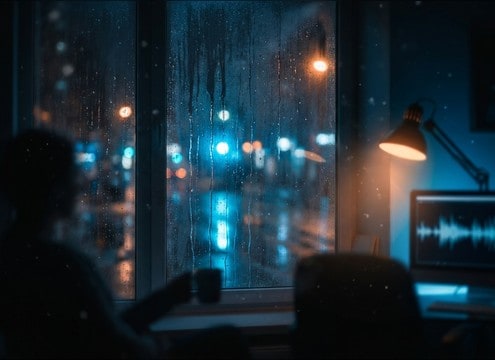




Soft rain works best when it supports the scene without calling attention to itself. Use prompts that specify distance, texture, and loop behavior, then select clips by transient sharpness, stereo width, and how much they mask speech. The tips below help you quickly land on a drizzle that feels natural for indoors, exteriors, or cozy atmospheres.
Pick the right perspective
Start by deciding where the listener is: near a window, under a roof, or outside in open air. Close perspectives add defined droplet taps; distant perspectives become a smooth noise-like bed with fewer spikes.
- Close: "rain on window, light taps, narrow stereo"
- Mid: "roof patter, soft peaks, short decay"
- Far: "distant rain wash, wide stereo, minimal transients"
Ask for loop behavior explicitly
Rain used as ambience often needs seamless repetition. Prompts that mention stable density and smooth tails help prevent obvious level jumps or random loud hits that break continuity.
- Use: "loopable bed, stable noise floor"
- Avoid: "big drops" or "random heavy splashes" when looping
- Prefer: "consistent drizzle" over "gusty rain" for long scenes
Control masking and brightness
Soft rain can still crowd dialogue if it is too bright or too transient-heavy. Choose clips with gentle attacks and a balanced high end so speech stays clear without aggressive EQ.
- For narration: "soft transients, rolled-off highs, low masking"
- For cozy mood: "warm texture, muffled fabric filtering"
- For realism: keep some mid detail, but limit sharp ticks
Match the space with subtle reflections
Indoor and tight spaces can sound wrong if the rain is too open and wide. Add cues like faint reflections, room tone, or a slightly tighter stereo image to match apartments, hallways, or alleys.
- Indoor: "heard from inside, subtle room tone"
- Narrow exterior: "alley reflections, tight stereo"
- Open exterior: "wide stereo bed, airy wash"