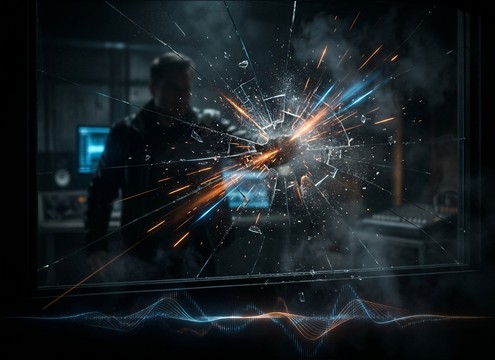


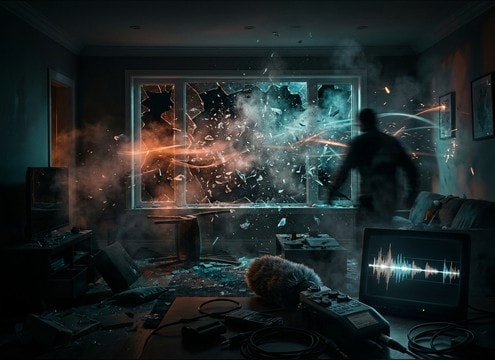
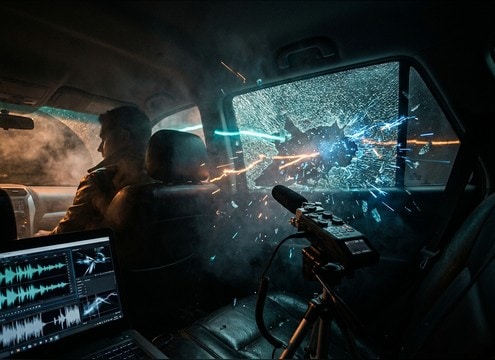




Glass breaks are all about the first transient and what happens after it. Use prompts and previews to control whether you need a single crack, a full shatter burst, or a debris-heavy settle tail. The tips below help you choose the right intensity, perspective, and decay so the sound reads as the object on screen, not a random smash.
Choose the break type first
Start by naming the object and the action. A bottle drop is a tighter crack with bright tinkles, while a window hit usually has a stronger impact plus a wider scatter. If the picture shows fragments continuing to move, ask for a settle tail instead of a one-shot.
- Use words like crack, snap, shatter, smash, or fracture to shape the attack
- Call out the object: bottle, window pane, car side glass, thin stemware
- Add what happens next: shards raining, rolling debris, or quick stop
Match distance with room tone
A close mic break feels dry and bright, while a distant break carries more air and reflections. If your scene is outdoors, keep reflections subtle. If it is a hallway or kitchen, a short reflected tail often sells the space better than a huge reverb.
- Close-up: minimal room tone and fast, present transients
- Mid or distant: softer highs and longer, quieter tails
- Mention environment: small room, hallway, exterior, car interior
Control debris density and stereo width
Debris is what makes glass feel like glass. Too little and it sounds like a stick snap. Too much and it masks dialogue or becomes a constant sparkle layer. Stereo width also changes the perceived size: narrow for small cracks, wider for big window breaks.
- Ask for fewer shards when you need clarity under dialogue
- Request wide stereo scatter for large panes or dramatic cuts
- Keep loudness controlled to avoid harsh clipping-like brightness
Avoid common fake-sounding cues
Some glass sounds fail because they are too metallic, too reverby, or too long for the cut. If the tail feels disconnected, shorten decay or reduce reflections. If it sounds like a crash cymbal, reduce ringing and emphasize short tinkles instead.
- Avoid long, washy reverb unless the location is clearly cavernous
- Avoid constant ringing; glass debris should be irregular and decaying
- Avoid overly boomy low-end that makes small objects feel huge