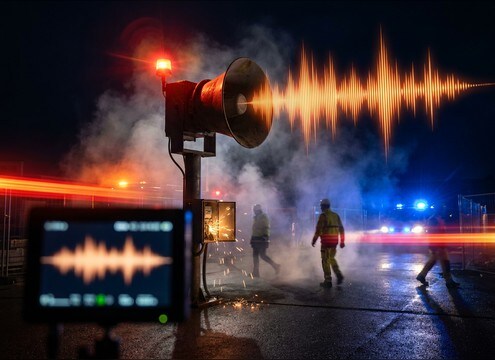


Civil defense sirens are defined by their modulation pattern and where they live in the world: a rotating rotor pulse, a slow wail sweep, and an environment that can add reflections or muffling. Use the prompts below to specify the cycle shape, perceived distance, and tail behavior so the siren supports your scene rather than fighting dialogue or sounding like a generic police yelp.
Start with the wail pattern
A believable civil defense siren usually has a slower rise and fall than modern emergency vehicle sirens. Name the sweep speed and whether the modulation feels like a rotating mechanism or a smoother electronic tone.
- Use phrases like slow wail cycle, full rise-and-fall, or rotating wail
- Call out rotor throb or amplitude modulation if you want the mechanical feel
- Ask for stable pitch sweep if you need a clean, mix-ready asset
Specify distance and placement
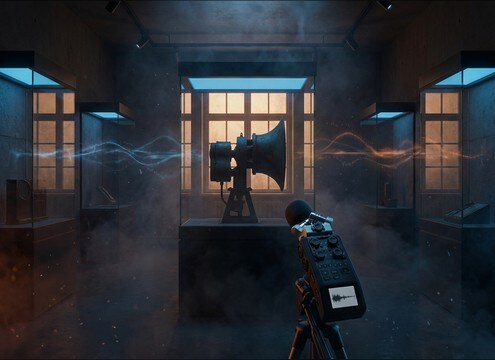
Distance changes everything: close sirens have sharper transients and more harmonics, while distant sirens lose highs and gain a longer, softer tail. Tell the generator where the listener is in relation to the siren.
- Close-up: brighter tone, stronger modulation, tighter attack
- Distant: rolled-off highs, lower presence, longer decay tail
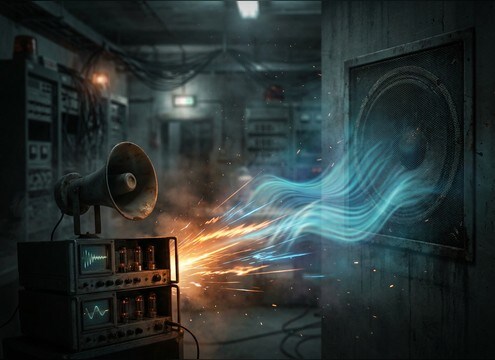
- Through walls: muffled filter, softened transient, short indoor reflections
Choose the space: alley, open air, or room
Civil defense sirens often live outdoors, but the scene might be inside, in a courtyard, or down a street canyon. Adding the right reflections makes the siren sit naturally in the picture.
- Open air: minimal reflections, gentle movement, light wind hiss optional
- Urban canyon: slapback echoes and reflective tails without drowning the source
- Indoor playback: short room reflections plus muffled EQ for realism
Common mistakes to avoid
Most unrealistic results come from asking for the wrong siren type or leaving out context. Keep prompts literal and scene-based, and avoid over-stylized language that pushes the sound into music territory.
- Avoid police yelp or fast chirps unless you truly want that sound
- Do not request heavy distortion or extreme sub-bass that masks narration
- For loops, ask for seamless endpoints to prevent clicks and pumping