
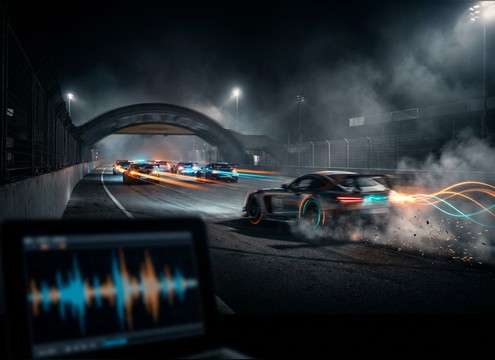




Race footage changes fast: one shot wants a tight curbside doppler, the next needs a distant pack bed, then a tunnel pass with a longer tail. Use the library when you only need a clean clip, and use AI prompts when you must match speed, perspective, or timing. The tips below help you describe engine behavior and space clearly so the result lands in the mix with minimal cleanup.
Choose perspective and motion
Start by describing where the listener is and how the car moves. Pass-bys need a clear pitch sweep and a believable fade, while onboards want steadier tone and less doppler.
- Use words like close, mid-distance, or distant to control air rolloff
- Specify direction: left to right, approaching then receding, or overhead bridge
- Ask for a longer tail when the car exits frame instead of an abrupt stop
Describe throttle, shifts, and limiter behavior
Race cars are defined by transients: shift clunks, throttle blips, and limiter stutters. Naming the action makes the generator output more cuttable moments.
- For braking shots, request downshift blips and short engine unloads
- For starts, request a launch with a brief tire chirp and one clear upshift
- For dramatic punch-ins, request a short limiter hit with gritty texture
Match the environment and reflections
Space changes the tail and stereo image. A tunnel exaggerates reflections, while an open track has a drier fade and more wind-like air movement.
- Use tunnel, underpass, or concrete walls to get stronger early reflections
- For open-air trackside, request a dry ambience with minimal reverb
- For garage or dyno shots, request short room reflections and less wide stereo
Avoid common prompt mistakes
Small wording issues can produce unrealistic results or sounds that fight your dialogue and music. Keep prompts concrete and avoid conflicting instructions.
- Do not ask for both distant and extremely loud in the same take
- Avoid vague words like epic; describe speed, distance, and tail instead
- If you need a clean cut, request minimal crowd and minimal wind noise