

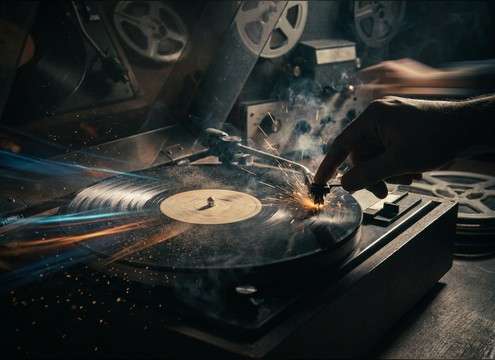






Scratchy record SFX usually fail for two reasons: the noise is too uniform, or the transients (pops/scratches) are too random and distracting. Use prompts that describe the "event" (needle drop, drag, stop), the texture (crackle vs scratches), and how much it should mask dialogue. The tips below help you choose or generate a clip that cuts cleanly and sells the vintage playback illusion.
Start with the record action
If you need a transition, ask for a clear action up front. "Needle drop" should have a crisp initial transient; "needle drag" should include a scrape; "stop-start" should include a short motor wobble.
- Use: "needle drop then steady crackle" for intros
- Use: "needle drag scrape then settle" for reveals
- Use: "quick stop-start with brief wobble" for cut points
Choose the right texture intensity
Crackle beds work under narration; scratch streaks are attention-grabbing and better for comedy, horror cues, or hard transitions. Ask for the pop rate and harshness so the generator doesn't overfill the clip.
- For dialogue: "fine crackle, very few pops, low masking"
- For grit: "dusty pops, moderate intensity, occasional scratch"
- For impact: "loud crackle, several harsh scratch streaks"
Control pitch drift and width
Wow/flutter sells "worn playback," but too much sounds like a broken effect. Stereo width also matters: mono feels archival, wider stereo reads more modern and hi-fi.
- Ask for "subtle wow and flutter" rather than extreme wobble
- Specify "narrow mono" for old-recording scenes
- Specify "moderate stereo width" for modern lo-fi aesthetics
Make it edit-friendly
For beds, prioritize consistency; for stingers, prioritize a clean tail. Prompt for stable level and avoid sudden spikes if you plan to loop or sit under music.
- For looping: "consistent noise floor, rare pops, no sudden spikes"
- For tight cuts: "short tail, minimal ambience, clean ending"
- For realism: "close-up, no music, natural surface noise"