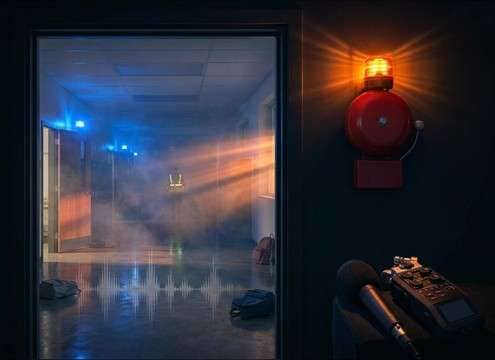





Fire-drill alarms are all about cadence, perceived distance, and how the tail interacts with a space. Use the library to find a ready clip, or prompt the generator with specifics like "hallway slapback," "stairwell ring," or "outdoor distant" so the alarm supports the scene instead of overpowering it.
Choose the alarm type and cadence
Start by deciding whether your scene needs electronic beeps, a mechanical horn, or a bell-like ring. The cadence is what viewers recognize first, so describe it clearly in your prompt and keep it consistent with the visual pacing.
- Use "steady beeps" for modern panels; use "harsh horn burst" for older systems
- Specify "fast attack" if you need the alarm to cut through narration
- Ask for "clean gaps between pulses" to create natural edit points
Match perspective: close, hallway, stairwell, outdoor
Perspective is mostly transient sharpness, stereo width, and reflections. A close alarm has crisp edges and less room tone; a hallway or stairwell version adds reflections and ringing decay; outdoor versions feel drier but more distant and airy.
- Prompt "close, minimal room tone" for on-camera panels or near-mic moments
- Prompt "corridor reflections, medium decay" for school or office hallways
- Prompt "distant, softened transient" for exterior wide shots
Keep it usable in a mix
Fire-drill tones can mask speech quickly. If the alarm sits under voice or on small speakers, prioritize controlled peaks, moderate brightness, and shorter tails so the message remains intelligible.
- Prompt "controlled peaks, no clipping" for announcements and training videos
- Prompt "reduced low-end rumble" to avoid muddying narration
- Choose narrower stereo when the alarm must feel like it's coming from a fixed point
What to avoid for realism
Overly cinematic sirens, exaggerated reverb, or inconsistent cadence can break believability. When in doubt, regenerate with simpler wording and fewer extreme adjectives to get a more neutral, drill-accurate result.
- Avoid "epic" or "cinematic" if you need a real building drill tone
- Avoid ultra-long decay tails unless the scene is clearly in a reverberant stairwell
- Avoid excessive stereo width for a single alarm source in a small space