


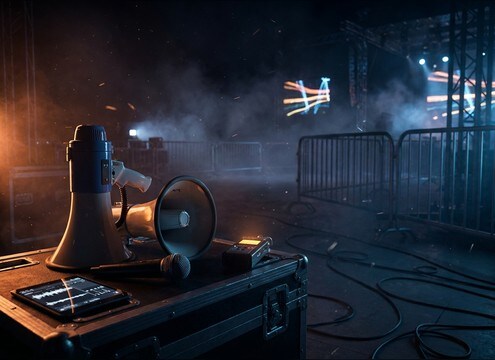


Bullhorn audio is all about midrange bite, limited bandwidth, and believable space. Use the library when you just need a quick burst, and switch to AI prompting when you must match distance, distortion, or an indoor tail to a specific shot. The tips below help you describe the right kind of bullhorn quickly, avoid unusable extremes, and land a clip that sits over crowds, wind, or traffic without turning into painful feedback.
Start with perspective and space
Decide whether the bullhorn is right next to camera, across the street, or bouncing in a hallway. Perspective determines how much low end rolls off, how sharp the transient feels, and how long reflections should hang.
- Close: dry, strong transient, higher intelligibility feel
- Distant: softer attack, more ambience, more attenuation
- Indoor: audible early reflections and a longer, darker tail
Describe distortion and noise texture
Bullhorns often have cone breakup, saturation, and hiss. In prompts, ask for mild, moderate, or heavy distortion, and specify whether you want a clean tone or a gritty device character that masks other sounds.
- Mild: clearer, better for staff announcements and cues
- Heavy: crunchy, aggressive, good for chaos or urgency
- Hiss: steady noise bed that helps it read as amplified
Match the edit with timing words
For quick cuts, you usually want fast attack and short decay. For wide establishing shots, a longer tail and steadier level reads more realistic. Use timing language so the generator outputs something that lands on the beat.
- Ask for a sharp attack for instant attention grabs
- Ask for a quick cutoff to avoid stepping on dialogue
- Ask for a smooth decay when the location should ring
Avoid common prompt mistakes
Overly bright feedback or too-wide stereo can make the result hard to use. Keep the request simple: bullhorn, space, intensity, and tail. Then regenerate variations instead of stacking too many constraints in one prompt.
- Avoid extreme feedback unless you truly need a squeal moment
- Avoid heavy low-end rumble that does not fit real bullhorn playback
- Avoid overly wet reverb that sounds like a special effect