

Door openings are easy to overdo: the latch click, hinge movement, and room tail must match the on-screen material and camera distance. Use the library when you need a quick, mix-ready take, and use prompts when you need a specific action like a slow creak, a chain release, or a heavy swing that lands on a cut.
Start with the action sequence
Most believable door opens are a short chain of events. If your picture shows a hand on the handle, you will often need handle turn plus latch release before the swing. If it is a push bar or automatic closer, the transient and tail behave differently.
- Handle turn then latch click for knob doors
- Single snap transient for latch-only openings
- Add a settling thunk if the door stops or hits a limiter
Match material and weight
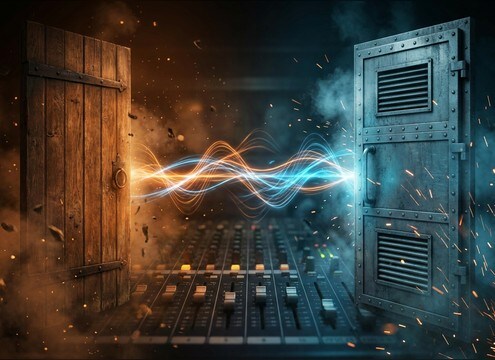
Material sets the spectral color: wood reads warmer with softer midrange creak, metal reads brighter with sharper edges, and hollow-core doors have a light, papery resonance. Weight controls how much low-end thunk and how long the decay hangs.
- Wood: softer attack, more organic creak texture
- Metal: brighter transient, more ringing overtones
- Heavy doors: deeper low-end and longer decay
Choose perspective and space
Camera distance changes how prominent the latch transient is versus the room tail. A close perspective favors detail and low noise floor. A distant perspective needs more room tone and reflections so it does not sound pasted on top of the ambience bed.
- Close: crisp latch, minimal reflections, tight tail
- Mid: balanced detail with modest room reflections
- Distant: reduced attack, stronger room tone and decay
Avoid common door SFX giveaways
The fastest way to break realism is a squeak that is too loud, too tonal, or repeated identically across scenes. Another giveaway is a long reverb tail on a tight interior shot, or a latch click that is late compared to the hand movement.
- Do not reuse the same squeak every time a door opens
- Do not pick long tails for close, dry interior shots
- Do not let the latch transient miss the on-screen contact