


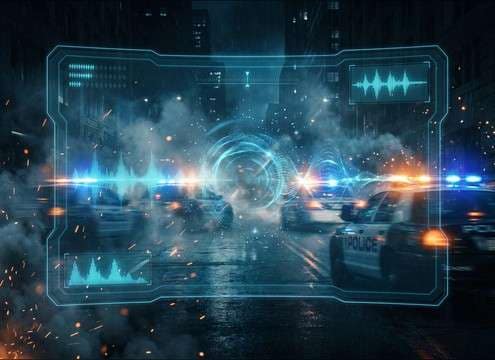


Police sirens read as pattern plus perspective. When you preview clips or write prompts, focus on the cadence (wail, yelp, phaser), how far the source feels, and whether the siren is stationary or moving past camera. The tips below help you get a siren that supports story beats without masking dialog or sounding like a generic alarm.
Choose the siren pattern that matches the moment
Wail suggests steady response or approach, yelp feels urgent and aggressive, and phaser often reads modern and attention-forward. Match the rhythm to the edit length and the emotion on screen.
- For steady approach shots, prompt or pick a wail with even cycles and a clean fade
- For fast cuts and spikes in tension, use yelp bursts with short decay
- For contemporary fleets or stylized edits, choose phaser with smooth pitch travel
Dial perspective: close, distant, or moving pass-by
Perspective is what makes the siren believable. Close sirens have crisp transients and more high-end bite, while distant sirens lose highs and sit behind ambience. Pass-bys need Doppler shift and a clear approach-to-recede arc.
- Close-up: look for strong attack and controlled tail so it cuts without smearing
- Distant: prefer softened transients, narrowed stereo, and a quieter noise floor
- Pass-by: ensure the pitch drops naturally on the exit and the level tapers smoothly
Match the environment and reflections
Siren reflections should fit the space. A street canyon adds slapback and a wider stereo image, tunnels create longer resonant tails, and interior POV should feel filtered as if through glass or walls.
- Downtown: pick obvious early reflections and a wider stereo spread
- Tunnel or underpass: use longer decay, but avoid boomy low-end build-up
- Interior: choose muffled variants with rolled-off highs and subtle cabin tone
Avoid common siren mistakes in edits
The wrong siren can feel fake even if it is loud. Watch for clipping, overly perfect loops, or tones that read like a synth alarm. Keep room tone consistent and leave space for dialog and key foley.
- Avoid harsh clipping and square-wave tone that screams non-diegetic alarm
- Do not let long tails overlap dialog beats unless the scene calls for it
- If looping, crossfade between cycles so the cadence does not reset abruptly