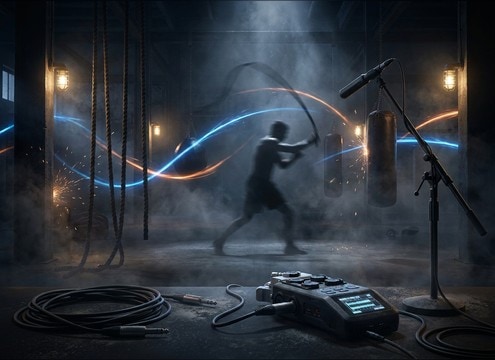


A whip effect lives or dies on the transient. When you preview or generate, decide whether you need a dry, needle-sharp crack for tight sync, or a swish-forward flourish where motion matters more than impact. Use prompts that call out the whip type, perspective, and environment, and you will get versions that cut through without turning into a harsh click.
Pick the whip type and hit style
Different props read differently on screen. Bullwhips tend to have an aggressive snap and bright top end, while a riding crop feels shorter and more slap-like. If the shot shows the full swing, ask for a swish lead-in so the motion feels connected.
- For hard impacts: specify bullwhip crack, sharp snap, strong transient
- For short hits: specify crop slap, tight attack, very short decay
- For motion sells: specify long swish arc, then a lighter crack
Match perspective with distance and room
A close crack should be dry and present, while a far crack needs more air and a longer tail. Indoor versions benefit from quick reflections that feel like walls, but too much reverb can smear timing and sound fake.
- Close: request dry, minimal ambience, tight tail
- Distant: request reduced highs, more air, longer decay
- Indoor: request subtle room reflections, controlled reverb tail
Control harshness and mix masking
Whip transients can be painfully bright, especially under music. If a crack feels like a click, ask for a slightly softer transient edge or less high-end bite. If it disappears, ask for more body in the midrange and a touch more tail.
- Too sharp: request softer transient, less high-end, smoother snap
- Too dull: request brighter attack, clearer snap, slightly louder crack
- Too noisy: request clean room tone, low hiss, no debris
Time the action with the right duration
Short clips are best for single hits and fast gags, while longer durations help when the camera holds on choreography. Use duration to avoid trimming mid-tail or forcing loops that reveal repetition.
- 5 seconds: single crack, quick swish, or punchline accent
- 10 seconds: swish buildup plus one crack, or two spaced snaps
- 20 seconds: sequences for training drills or stunt choreography