





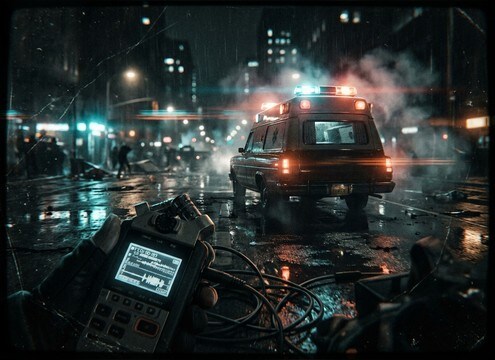



Old ambulance sirens are often defined by a mechanical rotor texture, a narrower band of midrange bite, and imperfect recording traits. When browsing clips or writing prompts, decide if you want a short yelp, a steady rotating tone, or motion (approach, pass-by, corner turn). Then lock the space: open street, alley reflections, or indoor garage echo, and choose how gritty or clean the transient should feel.
Start with the siren mechanism and pattern
A period-correct feel usually comes from mechanical movement and a recognizable yelp or rotator rhythm. Specify the pattern so the clip reads instantly, even at low volume under dialogue.
- Use words like mechanical rotator, vintage yelp, or steady sweep
- Ask for sharper attack if it must cut through traffic
- Ask for smoother decay if it should sit behind narration
Choose perspective: close, distant, or moving
Perspective changes the perceived pitch, level, and how much ambience wraps the siren. For motion, a Doppler pass-by is more convincing than a static loop.
- Close: stronger transient bite, less room tone, wider stereo if needed
- Distant: softer transients, more reflections, less low-end presence
- Moving: request approach, pass-by Doppler, or corner turn
Match the environment and tail behavior
Old sirens become believable when the tail interacts with the scene. Alleyways add fluttery reflections, garages add slap echo, and open streets keep the tail shorter and cleaner.
- Alley: tight reflections, slightly longer tail, reduced high-end
- Garage: obvious slap echo, longer decay, stronger resonance
- Open street: minimal reverb, clearer rhythm, less smear
Avoid common mismatches
The fastest way to break the illusion is to generate something too modern or too pristine. Keep the tone era-appropriate and avoid overdoing the distortion so it still reads as an ambulance.
- Avoid modern electronic hi-lo siren wording if you want vintage
- Avoid ultra-clean studio dryness unless the scene is very close
- Avoid extreme distortion that masks the yelp pattern