

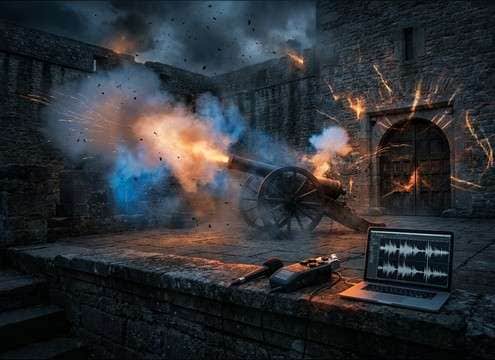





Cannon shots can read as a clean ceremonial boom, a gritty deck-fired blast, or a distant report with long returns. The fastest way to get believable results is to prompt for scale, perspective, and environment, then compare a few variations for transient punch and tail length. Use the tips below to avoid cannon hits that feel like generic explosions or modern gunfire.
Start with cannon type and charge
Tell the generator what kind of cannon you are hearing and how much power it should have. A light salute has a cleaner body and less debris, while a battle shot carries more low-end weight and a thicker decay.
- Use words like naval deck cannon, fortress cannon, or ceremonial salute
- Specify charge level: light, standard, heavy, or overcharged
- Call out texture: clean boom, smoky decay, gritty blast, minimal debris
Define distance and camera perspective
Perspective changes everything: close shots need a sharp transient and short immediate tail, while distant reports are softer and rely on reflections and lingering rumble. Prompt the listening position like you would frame a shot.
- Close: sharp crack, short decay, strong body, limited ambience
- Mid: balanced transient, audible reflections, moderate tail
- Distant: softened attack, long return echoes, lighter high-end
Match the environment and tail behavior
The same cannon will sound different by location. Stone courtyards add slapback and dense room tone, open water adds airy space, and valleys create extended returns. Describe the space so the tail ends naturally.
- Stone fort or corridor for hard reflections and thicker reverb tail
- Harbor or open sea for broader space and smoother high-end
- Valley or mountains for long echo returns and rolling decay
Avoid common cannon SFX mistakes
Many cannon clips fail because they sound like a modern explosion, clip too hard, or have a tail that overwhelms dialogue. Fix this by tightening the prompt and regenerating with clearer constraints.
- Avoid: fireball blast, shrapnel debris, modern gunshot crack
- Avoid: distorted clipping and overly bright highs on the transient
- Do: ask for controlled low-end and a tail length that matches the cut