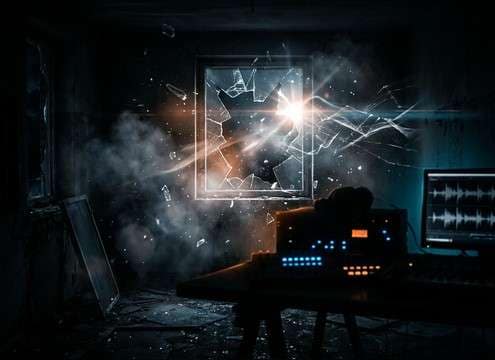
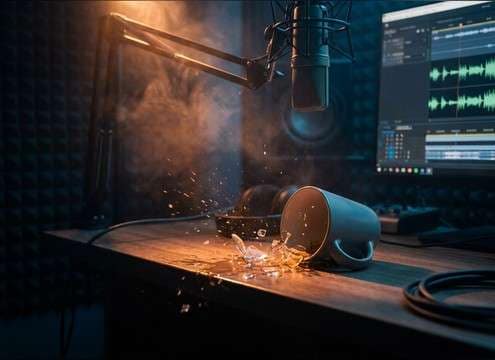
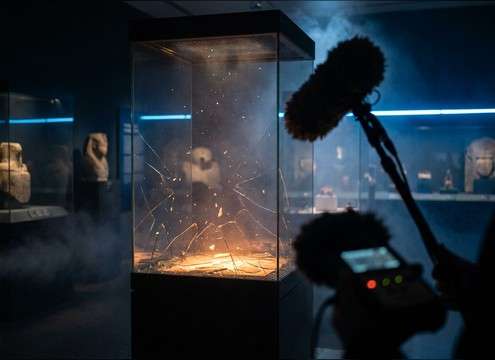
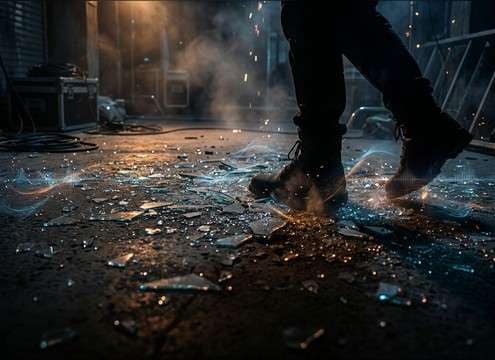


Glass breaking reads "fake" fast if the type, perspective, and debris don't match what's on screen. Use the tips below to choose the right library clip or write a prompt that generates a shatter with the correct transient bite, scatter density, and decay.
Start with the right glass type
Different glass behaves differently. A bottle smash is dense and gritty; a window pane has a clearer crack-to-break motion; tempered auto glass bursts into many small pieces.
- Use "bottle smash" for heavy impacts and chunkier debris
- Use "window pane shatter" for a clear snap plus falling shards
- Use "tempered car glass burst" for many small, busy fragments
Match camera distance and space
Distance changes the transient and how much room tone you hear. Close perspectives feel sharp and dry; distant perspectives feel softer with longer reflections.
- Ask for "close-mic, dry" when the break is on screen and near camera
- Ask for "distant, hallway/room reflections" for off-screen breaks
- Choose wider stereo scatter for exterior/action shots
Dial in debris, not just the impact
The aftermath sells reality: the shard roll, skids, and small tinkling pieces. Too much debris can mask dialogue, but too little can feel like a single sample hit.
- Add "rolling shards" for floor contact and movement
- Add "light tinkling" for small pieces settling after the initial break
- Reduce debris when the next line or sound cue is immediate
Avoid common giveaway artifacts
Some shatters sound synthetic because the top end is overly fizzy or the decay is unnaturally smooth. A realistic break usually has uneven scatter and a believable end point.
- Avoid "too bright" takes that hiss more than they crack
- Avoid tails that loop or fade perfectly smoothly
- Avoid using the same identical shatter on repeated shots—regenerate a variant