Make Your Own Duo
Turn a shared idea with a friend, partner or original character into a short performance. Start with clear references and tell the model exactly who belongs on the left and right.


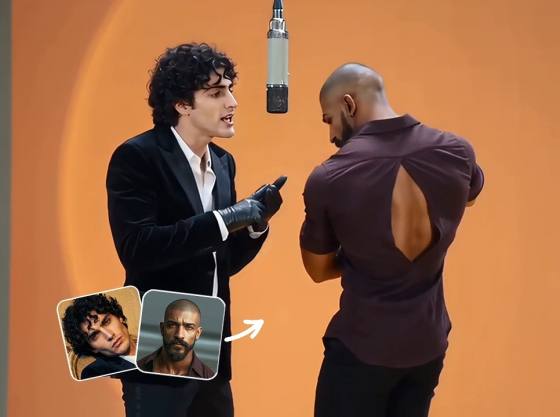
Want the viral two-person Hotel Lobby video with your own duo? Use clear reference photos and a focused prompt to build an orange-booth performance with Media.io. Learn what the Higgsfield Genjutsu version does, then create and refine a related video for your friends, partner, or original characters.
Use photos you have permission to use. Available inputs, credits, and results depend on the selected creation workflow.
Turn a shared idea with a friend, partner or original character into a short performance. Start with clear references and tell the model exactly who belongs on the left and right.
Describe the seamless orange studio, a single hanging microphone and even lighting. These scene cues make the Hotel Lobby trend recognizable without placing the duo in a literal hotel.
Give each person a separate action: one gestures toward the mic while the other reacts, then they switch. A steady, full-body frame makes the interaction easy to follow.
Preview the clip for face consistency, outfits, framing and stray extra people. Adjust one instruction or reference at a time to make your next version more controlled.
Choose two clear, well-lit photos, one for each performer. Show unobstructed faces and as much of each body as possible, then decide which subject stays LEFT and which stays RIGHT.
Enter a prompt for a vertical orange studio scene with one hanging mic, a fixed full-body camera and natural back-and-forth gestures. Specify who is LEFT and RIGHT, and keep each identity and outfit consistent.
Open the Media.io Hotel Lobby creation page, add your photos and generate. Check faces, positions and motion before exporting; revise the prompt or photos if needed.
Keep the orange studio and duo setup, then make the performance your own.
Put two friends on opposite sides of the mic. Give one an expressive verse-like gesture and the other a small nod or playful reaction before they switch.
Turn two portraits into a lighthearted call-and-response clip. Keep their faces, clothing and left-right positions distinct throughout the shot.
Pair two original characters with different colors and movements. Use a shared orange set and steady camera to make the crossover feel like one performance.
Illustrative review copy for editorial approval. Replace with verified Media.io customer comments before publishing.

Short-Form Creator · Sample
“Our duo had its moment.” I made a playful orange-booth clip with a friend. Assigning who stood on each side made it much easier to review the final result.

Music Fan · Sample
“The setting reads instantly.” The single mic and orange backdrop gave our version a clear Hotel Lobby feel. I adjusted the motion description after checking the preview.

Video Hobbyist · Sample
“Easy idea to personalize.” Starting with a simple two-person prompt helped me test the concept. I refined the reference image when one face shifted.
It is a take on the viral Hotel Lobby two-person performance, often made by using Higgsfield Genjutsu to replace performers in a reference clip while retaining its movement, camera and timing. The recognizable look has an orange studio backdrop and a hanging microphone. This Media.io page helps you create a related version with its own available tools.
No. Higgsfield Genjutsu uses an existing video as the motion reference and images for the replacement subjects. You can use a compatible Media.io template or image-to-video workflow for a similar orange-booth concept. A prompt-led generation may not reproduce the reference clip’s exact choreography or timing.
Try: “Vertical 9:16, two distinct performers in a seamless matte-orange studio, one hanging microphone centered between them, fixed full-body camera. Person 1 stays LEFT and gestures toward the mic; Person 2 stays RIGHT and responds with a nod, then they take turns. Preserve each face and outfit; natural movement, even lighting, no extra people, no text.” Adapt the reference instructions to the input fields your selected workflow actually offers.
Generative video can drift when faces are small, blocked or blended in the input. Use clear reference images, specify LEFT and RIGHT, leave space between subjects and request distinct outfits. Preview the result and try a simpler prompt or clearer reference if the identities change.
Free credits, available models, supported inputs and export options can change. Check the current Media.io creation screen before generating. If you use a source video, make sure you have permission for the footage and any music; avoid assuming a generated clip includes licensed audio.