印度節日 AI 照片編輯提示 | 排燈節、灑紅節和開齋節 2026

為印度節日準備的AI照片編輯提示,包括排燈節、灑紅節、九夜節、開齋節和查特普迦節。使用Media.io創建肖像圖像、情侶照、海報、動態和壁紙。
All Submissions

Canthal Tilt Test

Try the Canthal Tilt Test online free to explore how your eye corners appear in a front-facing photo. Upload one clear portrait, compare your source image with the AI test image, and see whether your visible eye angle reads as positive, neutral, or negative.

Source01
Source portrait for canthal tilt test
Original photo
Test image02
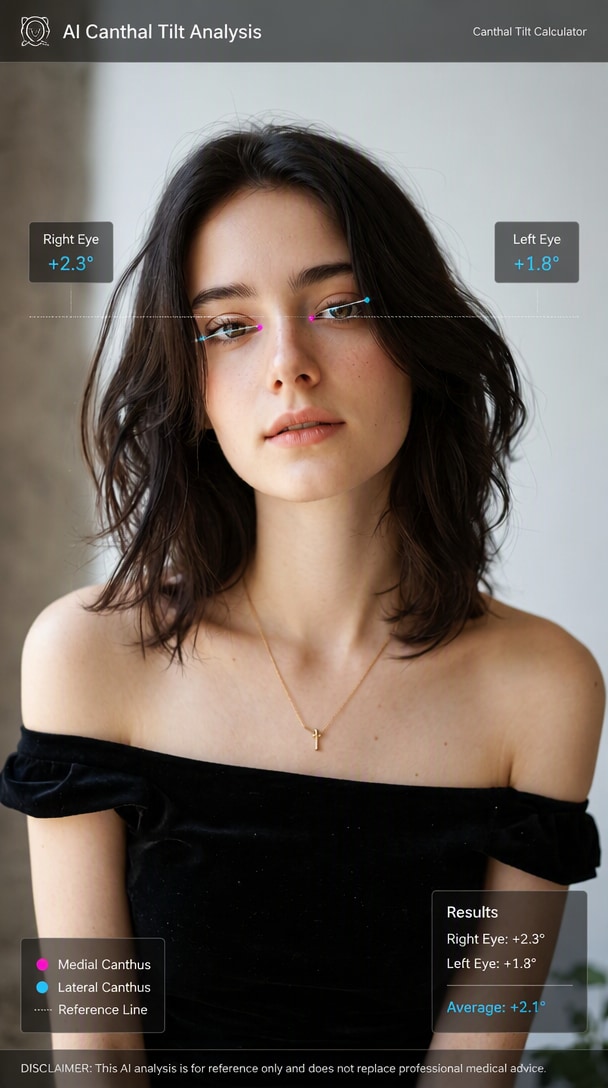
AI canthal tilt test result showing eye angle
ResultPositive tilt
Test canthal tilt

Free credits on signup.

Why Use the Media.io AI Canthal Tilt Test

Check Positive, Neutral, or Negative Tilt

Compare the visible line from the inner eye corner to the outer eye corner. An upward outer corner suggests a positive canthal tilt, a near-level line reads neutral, and a downward line suggests a negative canthal tilt.

Visual Canthal Tilt Calculator

Use AI-assisted image analysis to make the eye-corner direction easier to see than eyeballing a selfie. Treat the result as a photo-based visual estimate rather than a clinical measurement.

Understand Canthal Tilt Meaning

Learn what positive, neutral, and negative canthal tilt mean without turning one facial feature into a beauty verdict. Eye shape, brows, eyelids, expression, lighting, and overall facial harmony all affect appearance.

Try the Viral Canthal Tilt Filter Look

Recreate the social-media canthal tilt test filter concept with a clean source-and-result comparison that is easy to save, compare, or share with friends.

How to Take a Canthal Tilt Test Online Free

01

Upload a Front-Facing Photo

Choose a sharp portrait with a neutral expression, even lighting, minimal head roll, and both inner and outer eye corners clearly visible.

02

Run the AI Canthal Tilt Test

Let Media.io analyze the visible eye-corner direction and create a test image that makes the tilt easier to interpret.

03

Compare and Interpret

Check whether the outer corner appears higher, close to level, or lower than the inner corner. Retest with another level photo if the result looks borderline.

Popular Canthal Tilt Test Scenarios

Positive Canthal Tilt Test

See whether your outer eye corners appear higher than your inner corners. Positive tilt often reads as a more lifted or upturned eye-corner direction in a level photo, but it is not automatically “better.”

Negative Canthal Tilt Check

Explore whether the outer corners sit below the inner corners. A negative canthal tilt is a normal geometric variation and should not be treated as a flaw, diagnosis, or personality signal.

Eye Shape & Makeup Comparison

Compare natural and styled photos to see how winged eyeliner, lashes, brow framing, camera angle, or expression can change the apparent eye-corner direction without changing your anatomy.

What Does Your Canthal Tilt Result Mean?

Canthal tilt describes the visible slope between the medial canthus (inner eye corner) and lateral canthus (outer eye corner). Positive rises toward the temple, neutral is close to level, and negative slopes downward. Camera height, head rotation, expression, lashes, and image quality can change the apparent result.

FAQs About the Canthal Tilt Test

1. What is canthal tilt meaning?

Canthal tilt describes the direction of the line between the inner and outer corners of an eye. If the outer corner is higher, the visible tilt is positive; if the corners are nearly level, it is neutral; if the outer corner is lower, it is negative. It is one eye-area proportion cue, not a complete measure of attractiveness or eye health.

2. Is a positive canthal tilt good?

A positive canthal tilt can create a visibly lifted or upturned eye-corner direction, and some online aesthetics communities prefer that look. However, there is no universal rule that positive is “good” and negative is “bad.” Overall appearance also depends on eye shape, eyelids, brows, facial proportions, expression, styling, and photo conditions.

3. How does a canthal tilt calculator work?

A photo-based canthal tilt calculator estimates the relationship between visible inner and outer eye-corner landmarks. For the most repeatable result, use a straight-on photo at eye level with minimal head tilt. A 2D image can be affected by lens perspective, head roll, squinting, makeup, hair, and shadows, so treat the output as an estimate rather than a clinical measurement.

4. Can a canthal tilt test filter give different results on different selfies?

Yes. Even a small head roll or a camera placed above or below eye level can change the apparent slope. Expression, eyelid opening, lashes, eyeliner, image resolution, and asymmetry can also affect a canthal tilt test filter. If the result changes, compare two or three level, front-facing photos instead of relying on one selfie.

5. Is the Media.io canthal tilt test AI a medical or attractiveness test?

No. The canthal tilt test AI is intended for visual exploration and creative photo analysis. It should not diagnose eye conditions, recommend cosmetic procedures, or determine whether someone is attractive. If you notice a new or significant eyelid change, asymmetry, discomfort, or vision symptoms, consult a qualified eye-care professional.

Media.io Online AI Tools Quality Rating:
vote4.7 (162,357 Votes)